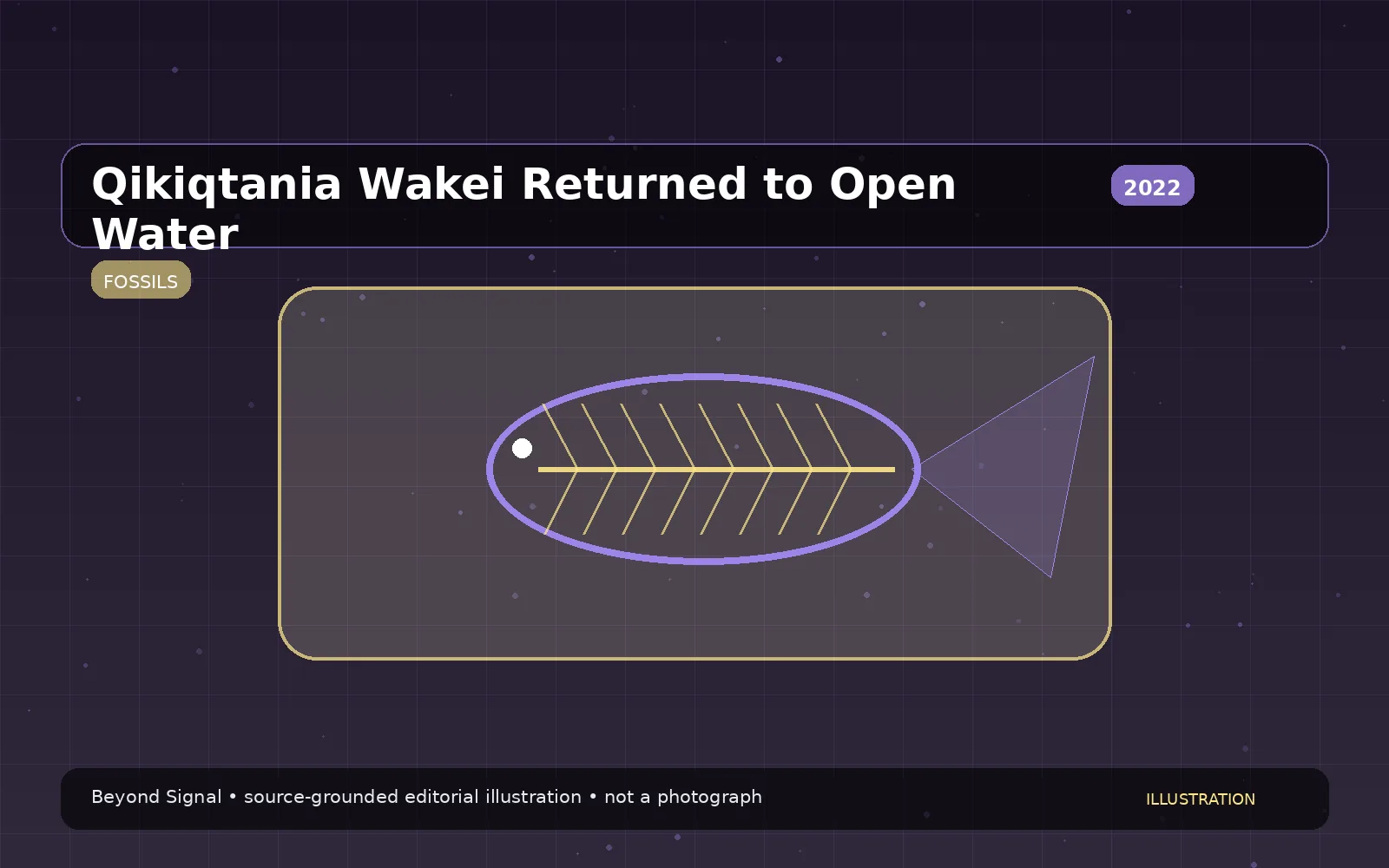
 Illustration — not a photo of the discovery
Qikiqtania Wakei Returned to Open Water
A Late Devonian fossil from Nunavut revealed Qikiqtania wakei, a close relative of limbed vertebrates whose pectoral fin was specialized for swimming rather than supporting the body on a hard surface. The animal shows that evolution near the fish-to-tetrapod transition explored more than one ecological direction.
The story
Why scientists were there
Paleontologists returned repeatedly to the Fram Formation because the same Arctic rocks preserve Tiktaalik and other fossils central to understanding how vertebrates moved from water toward land. The Qikiqtania specimen was collected from a nearby but slightly older floodplain horizon.
How they found it
The fossil included jaws, scales, gill-region bones, and a nearly complete pectoral fin. Micro-CT imaging exposed the humerus inside the rock, allowing researchers to compare muscle scars, joint orientation, and structural processes with those of Tiktaalik and early tetrapods.
What makes it unique
Its fin lacked anatomical features associated with weight-bearing on the bottom and instead retained a smooth, paddle-like configuration. That combination suggests a secondary return toward open-water swimming within a lineage often portrayed as moving steadily toward land.
Gallery
Where it was found
Fram Formation, southern Ellesmere Island, Nunavut
Tags
Related discoveries
 Illustration🦕 Dinosaurs & Fossils
Prototaxites May Represent an Extinct Eukaryotic Lineage
Chemical and structural analyses of the giant Devonian organism Prototaxites found that its tissues do not match known fungi and may represent an entirely extinct branch of complex eukaryotic life. The interpretation revives a long-running debate over the identity of trunk-like fossils that towered over early land ecosystems.
Read more → Illustration🦕 Dinosaurs & Fossils
Vasuki Indicus, a Giant Eocene Snake
Twenty-seven associated vertebrae from western India were described as Vasuki indicus, a giant madtsoiid snake that lived about 47 million years ago. Scaling from the vertebrae produced a broad estimated length of roughly 11 to 15 metres, placing it among the largest snakes known but leaving substantial uncertainty.
Read more →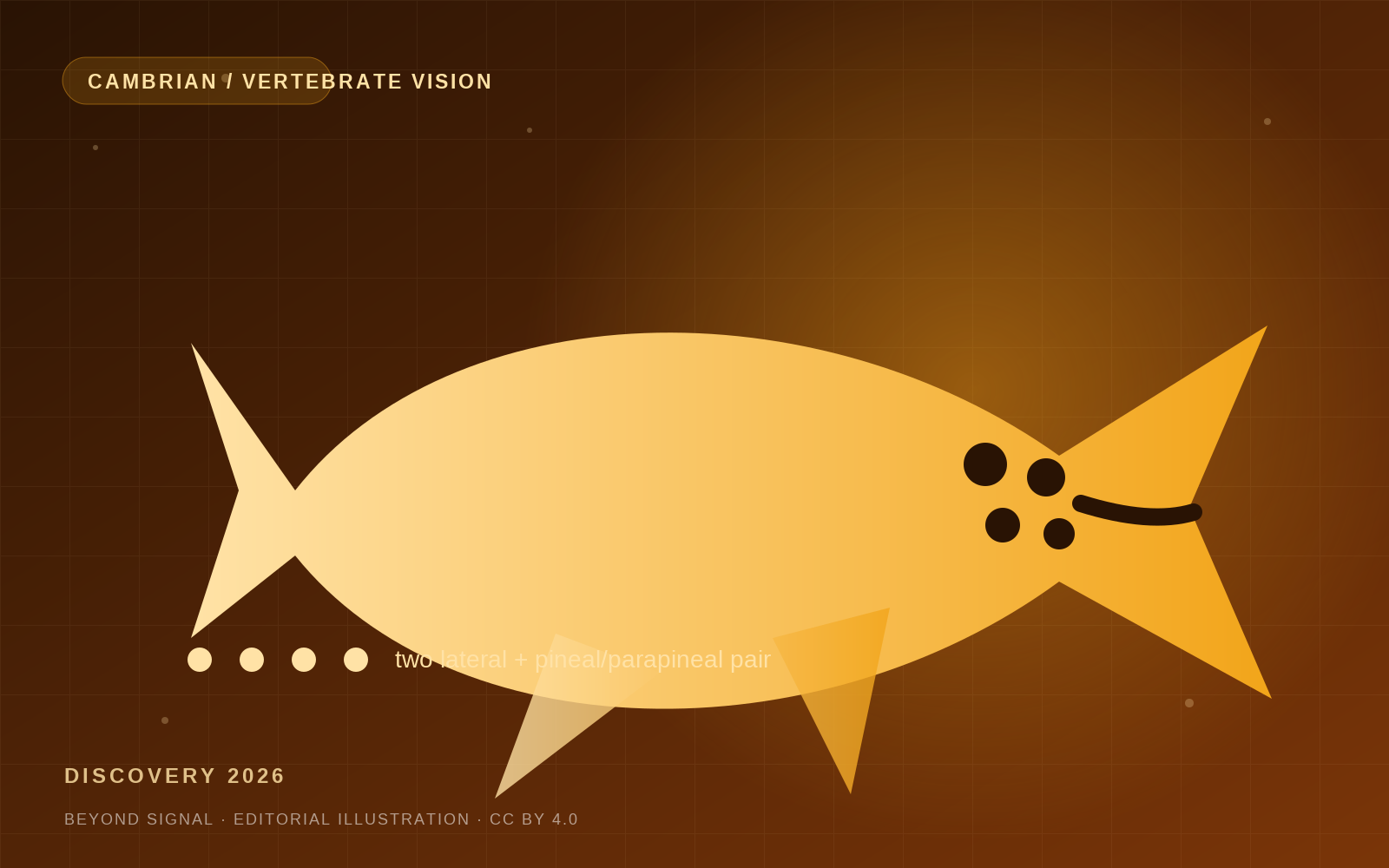 Illustration🦕 Dinosaurs & Fossils
Cambrian Vertebrates Had Four Camera-Type Eyes
Reanalysis of exceptionally preserved Cambrian fish fossils interpreted two structures once called nasal sacs as an additional pair of image-forming eyes.
Read more →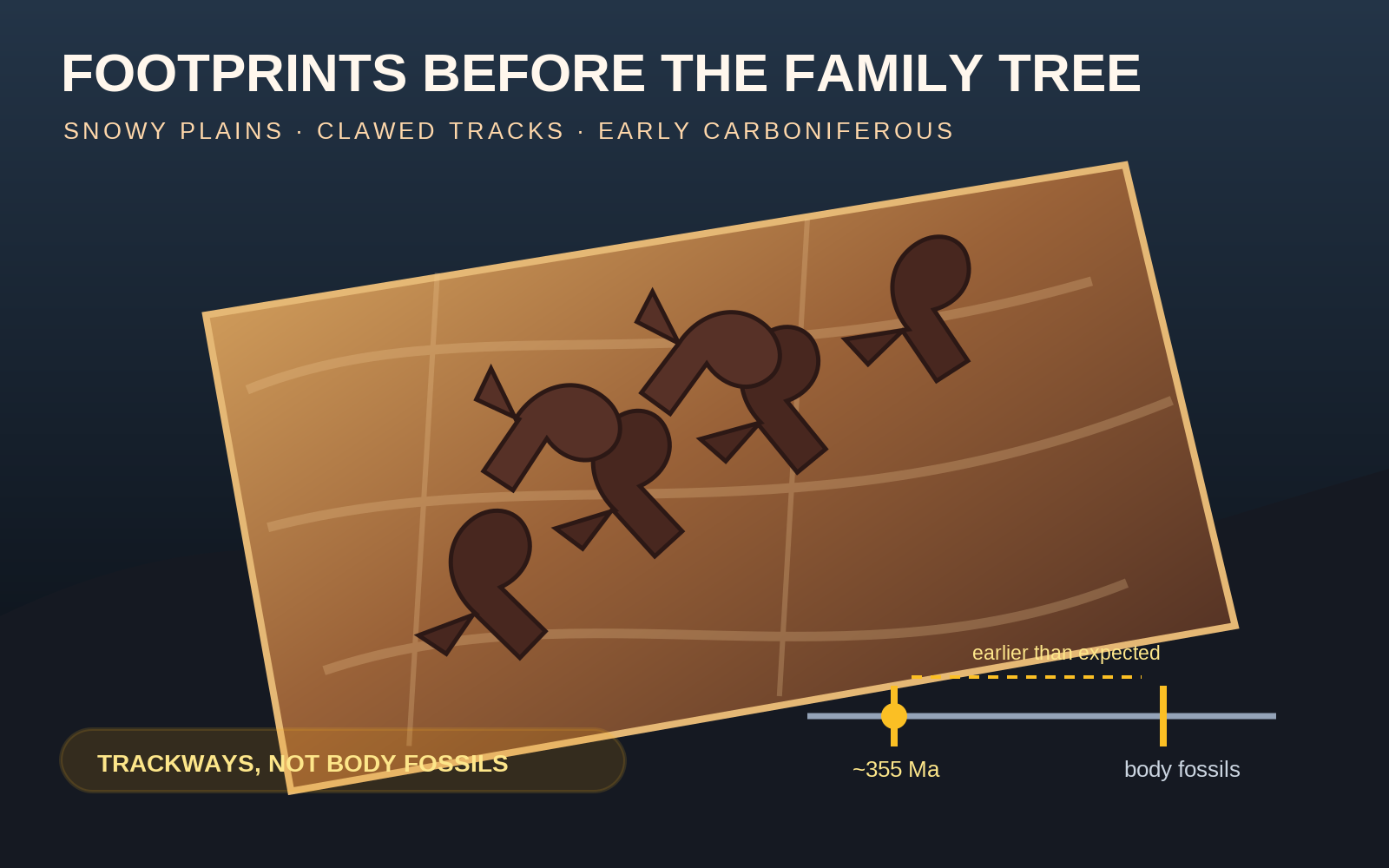 Illustration🦕 Dinosaurs & Fossils
The Earliest Known Amniote Trackways
Clawed five-toed trackways from Australia's Snowy Plains Formation were attributed to an early sauropsid amniote and dated to roughly 359–354 million years ago, extending the amniote record by about 35 million years.
Read more → Illustration🦕 Dinosaurs & Fossils
Pebanista yacuruna, the Largest Known River Dolphin
A 16-million-year-old skull from Peru established Pebanista yacuruna as a new, 3–3.5-metre river dolphin and the closest known fossil relative of living South Asian river dolphins.
Read more →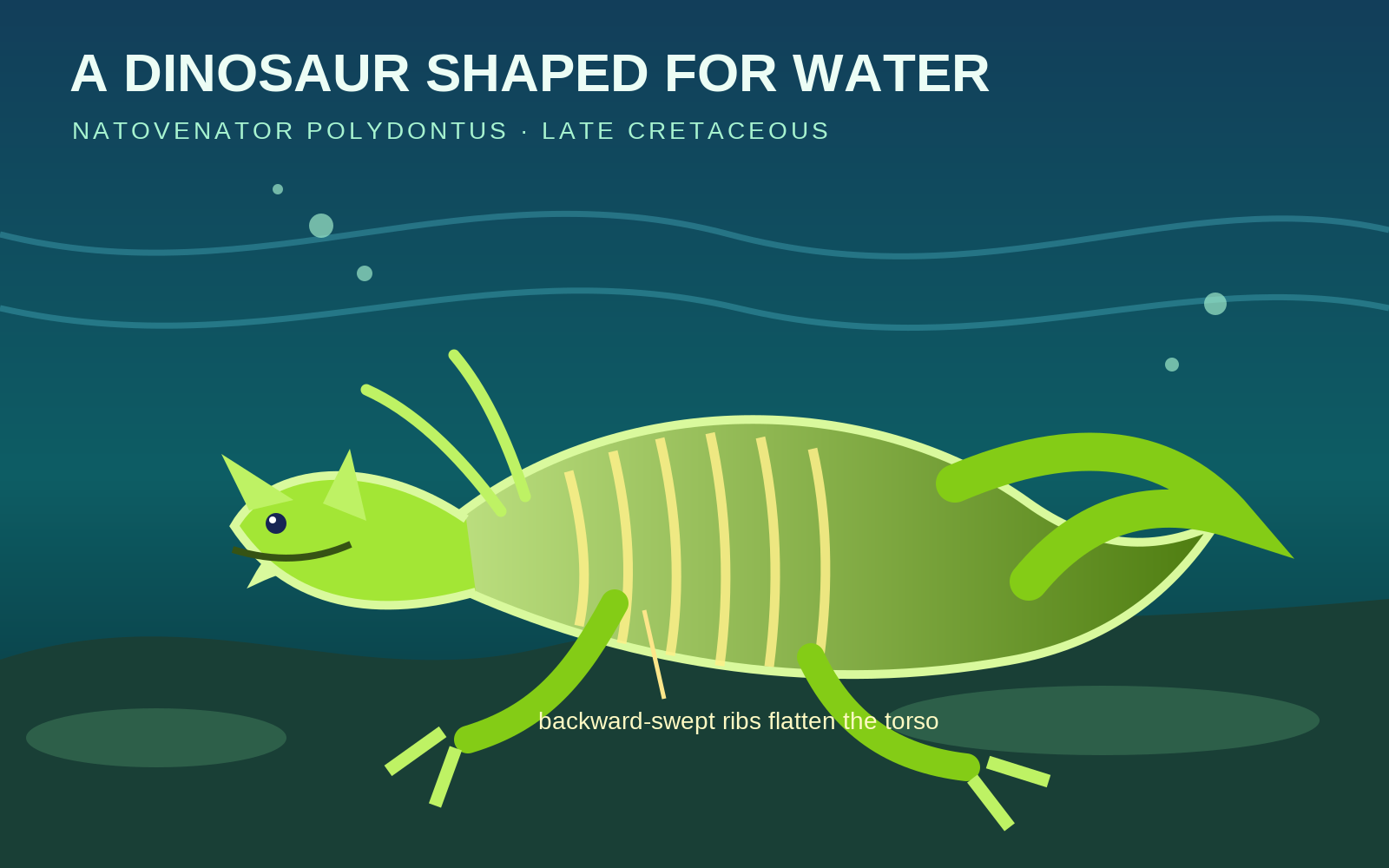 Illustration🦕 Dinosaurs & Fossils
Natovenator, a Streamlined Swimming Dinosaur
A well-articulated dromaeosaurid skeleton from Mongolia preserved backward-swept ribs and a flattened torso, providing the first compelling evidence of a streamlined body in a non-avian theropod dinosaur.
Read more →