Ocean Discoveries
New species, deep-sea expeditions, coral reefs, hydrothermal vents, shipwrecks, and the mysteries still hiding beneath the waves.
Field guide
Understanding ocean discoveries
Ocean discovery is the study of a world that is physically close to us but still difficult to reach. Pressure, darkness, cold, distance from shore, and the cost of operating a research vessel all limit what scientists can observe. As a result, a new ocean discovery can be a species, a habitat, a geological process, or a clue about how life survives without sunlight. The catalogue brings these findings together so a named animal can be understood alongside the seafloor, expedition, and chemistry that make its existence possible.
The strongest ocean discoveries connect field observation with careful identification. A remotely operated vehicle may record an unusual animal, but taxonomy, genetics, microscopy, and repeat observations are what establish whether it is genuinely new. This distinction matters in the deep sea, where a striking appearance is not by itself proof of a new species. Beyond Signal follows that chain from where a discovery was made to what it changes about our understanding of marine life.
From sunlight to the hadal zone
The ocean is not one uniform environment. Coral reefs, open-water habitats, abyssal plains, hydrothermal vents, and trenches each impose different physical and biological conditions. Depth is therefore a useful organising principle: it helps explain why a transparent fish, iron-armoured snail, or pigmentless octopus can evolve traits that would be unnecessary or impossible near the surface.
Why expeditions matter
Most marine discoveries are collaborative. A research vessel supplies the navigation and sampling platform; an ROV or submersible supplies the eyes and hands; museums, universities, and reference collections preserve the evidence. Reading an entry with its institution and location keeps the headline discovery connected to the scientific work that made it credible.
Ocean Discoveries guides & articles
All guides →Explore by subtopic
21 discoveries
 Representative🪸 Ocean Discoveries
31 New Species Found in Brazil's Ocean Midwater
A two-week expedition off Brazil rapidly identified 31 likely new species, including jellyfish, comb jellies, siphonophores, worms, amphipods, larvaceans, and giant single-celled organisms.
Read more → Representative🪸 Ocean Discoveries
Dudgeon's Walking Shark
A newly described walking shark from shallow Papua New Guinea reefs, identified by its distinctive spotted pattern and confirmed as a separate species through DNA comparisons.
Read more → Representative🪸 Ocean Discoveries
A Tiny Blue Octopus from the Galápagos Deep
A golf-ball-sized, deep-blue octopus from nearly 1,800 m below the Galápagos was formally described as a new species after non-destructive CT scans revealed its unusual anatomy.
Read more → 🪸 Ocean Discoveries
The Deep-Sea ‘Golden Orb’ Identified
A mysterious golden mass collected from the Gulf of Alaska seafloor was identified as tissue shed from the attachment base of the giant deep-sea anemone Relicanthus daphneae.
Read more → Illustration🪸 Ocean Discoveries
Chemosynthetic Communities Found Across Hadal Trenches
Crewed dives documented extensive communities of tube worms and bivalves sustained by methane- and hydrogen-sulfide-rich fluids from 5,800 to 9,533 metres in the Kuril–Kamchatka and western Aleutian trenches.
Read more →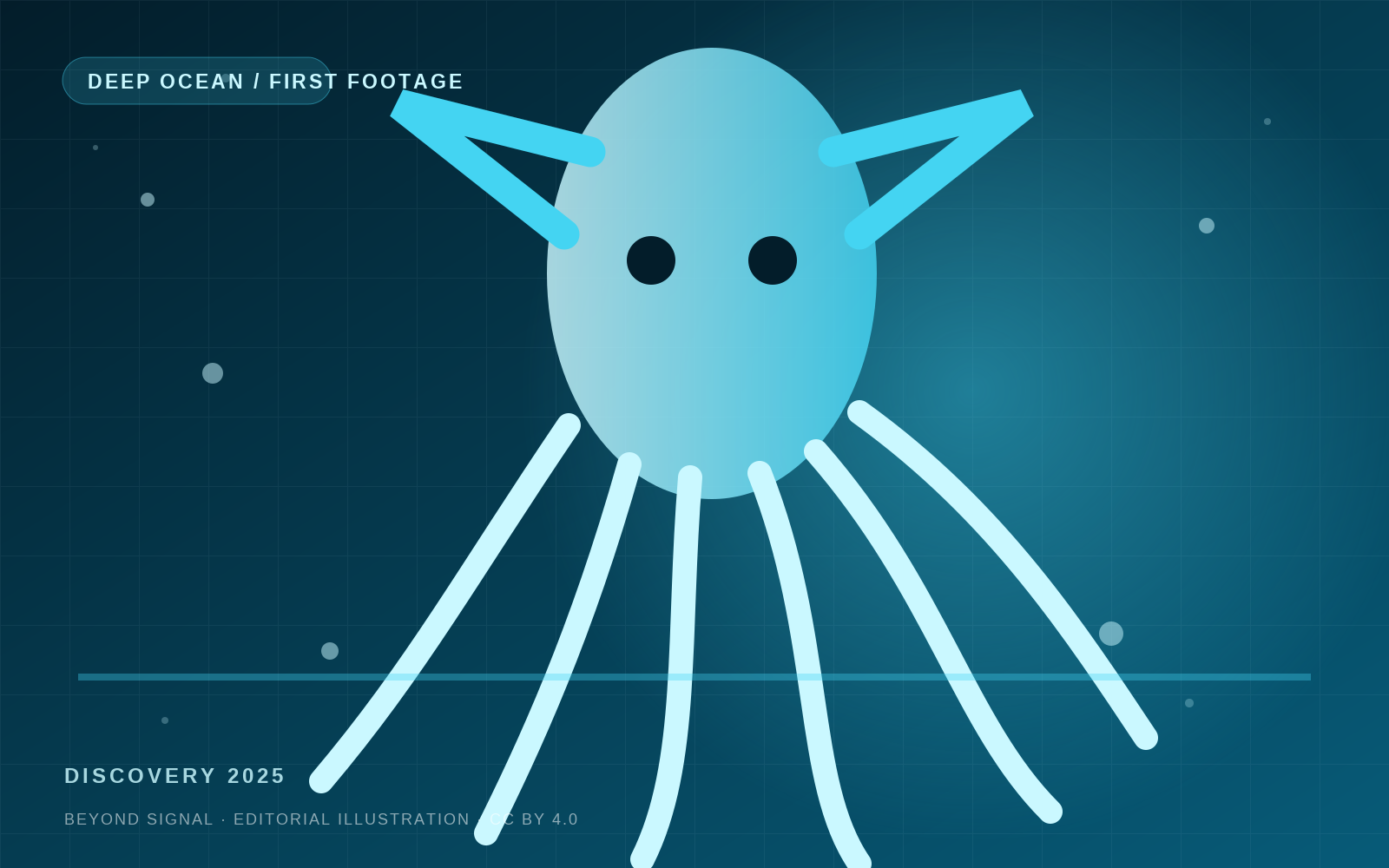 Illustration🪸 Ocean Discoveries
A Colossal Squid Filmed Alive in Its Natural Habitat
An ROV recorded a transparent juvenile colossal squid at about 600 metres depth, providing the first confirmed video of the species alive in its natural deep-sea habitat.
Read more →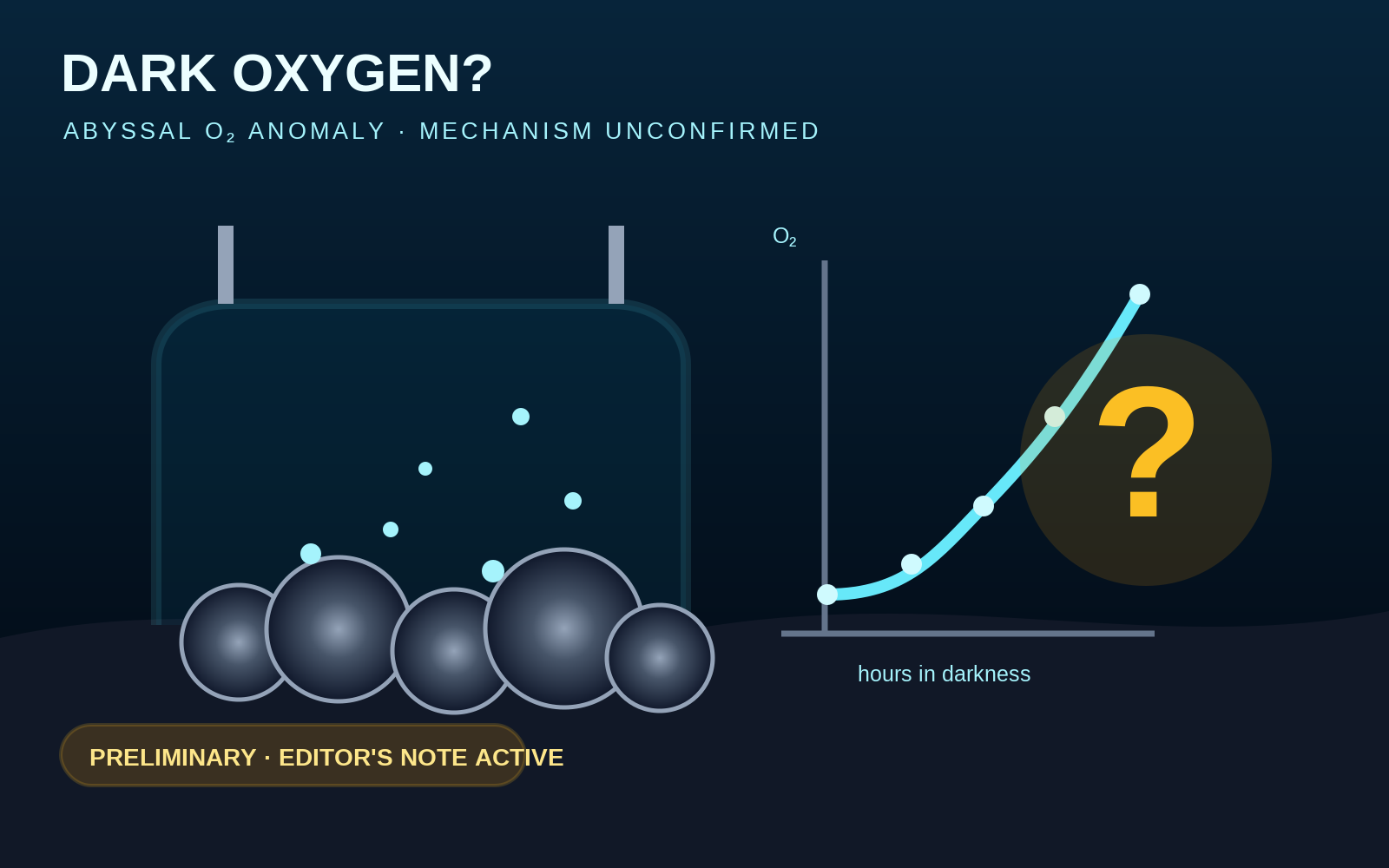 Illustration🪸 Ocean Discoveries
Evidence for 'Dark Oxygen' at the Abyssal Seafloor
Benthic-chamber experiments in the Clarion-Clipperton Zone recorded oxygen concentrations increasing in darkness near polymetallic nodules, but the proposed natural production mechanism remains unconfirmed and aspects of the paper are under editorial review.
Read more →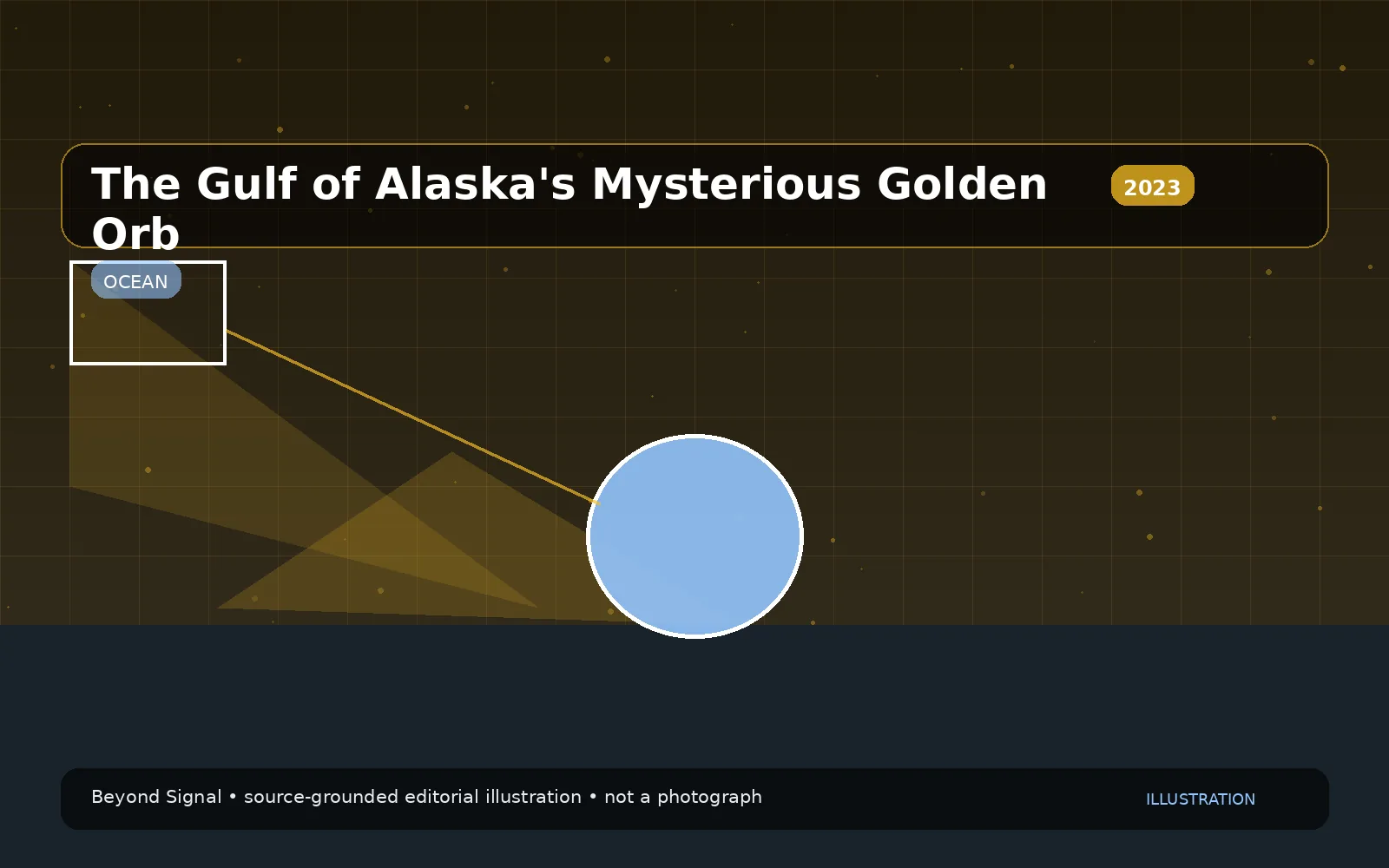 Illustration🪸 Ocean Discoveries
The Gulf of Alaska's Mysterious Golden Orb
A NOAA remotely operated vehicle found a smooth golden object attached to rock about 3,300 metres deep in the Gulf of Alaska. It resisted immediate identification as an egg case, sponge, or coral. Later microscopy and genetic work linked the material to the anchoring structure of the deep-sea anemone Relicanthus daphneae.
Read more →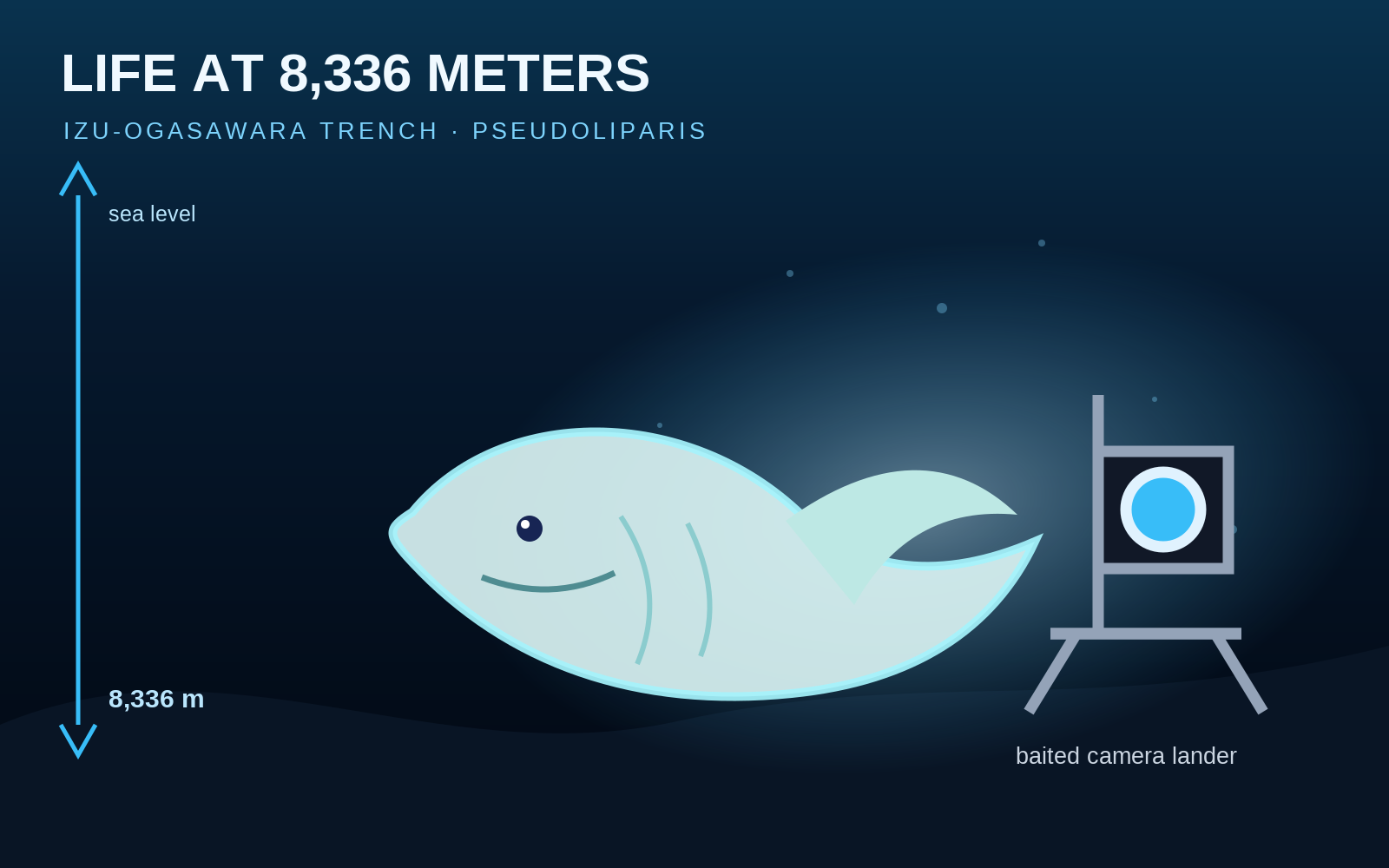 Illustration🪸 Ocean Discoveries
The Deepest Fish Ever Filmed
A baited lander recorded an unidentified Pseudoliparis snailfish 8,336 meters down in the Izu-Ogasawara Trench, setting the verified depth record for a fish filmed in the ocean.
Read more → Illustration🪸 Ocean Discoveries
A Global Ocean Census of RNA Viruses
A metatranscriptomic survey of ocean samples substantially expanded the known RNA virome, reorganizing major evolutionary groups and revealing that marine RNA viruses are both abundant and deeply diverse.
Read more → Illustration🪸 Ocean Discoveries
Shackleton's Endurance Found in the Weddell Sea
The Endurance22 expedition located Sir Ernest Shackleton's ship Endurance upright on the Weddell Sea floor at 3,008 metres, roughly four miles south of Captain Frank Worsley's recorded sinking position. The unusually intact wooden wreck was documented without being touched under Antarctic Treaty protection.
Read more → Representative🪸 Ocean Discoveries
A 500-Metre Detached Coral Reef
The first detached reef found in over a century — taller than the Empire State Building at ~500 m, with its peak just 40 m below the surface.
Read more → 🪸 Ocean Discoveries
The Deepest Octopus Ever Seen
A Dumbo octopus filmed at 6,957 m in the Java Trench — nearly 2 km deeper than any confirmed octopus before, pushing the group into the hadal zone.
Read more → 🪸 Ocean Discoveries
The Mariana Snailfish, Deepest Fish
A small, translucent snailfish that thrives near 8,000 m in the Mariana Trench — the deepest-living fish ever described.
Read more → 🪸 Ocean Discoveries
"Casper" the Ghost Octopus
A ghostly, pigmentless octopus filmed at 4,290 m off Hawaii — likely a previously unknown genus living deeper than any known finned octopod.
Read more → Representative🪸 Ocean Discoveries
Giant Squid Filmed in the Deep
The first footage of a live giant squid in its natural deep-sea habitat, ending centuries of the animal being known mostly from carcasses.
Read more → 🪸 Ocean Discoveries
The Barreleye Fish with a Transparent Head
The first images of a living barreleye — a fish whose transparent, fluid-filled head lets its tubular eyes rotate to peer up through its own skull.
Read more → 🪸 Ocean Discoveries
The Yeti Crab
A blind, silky-clawed crab from hydrothermal vents so distinctive it required an entirely new family — nicknamed the 'yeti crab' for its hairy arms.
Read more →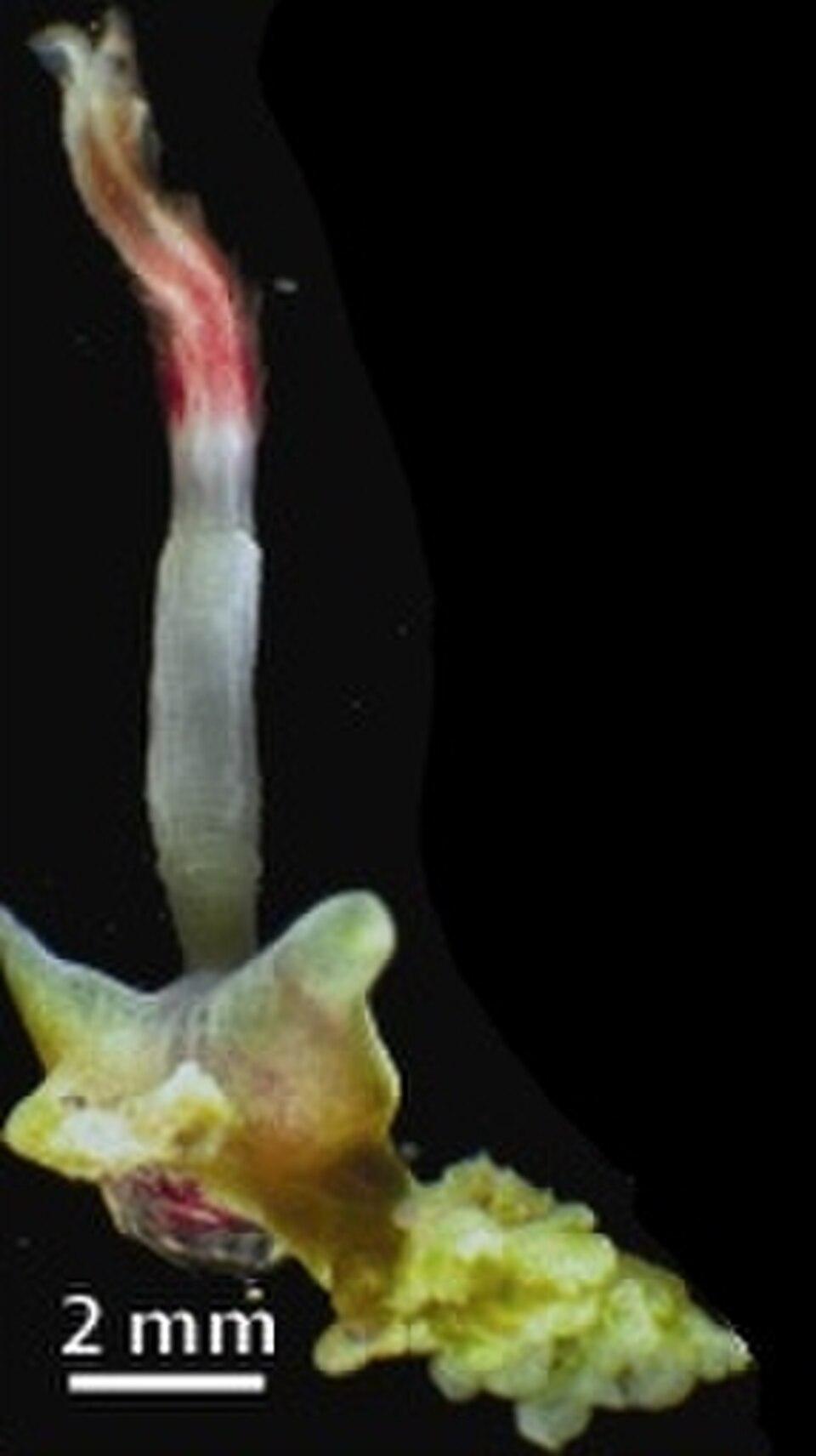 🪸 Ocean Discoveries
Bone-Eating 'Zombie' Worms
Rootless worms that bore into whale bones on the seafloor, dissolving them with acid and feeding through symbiotic bacteria — a new genus found on a sunken whale.
Read more → 🪸 Ocean Discoveries
The Scaly-foot Snail
A deep-sea snail that armors its foot with iron-sulfide scales — the only animal known to build part of its skeleton from iron.
Read more → 🪸 Ocean Discoveries
The Lost City Hydrothermal Field
A field of towering white carbonate chimneys — one over 60 m tall — driven by seawater reacting with mantle rock rather than volcanic heat.
Read more →Major discoveries by year
- 31 New Species Found in Brazil's Ocean Midwater
2026 · New species
- Dudgeon's Walking Shark
2026 · New species
- A Tiny Blue Octopus from the Galápagos Deep
2026 · New species
- The Deep-Sea ‘Golden Orb’ Identified
2026 · Ocean mysteries
- Chemosynthetic Communities Found Across Hadal Trenches
2025 · Deep-sea expeditions
- A Colossal Squid Filmed Alive in Its Natural Habitat
2025 · Ocean mysteries
- Evidence for 'Dark Oxygen' at the Abyssal Seafloor
2024 · Ocean mysteries
- The Gulf of Alaska's Mysterious Golden Orb
2023 · Ocean mysteries
Related scientific terms
Frequently asked questions
Why are new ocean species still being found?
Much of the seafloor and deep water has never been observed at the resolution needed for species identification. New expeditions continue to sample habitats that have been visited rarely or never.
Does a video prove that an animal is a new species?
Usually not. Video can document appearance and behaviour, but formal identification often requires anatomy, genetics, or comparison with preserved material.
What is a hydrothermal vent?
It is a seafloor opening where chemically altered, heated water enters the ocean. Vent ecosystems use chemical energy rather than sunlight as the foundation of their food webs.