
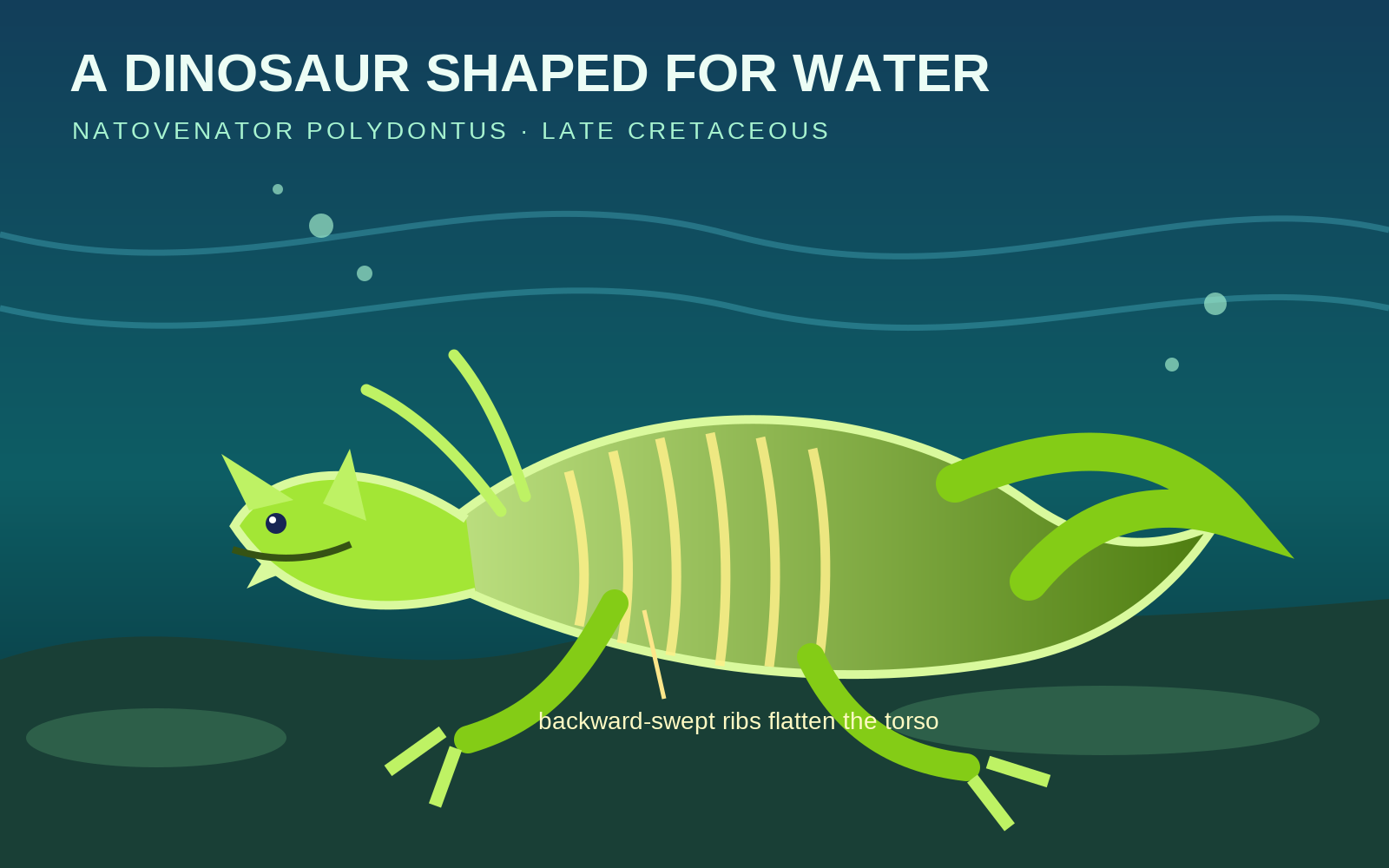
 Illustration — not a photo of the discovery
Natovenator, a Streamlined Swimming Dinosaur
A well-articulated dromaeosaurid skeleton from Mongolia preserved backward-swept ribs and a flattened torso, providing the first compelling evidence of a streamlined body in a non-avian theropod dinosaur.
The story
Why scientists were there
Non-avian dinosaurs occupied many habitats, but strong evidence for swimming adaptations is rare and debated. Natovenator expands the known range of theropod body plans; because behavior cannot fossilize directly, future specimens and biomechanical tests must determine how efficiently it swam and whether water was central to its ecology.
How they found it
Researchers described a mostly articulated skeleton with a nearly complete skull from the Baruungoyot Formation and used micro-CT imaging plus anatomical and phylogenetic comparisons. The posteriorly directed ribs imply a long, low trunk like those of diving birds, while retracted nostrils, numerous teeth, and other features align it with the unusual halszkaraptorine dromaeosaurids.
What makes it unique
Natovenator combined a recognizable small theropod skeleton with a dorsoventrally compressed, hydrodynamic torso not previously documented in a non-avian dinosaur. The anatomy supports a semiaquatic interpretation, but it does not by itself reveal propulsion style, dive depth, or diet.
Gallery
Where it was found
Hermiin Tsav, Gobi Desert
Tags
Related discoveries
 🦕 Dinosaurs & Fossils
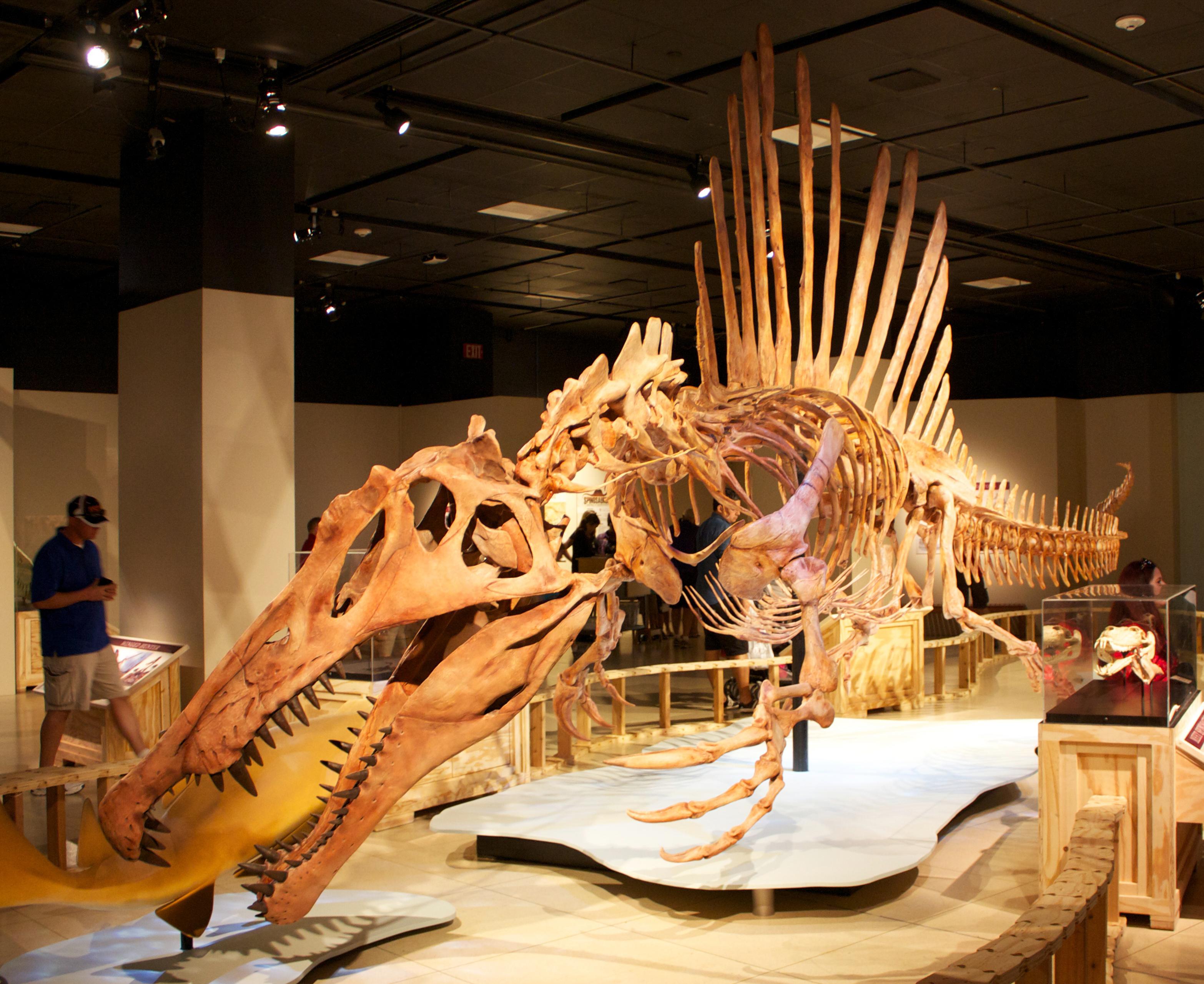
Spinosaurus: the Swimming Dinosaur
A near-complete fossil tail showed Spinosaurus had a fin-like paddle — the strongest evidence yet of a swimming, water-propelled dinosaur.
Read more → Illustration🦕 Dinosaurs & Fossils
Qikiqtania Wakei Returned to Open Water
A Late Devonian fossil from Nunavut revealed Qikiqtania wakei, a close relative of limbed vertebrates whose pectoral fin was specialized for swimming rather than supporting the body on a hard surface. The animal shows that evolution near the fish-to-tetrapod transition explored more than one ecological direction.
Read more →