
Topic hub
New species discoveries in Ocean Discoveries
This topic hub follows 8 catalogued new species discoveries across The Nucleon directory. Each entry connects the finding to its location, discovering institution, scientific source, and related work.
What this topic includes
In ocean discoveries, new species can describe a change in what scientists observe, classify, or measure. The entries below are grouped by their documented subject rather than by headline popularity, making it easier to compare discoveries from different years and places.
Key discoveries
 Representative🪸 Ocean Discoveries
31 New Species Found in Brazil's Ocean Midwater
A two-week expedition off Brazil rapidly identified 31 likely new species, including jellyfish, comb jellies, siphonophores, worms, amphipods, larvaceans, and giant single-celled organisms.
Read more → Representative🪸 Ocean Discoveries
Dudgeon's Walking Shark
A newly described walking shark from shallow Papua New Guinea reefs, identified by its distinctive spotted pattern and confirmed as a separate species through DNA comparisons.
Read more → Representative🪸 Ocean Discoveries
A Tiny Blue Octopus from the Galápagos Deep
A golf-ball-sized, deep-blue octopus from nearly 1,800 m below the Galápagos was formally described as a new species after non-destructive CT scans revealed its unusual anatomy.
Read more → 🪸 Ocean Discoveries
The Mariana Snailfish, Deepest Fish
A small, translucent snailfish that thrives near 8,000 m in the Mariana Trench — the deepest-living fish ever described.
Read more → 🪸 Ocean Discoveries
"Casper" the Ghost Octopus
A ghostly, pigmentless octopus filmed at 4,290 m off Hawaii — likely a previously unknown genus living deeper than any known finned octopod.
Read more → 🪸 Ocean Discoveries
The Yeti Crab
A blind, silky-clawed crab from hydrothermal vents so distinctive it required an entirely new family — nicknamed the 'yeti crab' for its hairy arms.
Read more →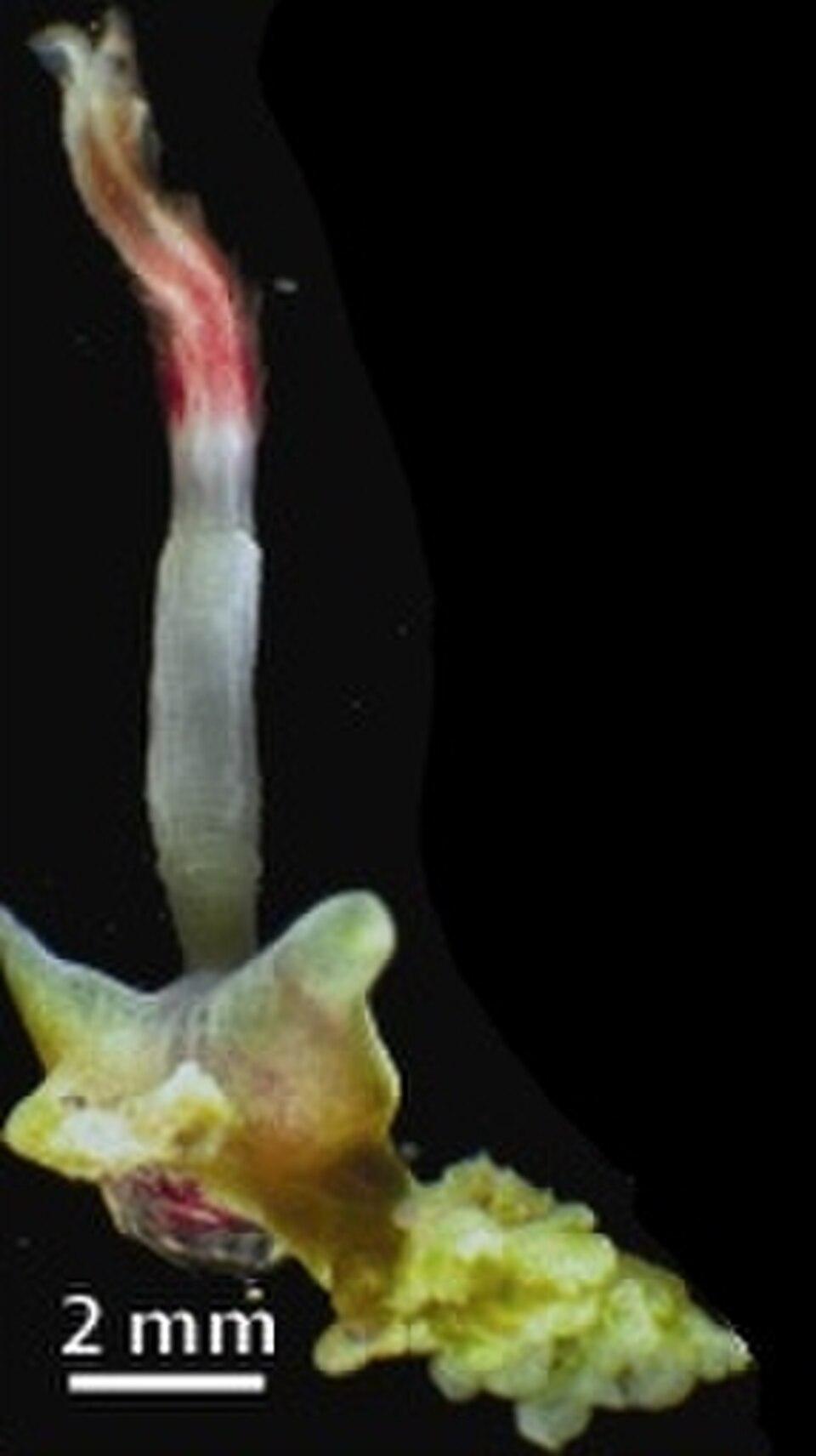 🪸 Ocean Discoveries
Bone-Eating 'Zombie' Worms
Rootless worms that bore into whale bones on the seafloor, dissolving them with acid and feeding through symbiotic bacteria — a new genus found on a sunken whale.
Read more → 🪸 Ocean Discoveries
The Scaly-foot Snail
A deep-sea snail that armors its foot with iron-sulfide scales — the only animal known to build part of its skeleton from iron.
Read more →Questions readers ask
How many new species discoveries are catalogued?
The Nucleon currently lists 8. The total changes as new source-checked entries are added.
Where have these discoveries been made?
They span 6 countries or international research settings, from International waters off Bahia, Brazil to other locations in the catalogue.
How should these entries be compared?
Start with the primary source and the discovery method. A visually striking result and a formal species or particle identification do not always use the same standard of evidence.