

The Deep-Sea ‘Golden Orb’ Identified
A mysterious golden mass collected from the Gulf of Alaska seafloor was identified as tissue shed from the attachment base of the giant deep-sea anemone Relicanthus daphneae.
The story
Why scientists were there
NOAA explorers were documenting deep habitats in the Gulf of Alaska when an ROV camera found a smooth golden object attached to rock more than three kilometres down.
How they found it
Microscopy and genetic evidence linked the object to Relicanthus daphneae, showing that the orb was not an egg case or sponge but material associated with the anemone’s anchoring base.
What makes it unique
The identification solved a widely followed deep-sea puzzle and revealed that this unusual anemone can leave behind a layered golden structure as it detaches or moves across the seafloor.
Gallery

Where it was found
Gulf of Alaska, northeastern Pacific Ocean
Tags
Related discoveries
 🪸 Ocean Discoveries
The Lost City Hydrothermal Field
A field of towering white carbonate chimneys — one over 60 m tall — driven by seawater reacting with mantle rock rather than volcanic heat.
Read more → 🪸 Ocean Discoveries
"Casper" the Ghost Octopus
A ghostly, pigmentless octopus filmed at 4,290 m off Hawaii — likely a previously unknown genus living deeper than any known finned octopod.
Read more →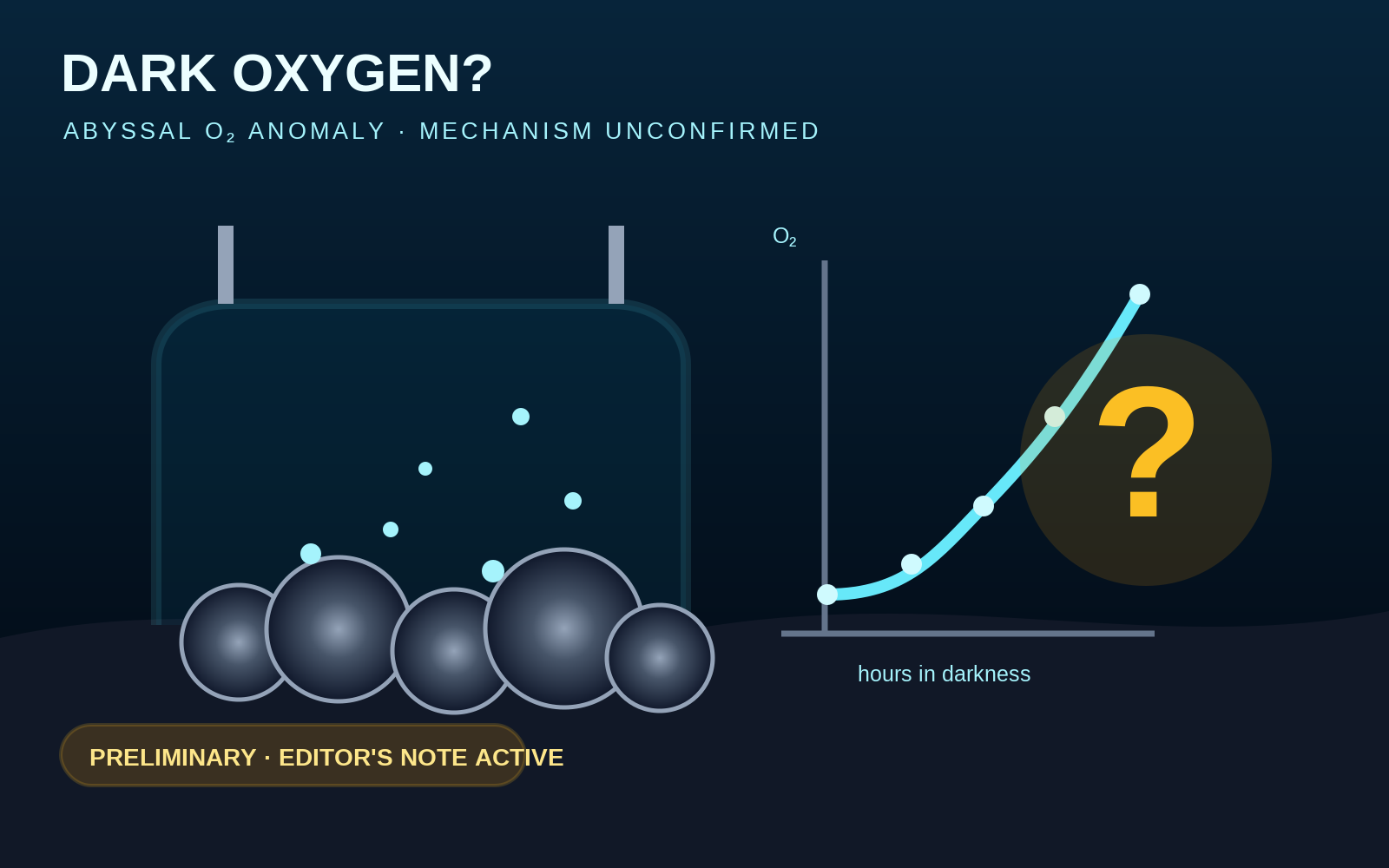 Illustration🪸 Ocean Discoveries
Evidence for 'Dark Oxygen' at the Abyssal Seafloor
Benthic-chamber experiments in the Clarion-Clipperton Zone recorded oxygen concentrations increasing in darkness near polymetallic nodules, but the proposed natural production mechanism remains unconfirmed and aspects of the paper are under editorial review.
Read more → Illustration🪸 Ocean Discoveries
The Gulf of Alaska's Mysterious Golden Orb
A NOAA remotely operated vehicle found a smooth golden object attached to rock about 3,300 metres deep in the Gulf of Alaska. It resisted immediate identification as an egg case, sponge, or coral. Later microscopy and genetic work linked the material to the anchoring structure of the deep-sea anemone Relicanthus daphneae.
Read more →