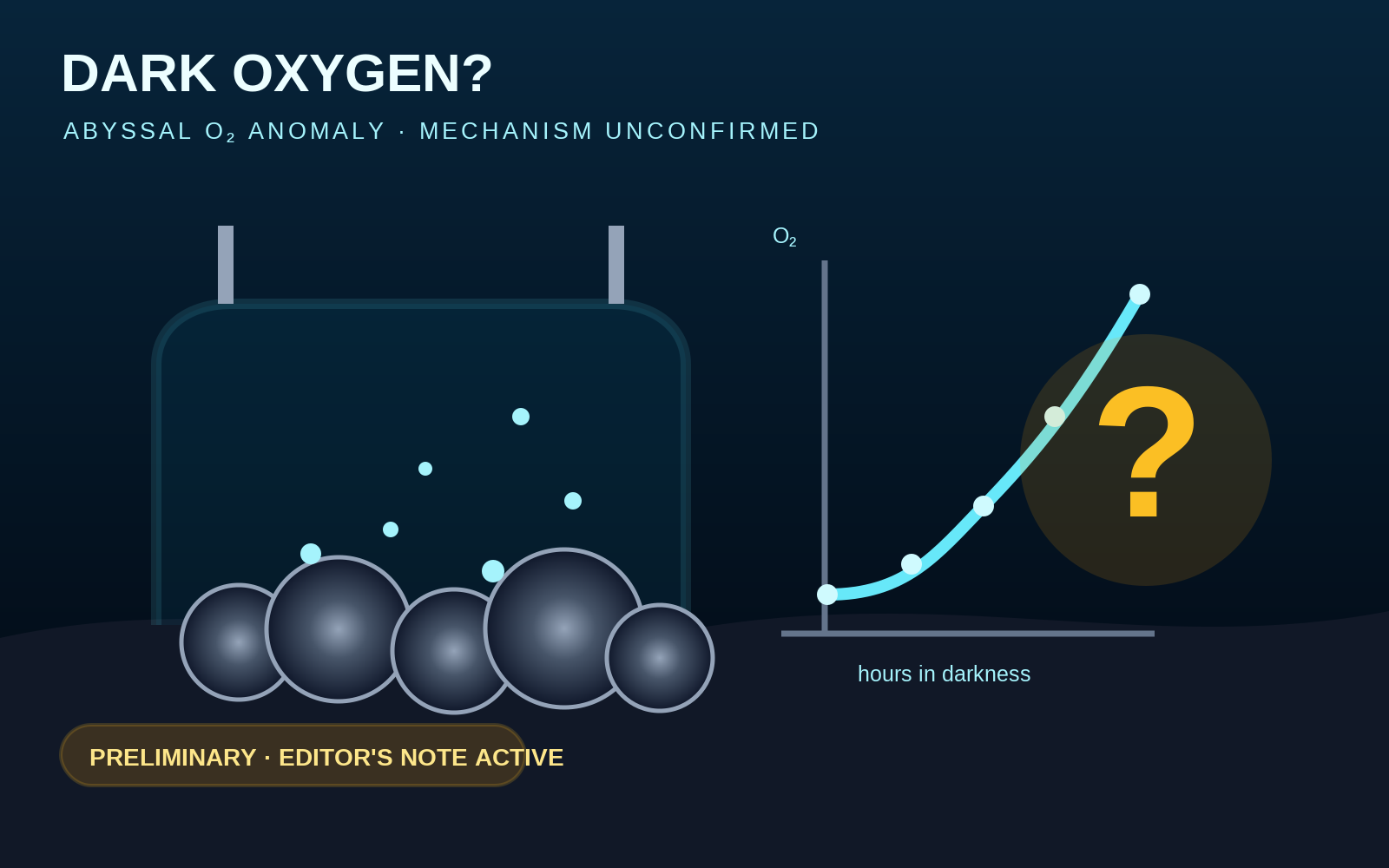
 Illustration — not a photo of the discovery
Evidence for 'Dark Oxygen' at the Abyssal Seafloor
Benthic-chamber experiments in the Clarion-Clipperton Zone recorded oxygen concentrations increasing in darkness near polymetallic nodules, but the proposed natural production mechanism remains unconfirmed and aspects of the paper are under editorial review.
The story
Why scientists were there
If a reproducible natural source exists, it could change models of abyssal oxygen cycling and assessments of nodule-mining impacts. The finding is preliminary because independent replication and a viable energy pathway are missing, critics have raised methodological concerns, and Nature Geoscience added an editor's note in April 2026; blinded multi-lab experiments and in-situ electrochemistry are the next requirements.
How they found it
Across several cruises, sealed seafloor chambers showed oxygen optode readings rising over roughly two days, sometimes to more than three times the starting concentration. Winkler titrations and ex-situ incubations were used as checks, and oxygen change correlated with nodule surface area; measured surface potentials reached 0.95 volts.
What makes it unique
The observations ran opposite to the expected oxygen consumption of deep-sea sediments and prompted the label 'dark oxygen.' The authors hypothesized nodule-driven seawater electrolysis, but their measured voltages did not by themselves demonstrate that reaction, so the entry records the anomaly without treating the mechanism or even natural origin as settled.
Gallery
Where it was found
NORI-D area, Clarion-Clipperton Zone
Tags
Related discoveries
 🪸 Ocean Discoveries
The Lost City Hydrothermal Field
A field of towering white carbonate chimneys — one over 60 m tall — driven by seawater reacting with mantle rock rather than volcanic heat.
Read more → 🪸 Ocean Discoveries
The Deep-Sea ‘Golden Orb’ Identified
A mysterious golden mass collected from the Gulf of Alaska seafloor was identified as tissue shed from the attachment base of the giant deep-sea anemone Relicanthus daphneae.
Read more →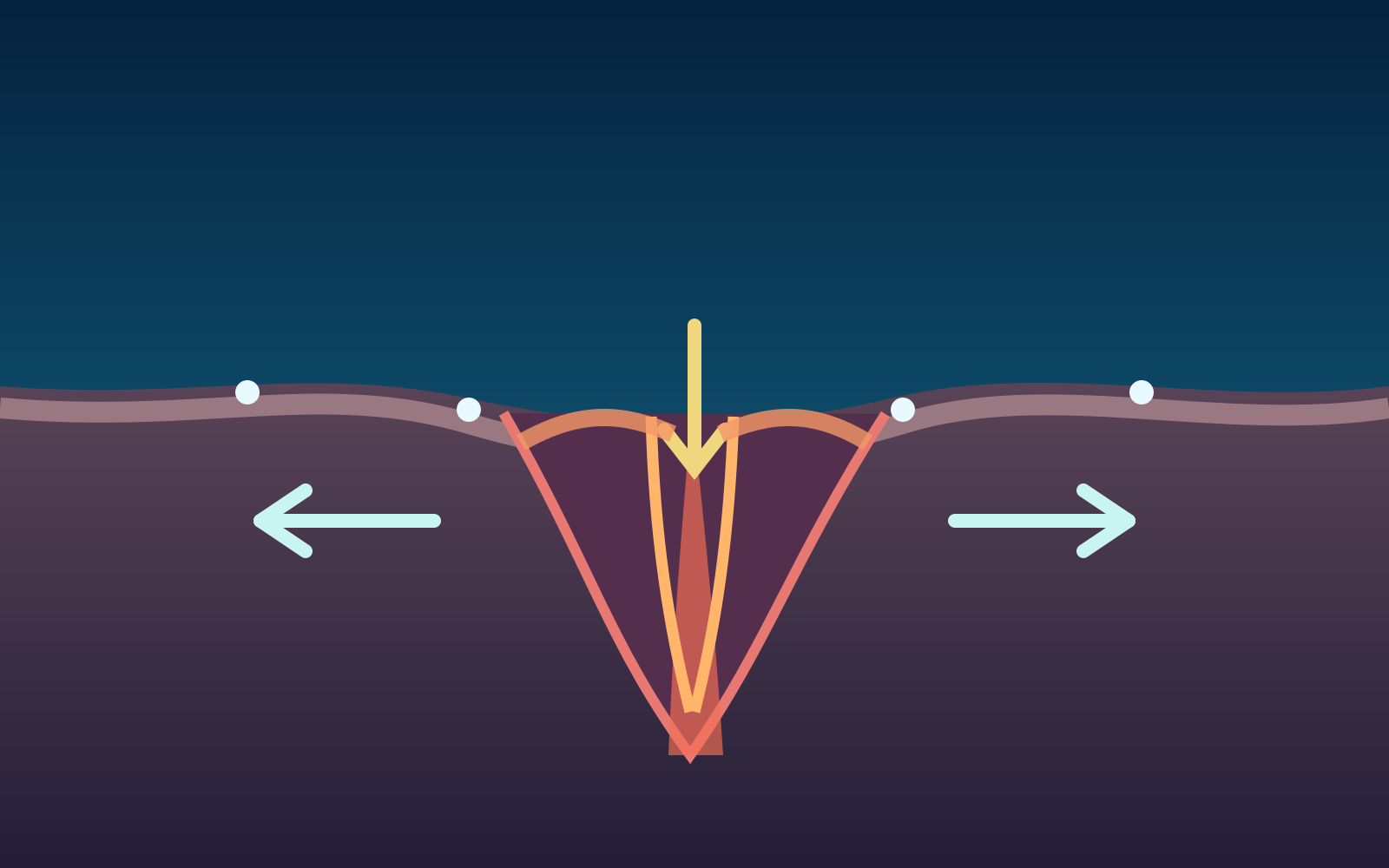 Illustration🌋 Earth Science
Seafloor Spreading Captured at the Southeast Indian Ridge
An autonomous seismogeodetic observatory captured a 2024 rifting event at the Southeast Indian Ridge, directly measuring seismicity, metre-scale deformation, and fresh lava emplacement at a mid-ocean ridge.
Read more → Illustration🪸 Ocean Discoveries
Chemosynthetic Communities Found Across Hadal Trenches
Crewed dives documented extensive communities of tube worms and bivalves sustained by methane- and hydrogen-sulfide-rich fluids from 5,800 to 9,533 metres in the Kuril–Kamchatka and western Aleutian trenches.
Read more →