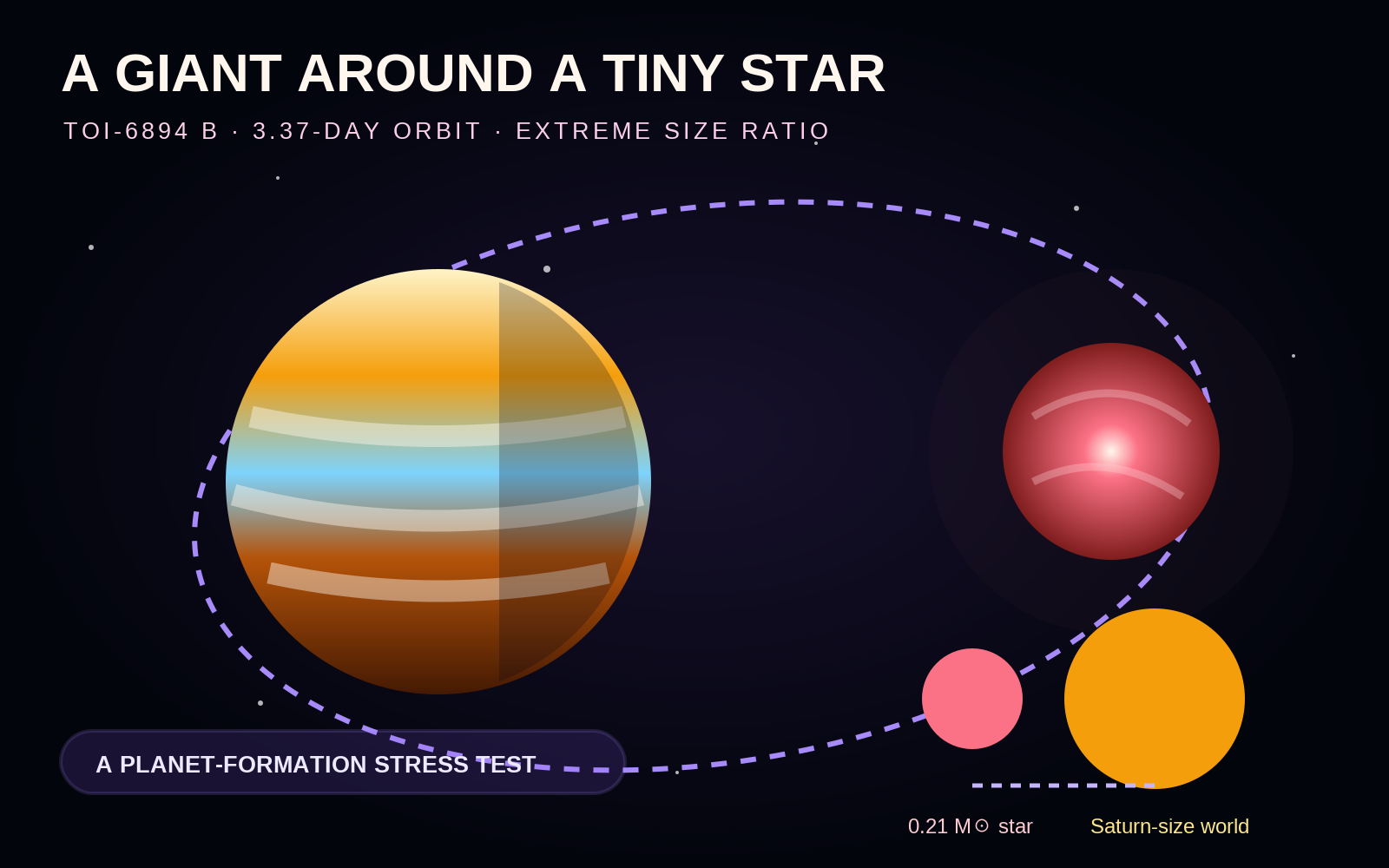
 Illustration — not a photo of the discovery
TOI-6894 b, a Giant Planet Around a Tiny Star
Transit and radial-velocity measurements confirmed a low-density giant planet around a star only about one-fifth the Sun's mass, creating a demanding test for planet-formation models around very low-mass stars.
The story
Why scientists were there
Small stars are expected to have low-mass disks that struggle to build giant planets before the gas disperses. TOI-6894 b provides a benchmark for core accretion and disk instability, but one rare planet cannot determine its formation route; atmospheric metallicity and a larger occurrence census are the next discriminants.
How they found it
TESS recorded 3.37-day transits that dimmed the small host star by about 17 percent. Multi-color ground photometry localized the events, while ESPRESSO and SPIRou radial velocities measured the companion's mass and ruled out blended binaries; a joint model gave 0.168 Jupiter masses and 0.855 Jupiter radii around a 0.207-solar-mass star.
What makes it unique
The host was the lowest-mass star known at publication to carry a transiting giant planet with a measured mass. Its cool temperature, deep transits, and puffy atmosphere also make it unusually accessible for methane and composition studies, although the inferred 12-Earth-mass metal inventory depends on interior models.
Gallery
Where it was found
University of Warwick, Coventry
Tags
Related discoveries
 🌌 Space
The TRAPPIST-1 Planetary System
Seven Earth-sized planets circling a cool red dwarf 40 light-years away — three of them in the habitable zone.
Read more → 🌌 Space
A 3D Weather Map of Exoplanet Tylos
For the first time, astronomers mapped several layers of an exoplanet's atmosphere in three dimensions, revealing separate winds carrying iron, sodium, hydrogen, and titanium.
Read more → Illustration🌌 Space
Webb Detects Carbon Dioxide in WASP-39 b’s Atmosphere
JWST transmission spectroscopy delivered the first unambiguous carbon-dioxide detection in an exoplanet atmosphere, measuring a strong 4.3-micrometre absorption feature in the hot gas giant WASP-39 b.
Read more →