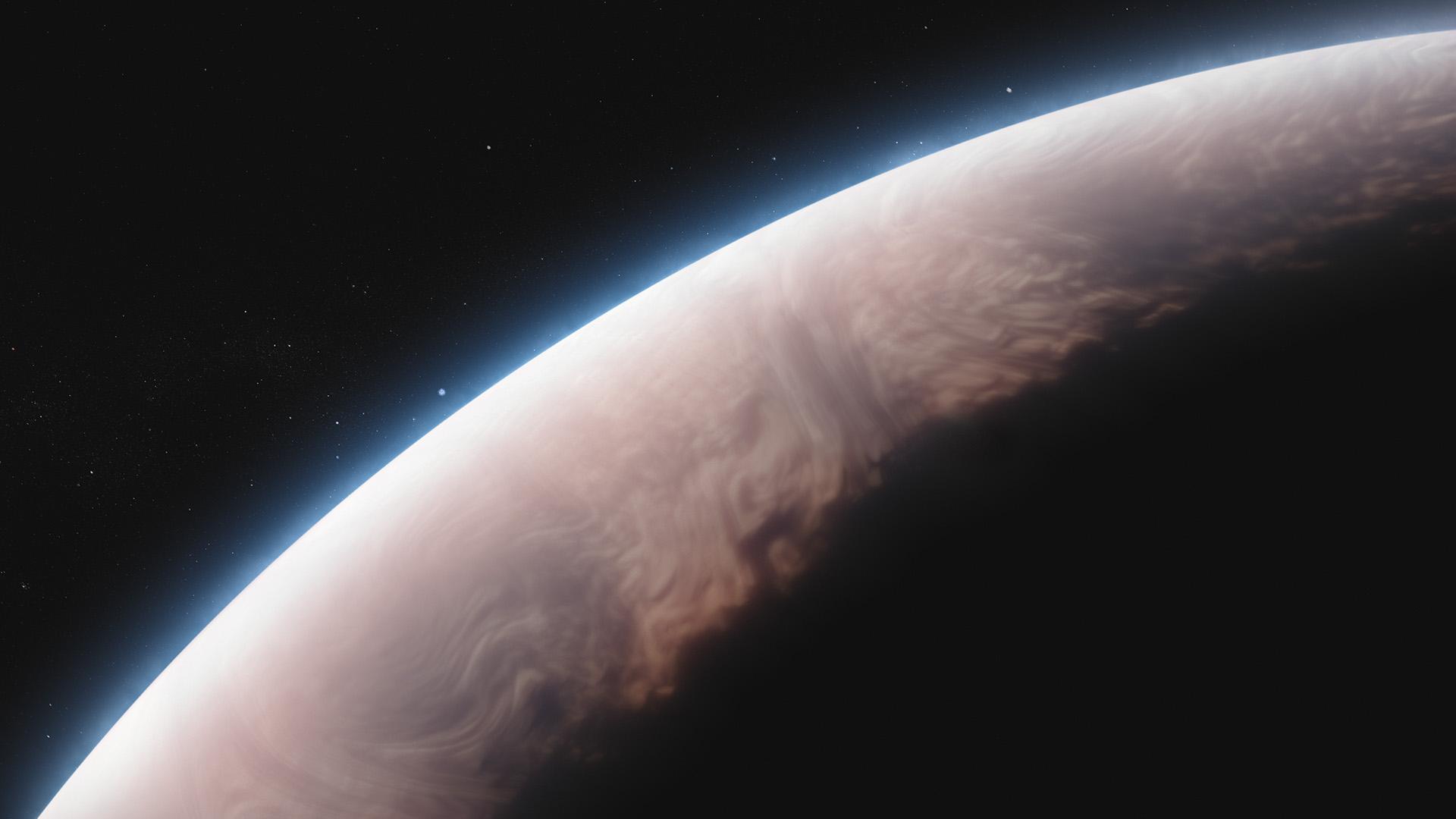
 Illustration — not a photo of the discovery
Webb Detects Carbon Dioxide in WASP-39 b’s Atmosphere
JWST transmission spectroscopy delivered the first unambiguous carbon-dioxide detection in an exoplanet atmosphere, measuring a strong 4.3-micrometre absorption feature in the hot gas giant WASP-39 b.
The story
Why scientists were there
Carbon dioxide is useful for reading an atmosphere’s chemical inventory and, in giant planets, for constraining formation models. The result does not make WASP-39 b habitable: it is a highly irradiated gas giant. Future spectra of smaller planets will need much subtler signals and careful treatment of clouds, stellar activity, and instrument systematics.
How they found it
During a transit, the team used Webb’s Near-Infrared Spectrograph to compare the host star’s light filtered through the planet’s atmosphere with unobscured starlight. The 3.0–5.5-micrometre transmission spectrum contained a prominent absorption feature at 4.3 micrometres, measured at 26-sigma significance and identified as carbon dioxide.
What makes it unique
The direct observation was the resolved carbon-dioxide absorption band, rather than an inferred color change. Atmospheric models that fit the wider spectrum are interpretations: they point to a metal-enriched, moderately cloudy atmosphere and predict other gases, while a smaller unexplained feature near 4.0 micrometres remains tentative.
Gallery
Where it was found
Space Telescope Science Institute, Baltimore
Tags
Related discoveries
 🌌 Space
A 3D Weather Map of Exoplanet Tylos
For the first time, astronomers mapped several layers of an exoplanet's atmosphere in three dimensions, revealing separate winds carrying iron, sodium, hydrogen, and titanium.
Read more →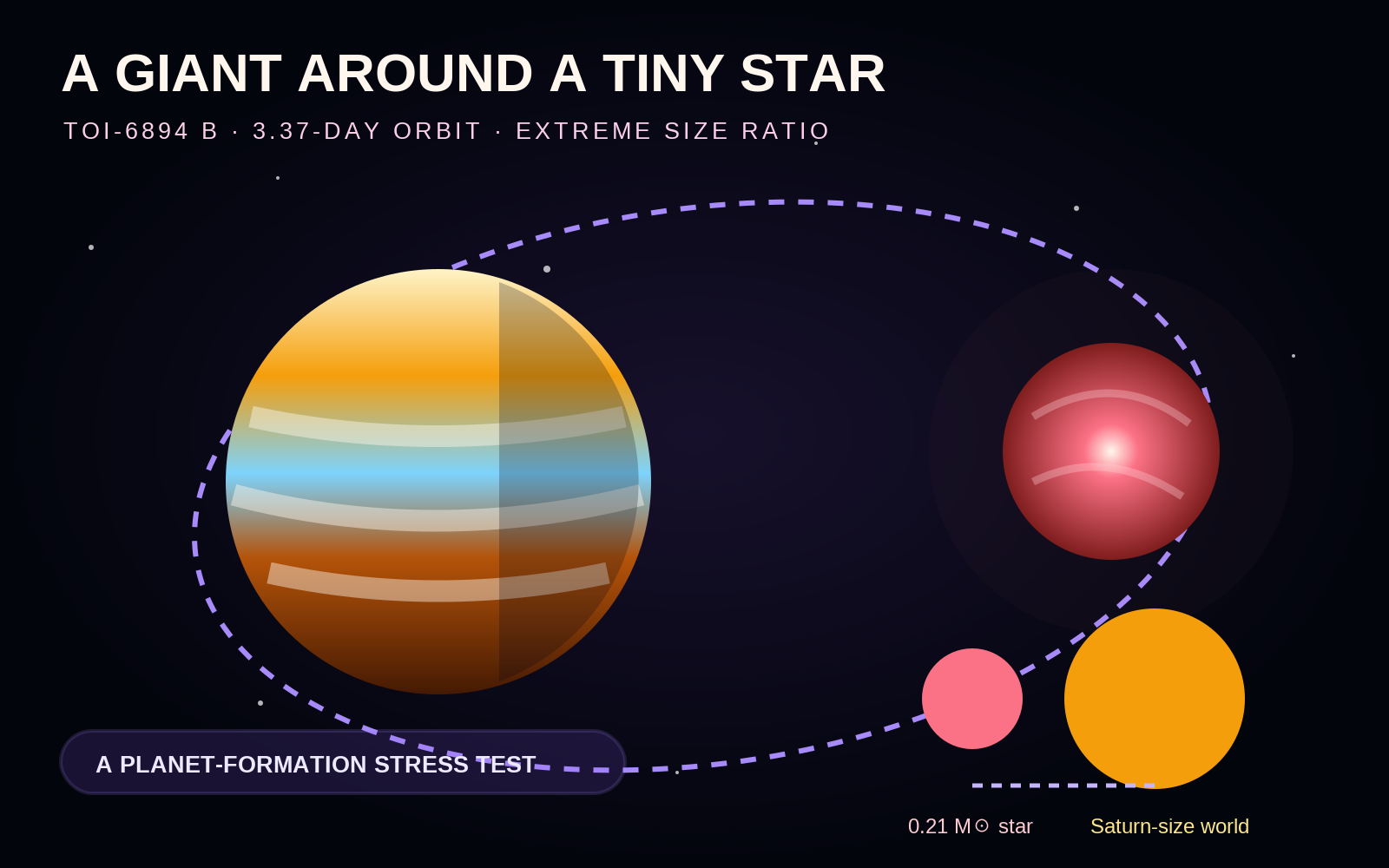 Illustration🌌 Space
TOI-6894 b, a Giant Planet Around a Tiny Star
Transit and radial-velocity measurements confirmed a low-density giant planet around a star only about one-fifth the Sun's mass, creating a demanding test for planet-formation models around very low-mass stars.
Read more → Illustration🌌 Space
JWST Detects the Methyl Cation in a Protoplanetary Disk
JWST spectra provided the first detection in space of CH₃⁺, the methyl cation, in a planet-forming disk in the Orion Nebula—direct evidence for a reactive carbon ion long expected to help initiate interstellar chemistry.
Read more →