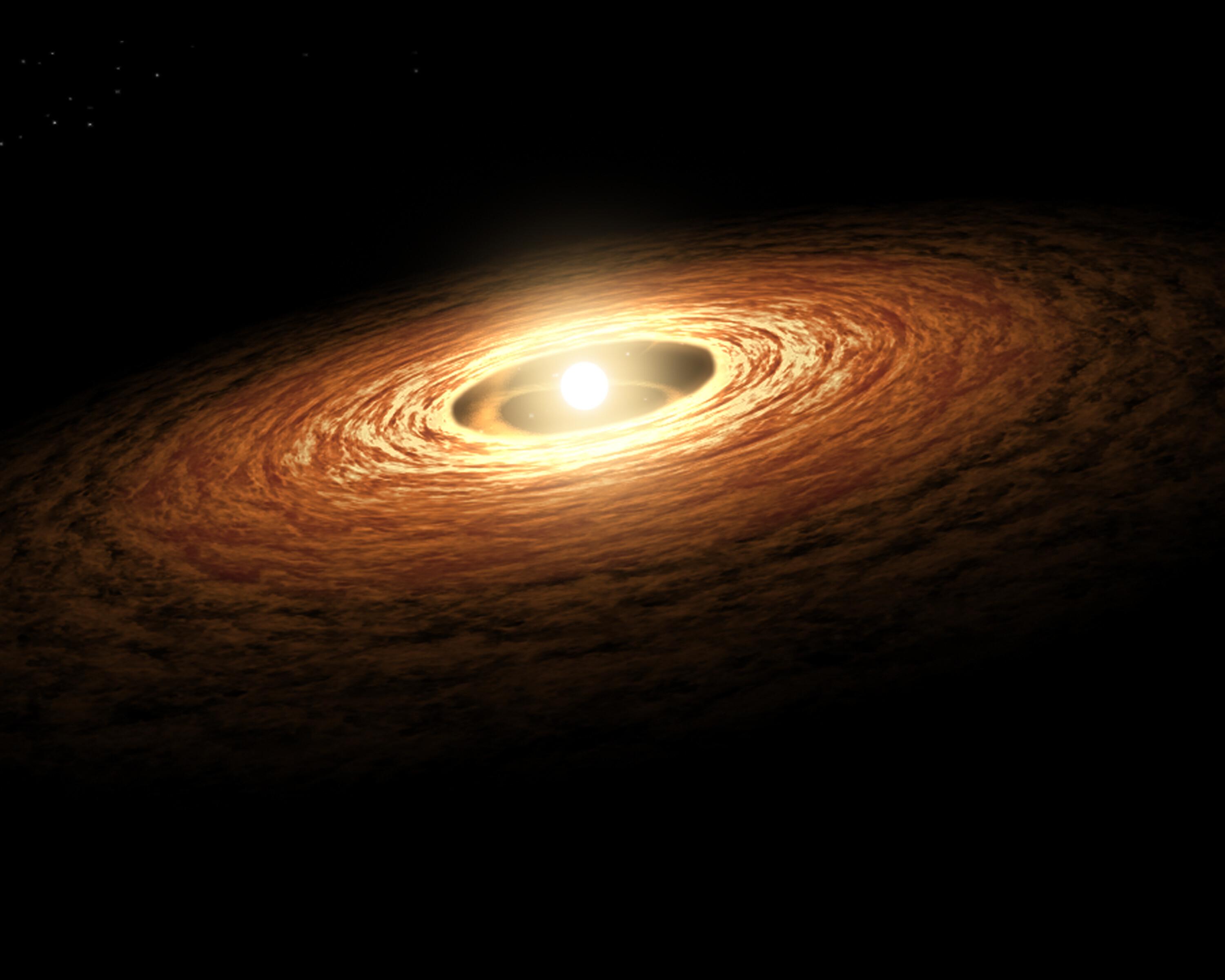
 Illustration — not a photo of the discovery
JWST Detects the Methyl Cation in a Protoplanetary Disk
JWST spectra provided the first detection in space of CH₃⁺, the methyl cation, in a planet-forming disk in the Orion Nebula—direct evidence for a reactive carbon ion long expected to help initiate interstellar chemistry.
The story
Why scientists were there
CH₃⁺ readily reacts with other molecules and is a key theoretical stepping stone toward larger carbon-bearing compounds. Its presence does not show that life-related molecules or planets have formed in the disk; researchers still need to trace how this ion behaves across different radiation fields, disk layers, and chemical environments.
How they found it
The PDRs4All team used Webb’s infrared spectroscopy to study the irradiated disk d203-506 in Orion. They matched a set of observed emission features to calculations for vibrational transitions of CH₃⁺ and evaluated whether other plausible molecules could reproduce the pattern.
What makes it unique
The direct result is the molecular spectral signature assigned to the methyl cation in a protoplanetary disk. The importance for complex organic chemistry is an interpretation of CH₃⁺’s known reactivity and the disk’s radiation environment, not a detection of complex organics made by the ion in that system.
Gallery
Where it was found
Space Telescope Science Institute, Baltimore
Tags
Related discoveries
 🌌 Space
Planet Formation Caught at the Start around HOPS-315
Astronomers observed the first specks of planet-forming minerals beginning to solidify around a young star, catching a process analogous to the birth of our Solar System.
Read more → Illustration🌌 Space
Webb Detects Carbon Dioxide in WASP-39 b’s Atmosphere
JWST transmission spectroscopy delivered the first unambiguous carbon-dioxide detection in an exoplanet atmosphere, measuring a strong 4.3-micrometre absorption feature in the hot gas giant WASP-39 b.
Read more →