 Illustration — not a photo of the discovery
JWST Images a Sub-Jovian Planet Candidate at TWA 7
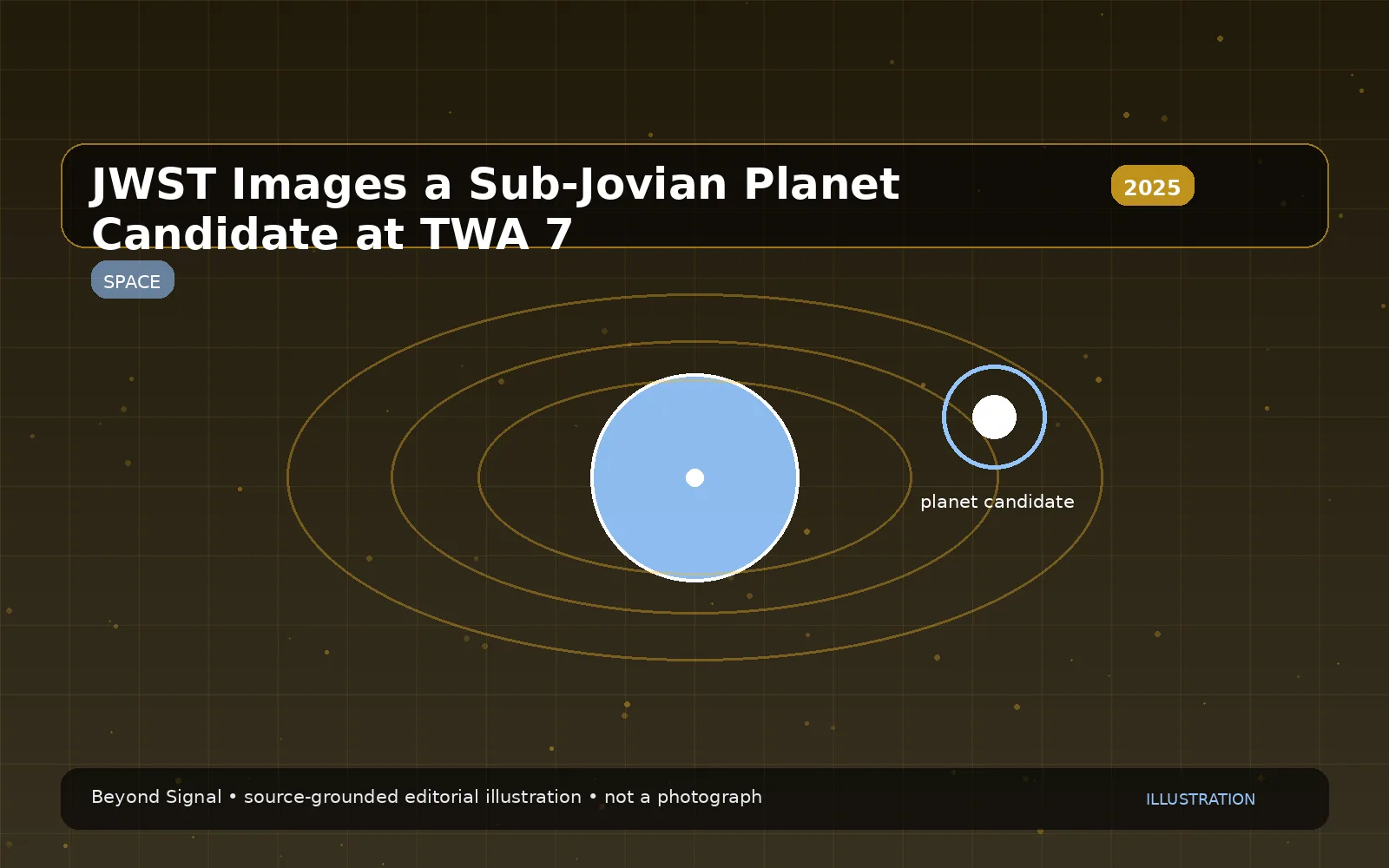
James Webb Space Telescope coronagraphy revealed a compact infrared source embedded in a narrow ring of the young star TWA 7's debris disk. Models place the candidate near 0.3 Jupiter masses at about 52 astronomical units, potentially making it the lowest-mass planet directly imaged around another star.
The story
Why scientists were there
TWA 7's nearly face-on debris disk contains rings, gaps, and asymmetries that could be sculpted by an unseen planet. The geometry makes the system unusually favourable for coronagraphic searches close to the star.
How they found it
JWST's MIRI instrument blocked most of the star's light and imaged the disk at mid-infrared wavelengths. Image processing isolated a point source inside a gap, while background-object tests, spectral modelling, and later observations assessed whether it shares the system's location and expected temperature.
What makes it unique
The source's position and brightness are consistent with a young Saturn-mass world shaping the disk, and follow-up work has strengthened that interpretation. It remains a planet candidate until independent observations fully exclude alternatives and establish orbital motion.
Gallery
Where it was found
Space Telescope Science Institute, Baltimore, Maryland
Tags
Related discoveries
 Illustration🌌 Space
Quaoar's Ring Beyond the Roche Limit
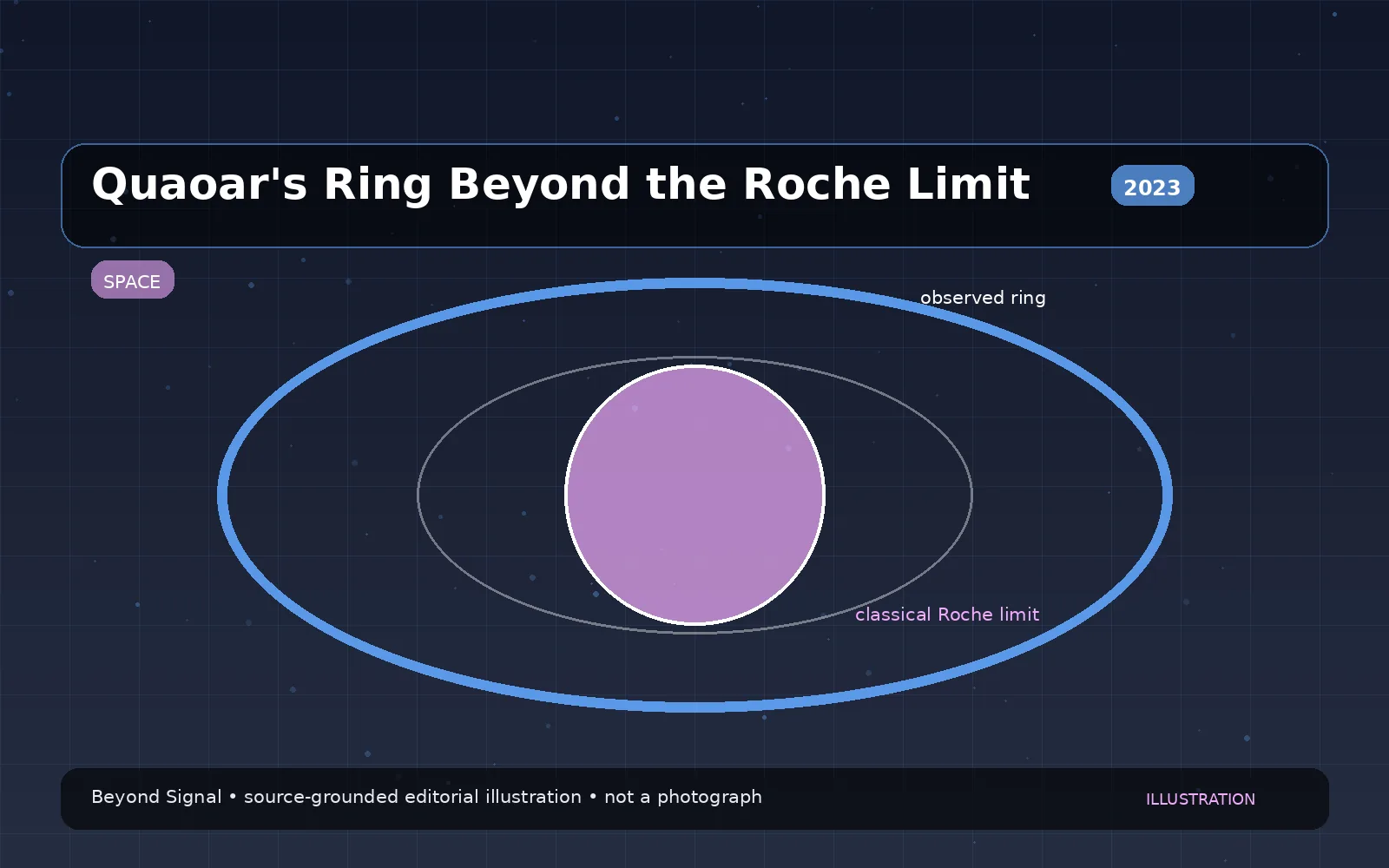
Observations of the dwarf planet Quaoar revealed a dense ring far beyond the classical Roche limit, the distance inside which tidal forces are expected to prevent ring material from assembling into a moon. The ring challenges a simple rule used to explain why planetary rings persist.
Read more →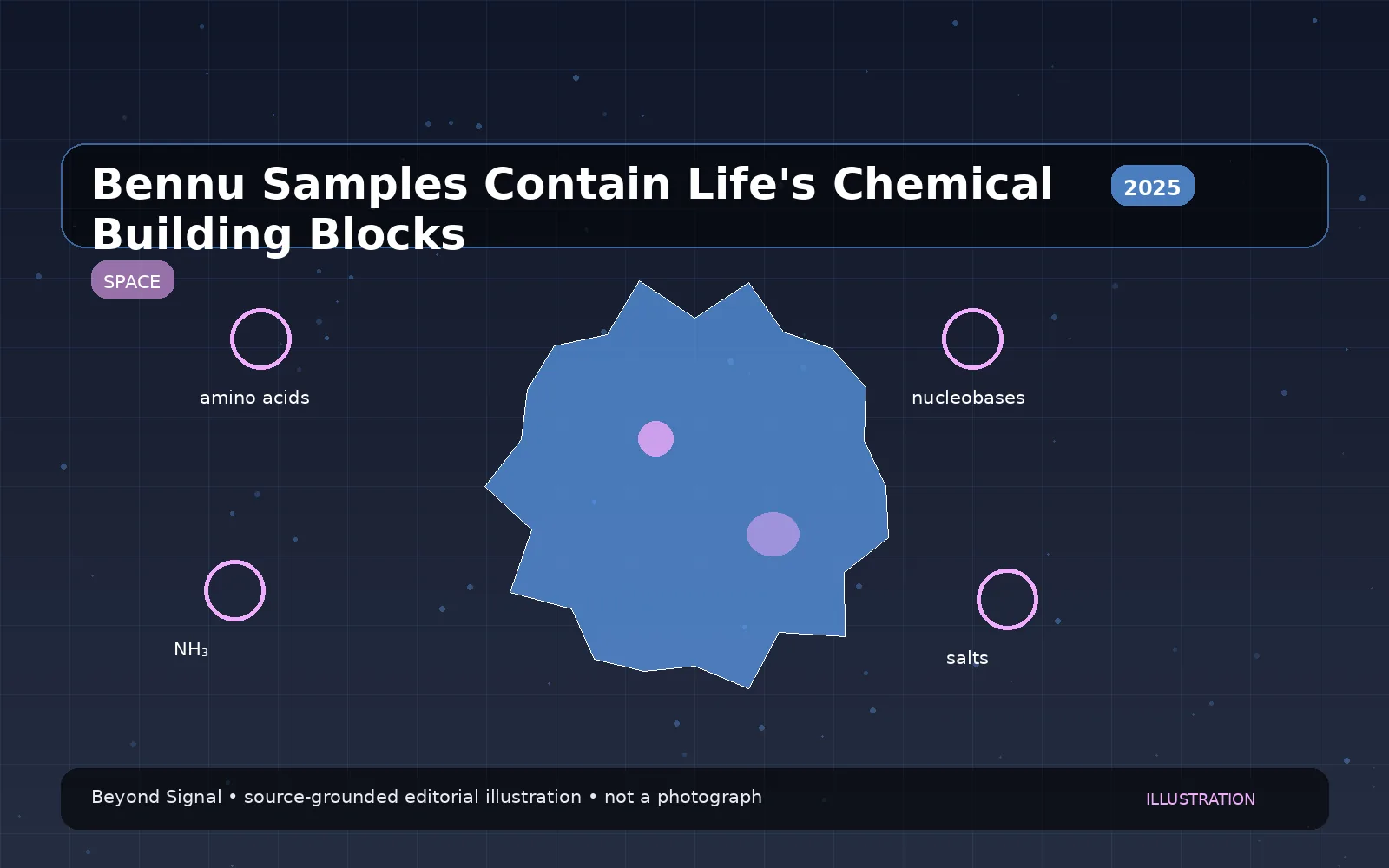 Illustration🌌 Space
Bennu Samples Contain Life's Chemical Building Blocks
Laboratory analyses of pristine asteroid Bennu material returned by OSIRIS-REx found abundant ammonia, nitrogen-rich organic matter, 14 of the 20 amino acids used by terrestrial life, and all five nucleobases used in DNA and RNA. The chemistry shows that life's ingredients were widespread, not that life existed on Bennu.
Read more →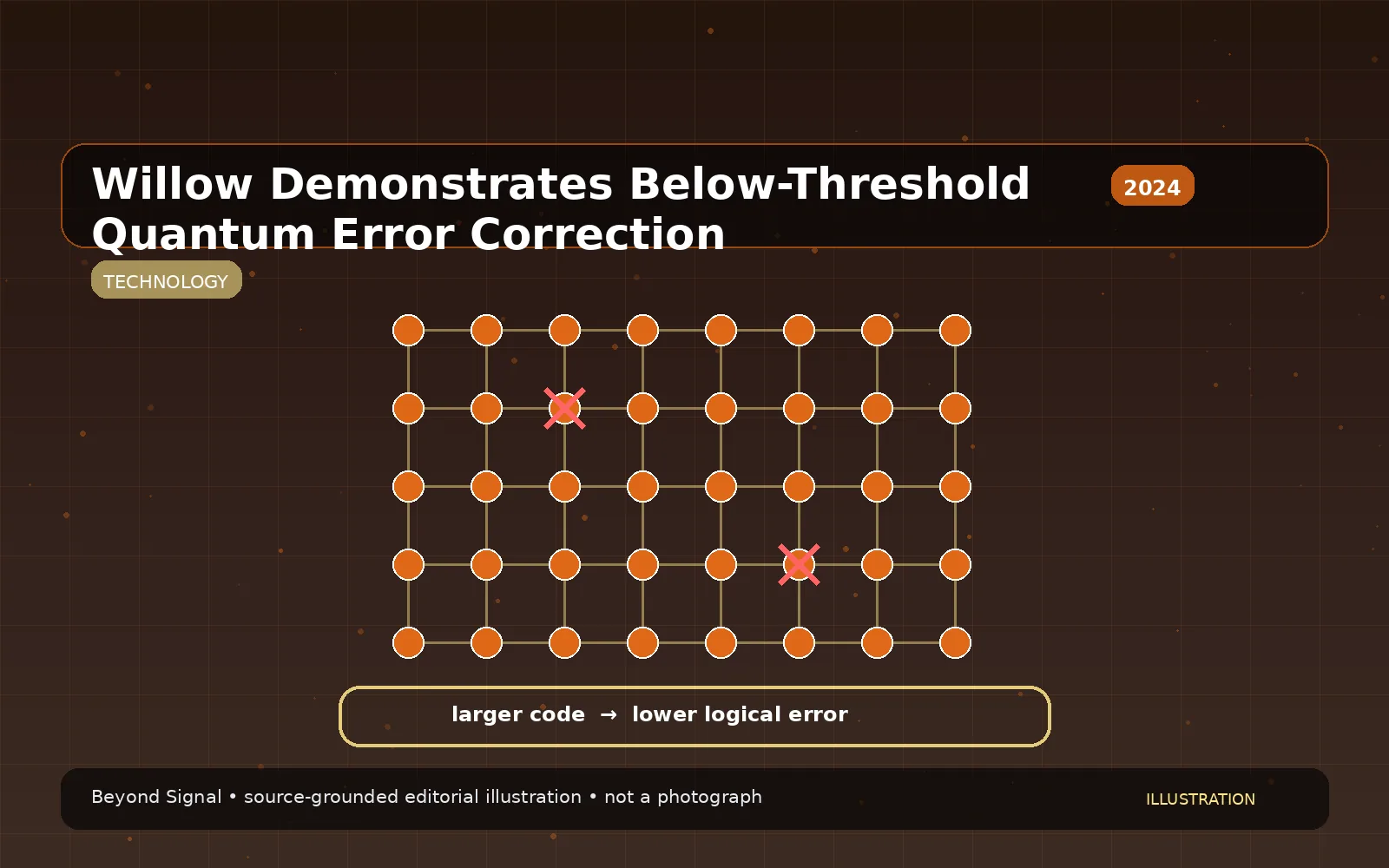 Illustration🤖 Technology
Willow Demonstrates Below-Threshold Quantum Error Correction
Google's Willow processor demonstrated below-threshold surface-code error correction: as researchers increased the size of encoded logical qubits, the logical error rate fell rather than rose. The experiment was an important scaling result for fault-tolerant quantum computing, although it did not produce a general-purpose error-corrected computer.
Read more →