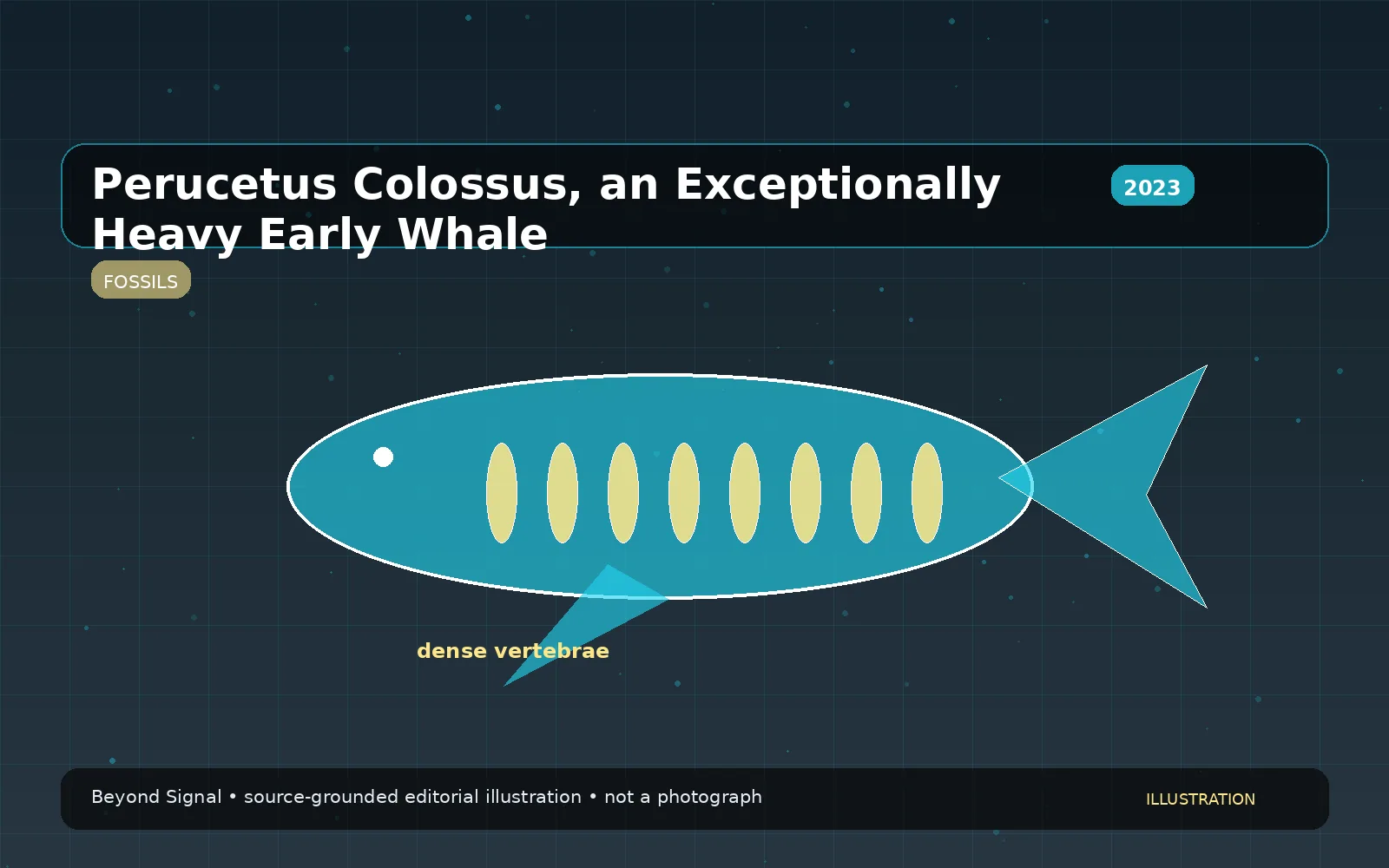
 Illustration — not a photo of the discovery
Perucetus Colossus, an Exceptionally Heavy Early Whale
A partial skeleton from Peru's Eocene Pisco Basin revealed Perucetus colossus, an early whale with extraordinarily thick and dense vertebrae and ribs. Initial mass estimates suggested an animal of exceptional weight, although later analyses have debated how much soft tissue should be reconstructed around the unusual bones.
The story
Why scientists were there
The Pisco Basin preserves a rich sequence of marine sediments and early whale fossils. Field teams excavated the specimen over multiple campaigns after recognizing giant vertebrae weathering from rocks deposited roughly 39 million years ago.
How they found it
Researchers described 13 vertebrae, four ribs, and part of the pelvis. CT scans and measurements showed extensive bone thickening and internal densification, adaptations often associated with buoyancy control in shallow-water aquatic mammals.
What makes it unique
Perucetus expands the known range of whale body plans and demonstrates that extreme skeletal mass evolved well before modern baleen whales. Because the skeleton is incomplete, its total body length and mass remain model-dependent rather than settled records.
Gallery
Where it was found
Pisco Basin, Ica Valley, Peru
Tags
Related discoveries
 Illustration🦕 Dinosaurs & Fossils
Mosura Fentoni, a Three-Eyed Cambrian Predator
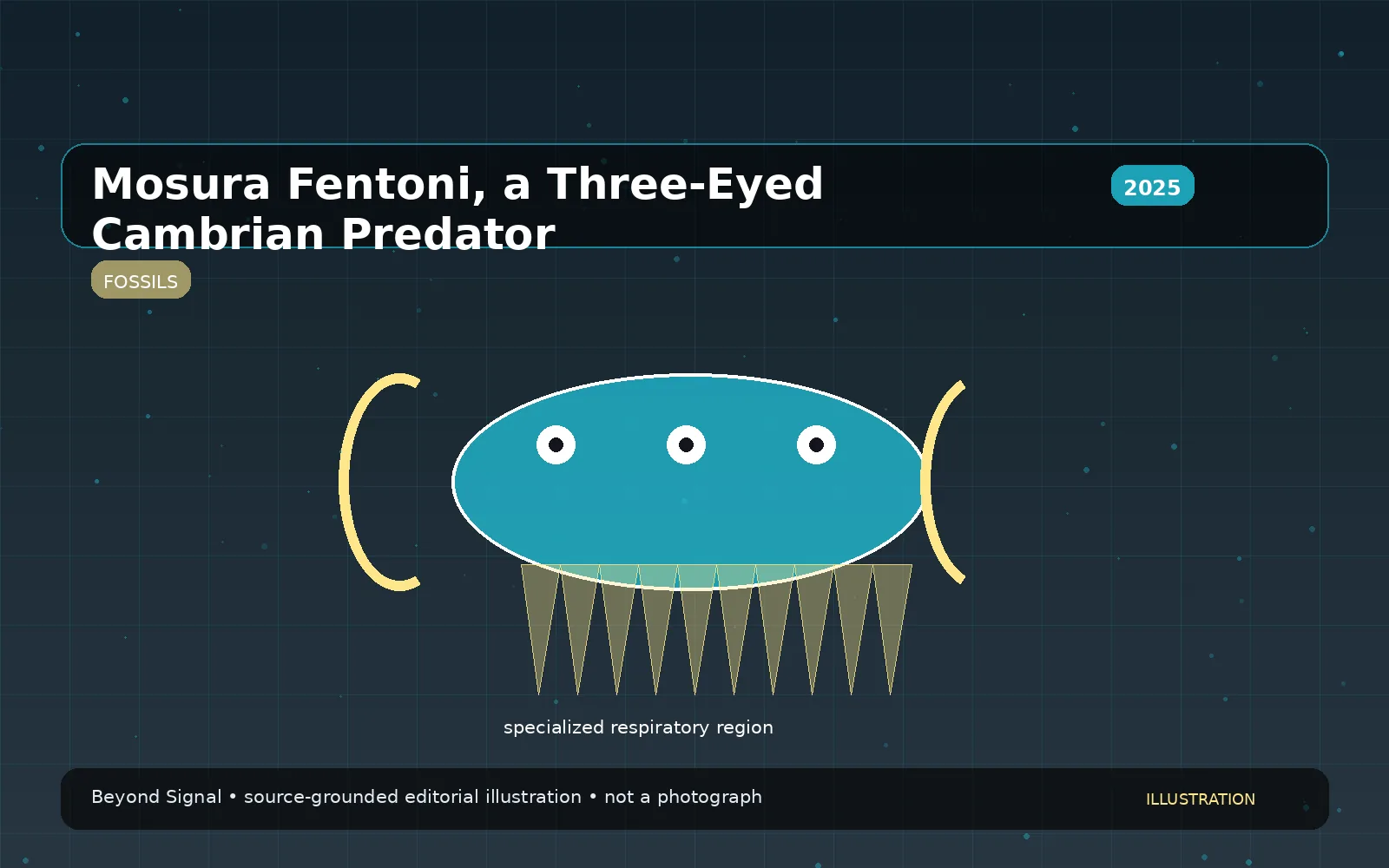
More than 60 Burgess Shale fossils revealed Mosura fentoni, a roughly six-centimetre radiodont with three eyes, grasping frontal appendages, and a body divided into a broad swimming region and a specialized rear section carrying respiratory structures. The anatomy expands the known diversity of early arthropod relatives.
Read more → Illustration🦕 Dinosaurs & Fossils
Vasuki Indicus, a Giant Eocene Snake
Twenty-seven associated vertebrae from western India were described as Vasuki indicus, a giant madtsoiid snake that lived about 47 million years ago. Scaling from the vertebrae produced a broad estimated length of roughly 11 to 15 metres, placing it among the largest snakes known but leaving substantial uncertainty.
Read more → Illustration🦕 Dinosaurs & Fossils
A Deep-Sea Whale Necropolis in the Diamantina Zone
Dives in the Diamantina Zone recorded five modern whale-fall communities and 476 fossil cetacean sites over 1,200 kilometres of seafloor, documenting a whale-fall archive that extends back at least 5.3 million years.
Read more → Illustration🦕 Dinosaurs & Fossils
Pebanista yacuruna, the Largest Known River Dolphin
A 16-million-year-old skull from Peru established Pebanista yacuruna as a new, 3–3.5-metre river dolphin and the closest known fossil relative of living South Asian river dolphins.
Read more →