
 Illustration — not a photo of the discovery
A Deep-Sea Whale Necropolis in the Diamantina Zone
Dives in the Diamantina Zone recorded five modern whale-fall communities and 476 fossil cetacean sites over 1,200 kilometres of seafloor, documenting a whale-fall archive that extends back at least 5.3 million years.
The story
Why scientists were there
Whale falls create food-rich islands on otherwise resource-poor seafloor, but their fossil record has been sparse. This survey characterizes one exceptional zone; estimates of the total number of carcasses and the role of the zone as a regional biological corridor are extrapolations that need further mapping and sampling.
How they found it
An IDSSE-led expedition made 32 crewed Fendouzhe dives along the Diamantina Zone, documenting active carcasses and fossil sites at 4,616–7,001 metres. The team examined associated animals and bones, and used strontium-isotope dating to constrain the age of the longer fossil record.
What makes it unique
The direct observations are the five active whale falls, 476 recorded fossil sites, their depths, and associated fauna. The isotopic evidence supports repeated whale falls since at least 5.3 million years ago; broader claims about carbon storage, carcass abundance, and ecosystem connectivity remain model-based extrapolations.
Gallery
Where it was found
Diamantina Zone, southeastern Indian Ocean
Tags
Related discoveries
 Illustration🪸 Ocean Discoveries
Chemosynthetic Communities Found Across Hadal Trenches
Crewed dives documented extensive communities of tube worms and bivalves sustained by methane- and hydrogen-sulfide-rich fluids from 5,800 to 9,533 metres in the Kuril–Kamchatka and western Aleutian trenches.
Read more →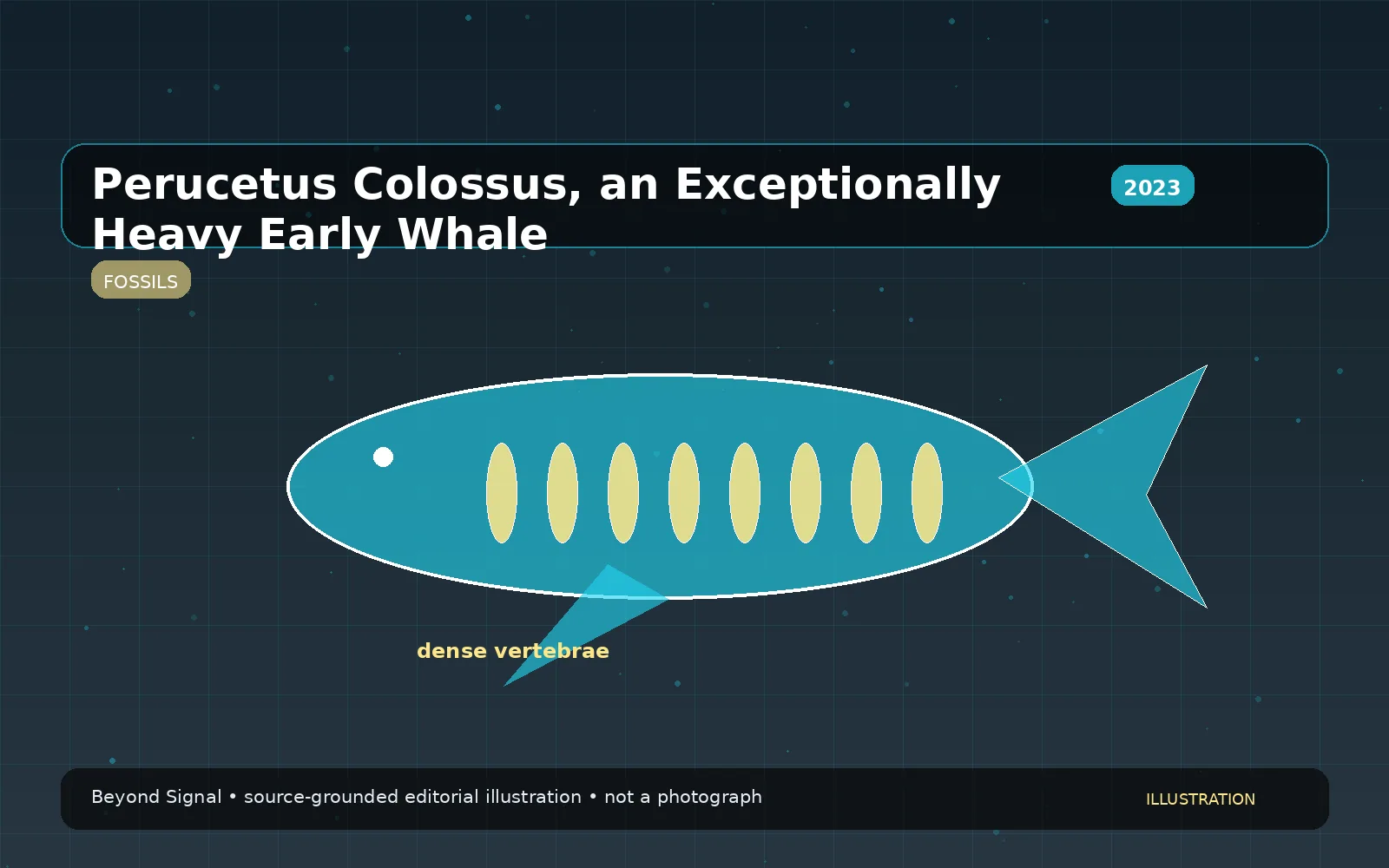 Illustration🦕 Dinosaurs & Fossils
Perucetus Colossus, an Exceptionally Heavy Early Whale
A partial skeleton from Peru's Eocene Pisco Basin revealed Perucetus colossus, an early whale with extraordinarily thick and dense vertebrae and ribs. Initial mass estimates suggested an animal of exceptional weight, although later analyses have debated how much soft tissue should be reconstructed around the unusual bones.
Read more →