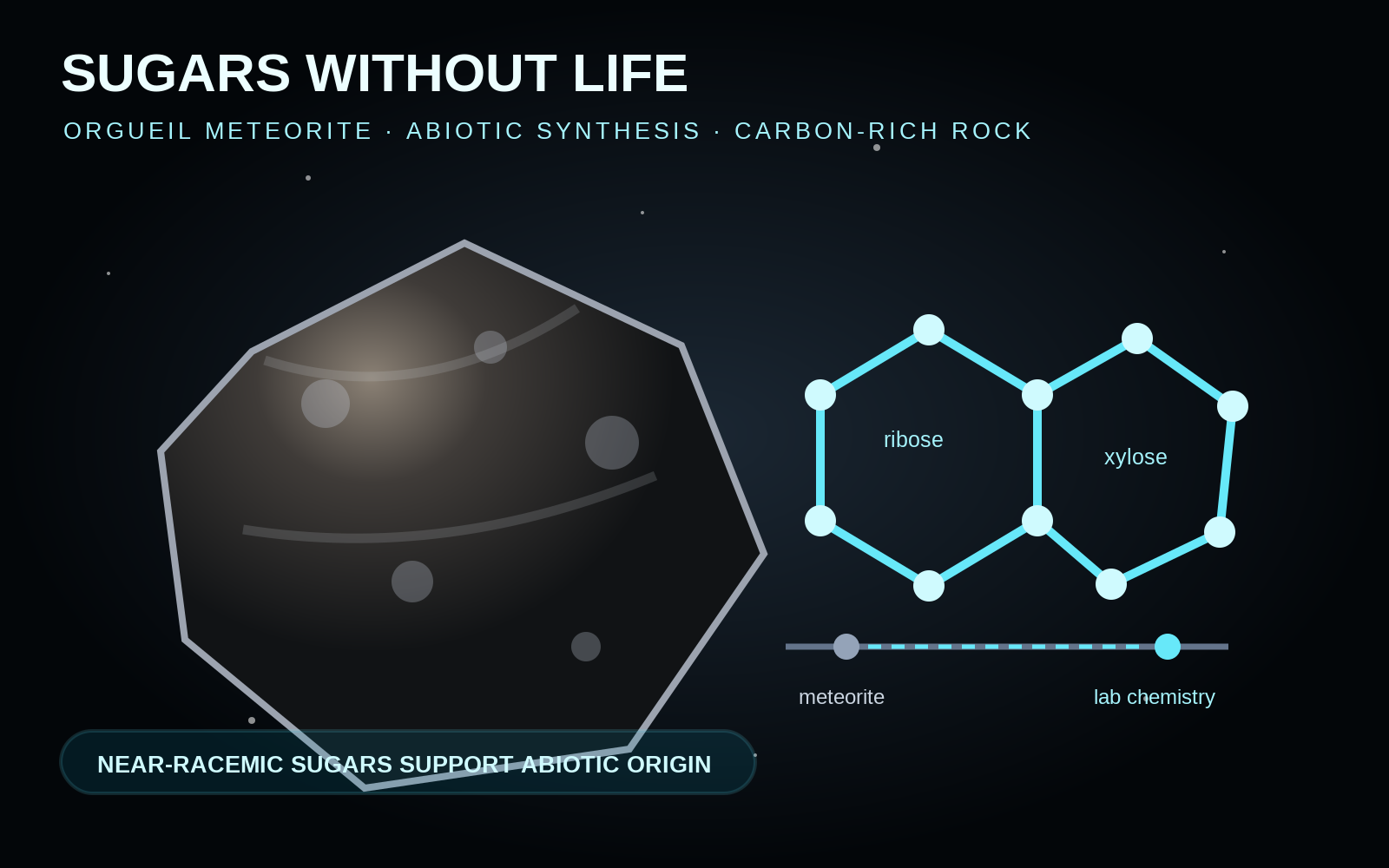
 Illustration — not a photo of the discovery
Abiotic Sugars in the Orgueil Meteorite
Chiral analysis of an Orgueil meteorite sample detected ribose, arabinose, xylose, lyxose, and ribulose, with several near-racemic mixtures supporting abiotic extraterrestrial formation rather than ordinary biological contamination.
The story
Why scientists were there
Sugars are central to nucleic acids and metabolism yet have been much harder to verify in meteorites than amino acids or nucleobases. The old fall and low concentrations keep contamination a concern, and isotopic tests were not feasible for every compound; analyses of pristine returned samples and independent laboratories are needed to generalize the inventory.
How they found it
Researchers extracted soluble organics, chemically derivatized them, and used enantioselective gas chromatography and mass spectrometry to separate mirror-image forms. Procedural blanks, recovery experiments, amino-acid measurements, and the presence of non-biological or near-racemic enantiomer ratios supported an indigenous abiotic component.
What makes it unique
The simultaneous sugar-and-amino-acid analysis found that corrected pentose abundances can rival some C4–C5 amino-acid enantiomers, challenging the view that meteoritic sugars are intrinsically scarce. It shows that prebiotic ingredients could be delivered, not that life or complete RNA existed inside the meteorite.
Gallery
Where it was found
Orgueil meteorite fall site, Tarn-et-Garonne
Tags
Related discoveries
 Illustration🌌 Space
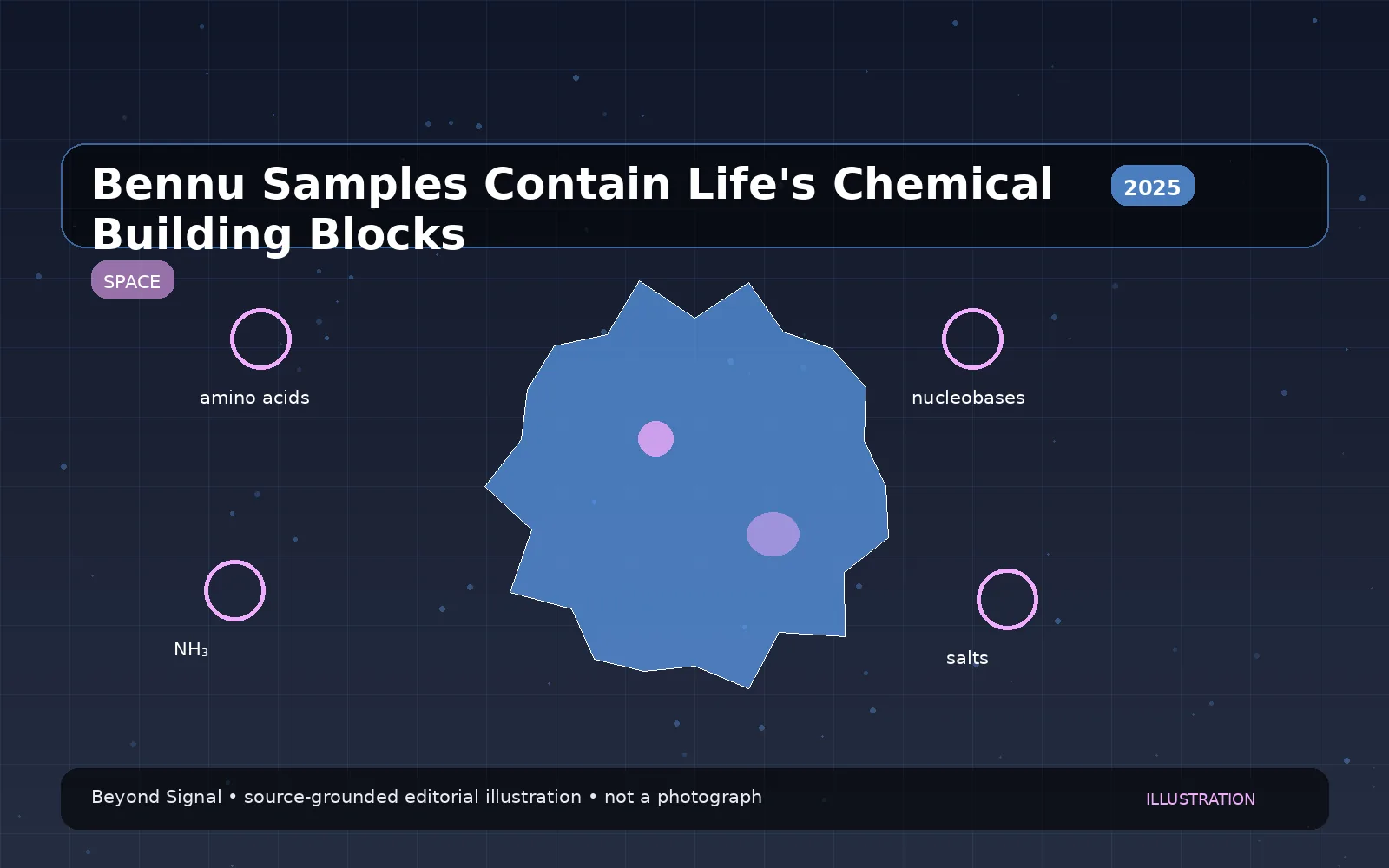
Bennu Samples Contain Life's Chemical Building Blocks
Laboratory analyses of pristine asteroid Bennu material returned by OSIRIS-REx found abundant ammonia, nitrogen-rich organic matter, 14 of the 20 amino acids used by terrestrial life, and all five nucleobases used in DNA and RNA. The chemistry shows that life's ingredients were widespread, not that life existed on Bennu.
Read more →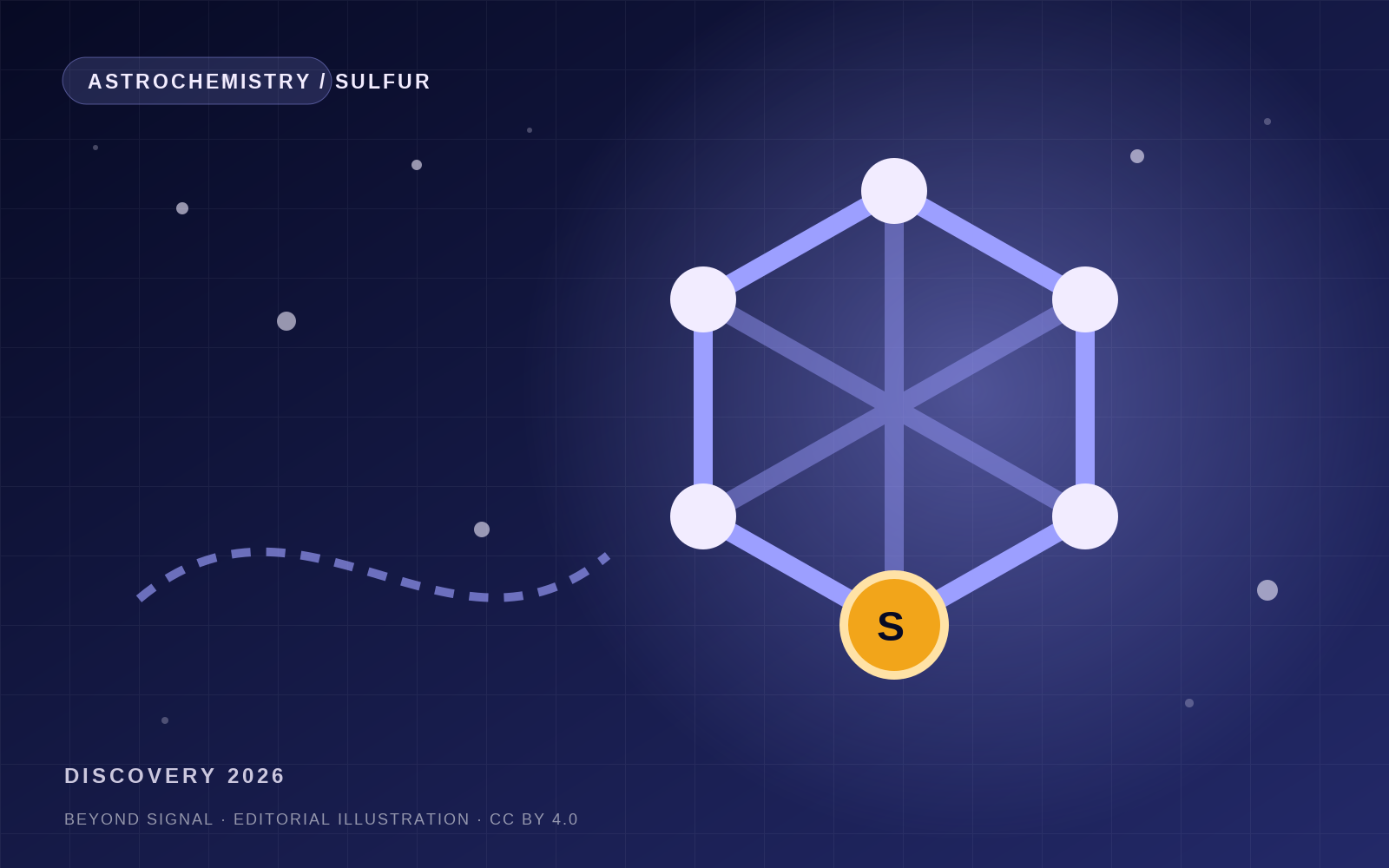 Illustration🌌 Space
The Largest Interstellar Sulfur-Bearing Molecule Yet
Radio spectra revealed 2,5-cyclohexadiene-1-thione in a Galactic-centre molecular cloud, the largest sulfur-bearing molecule yet identified in interstellar space.
Read more →