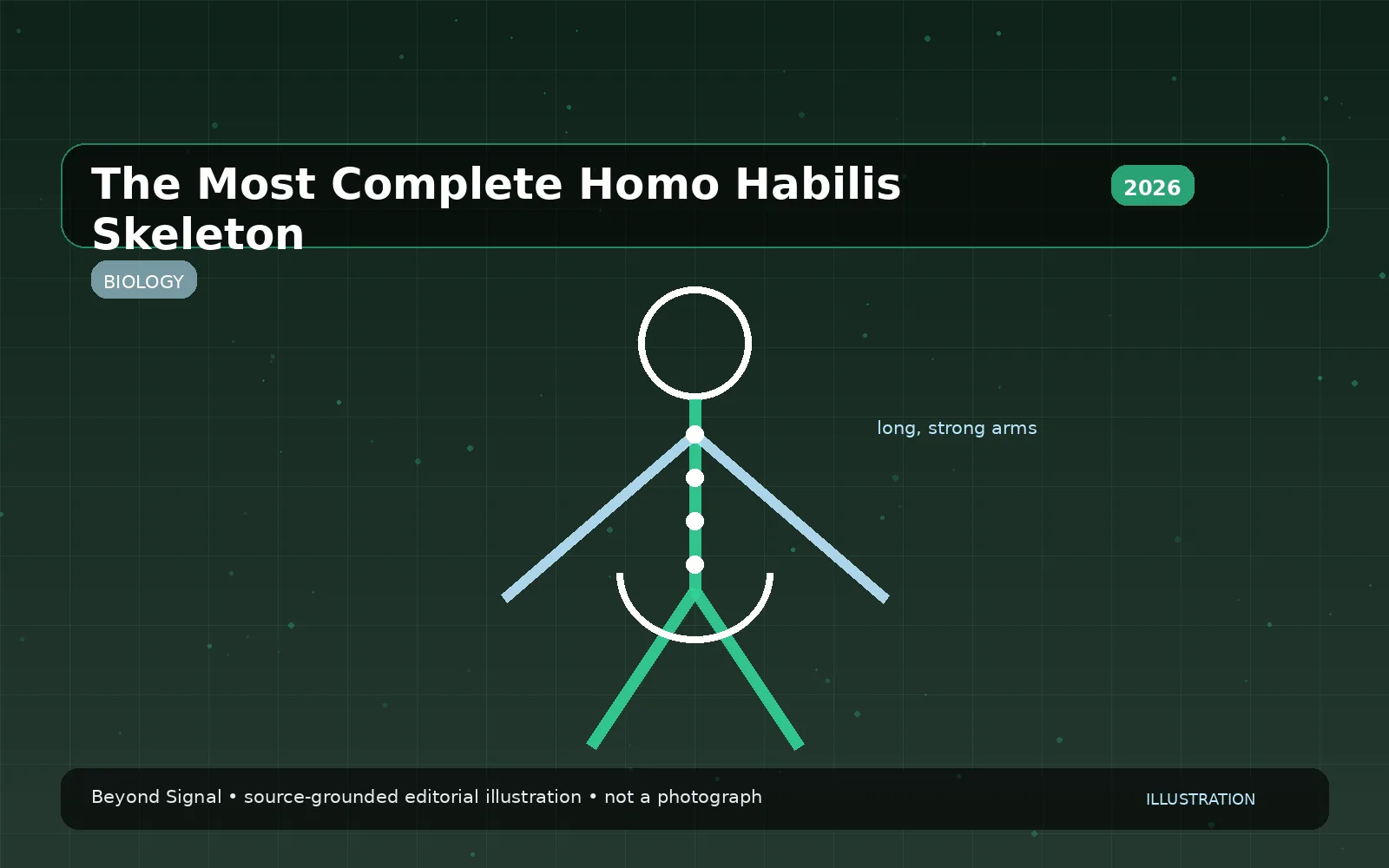
 Illustration — not a photo of the discovery
The Most Complete Homo Habilis Skeleton
KNM-ER 64061, a partial skeleton dated to about 2.02–2.06 million years ago, was described as the most complete Homo habilis skeleton yet recognized. Its associated teeth, shoulder, arm, spine, pelvis, and leg fragments reveal a small-bodied early human with long, powerful arms and a mosaic of primitive and derived traits.
The story
Why scientists were there
Homo habilis is known mainly from skulls, jaws, and isolated bones, leaving its body proportions poorly constrained. Excavations near Ileret recovered teeth and postcranial fragments from closely associated sediments, prompting years of work to establish whether they belonged to one individual.
How they found it
Researchers used CT imaging, sedimentary context, mineral patterns, anatomical matching, and geochronology to associate the fragments. They then compared limb proportions and joint anatomy with australopiths, Homo erectus, and other early Homo specimens.
What makes it unique
The skeleton supports a major anatomical gap between H. habilis and the taller, more human-proportioned H. erectus. Its long forearms and robust upper limbs retain australopith-like features, complicating simple models in which early Homo rapidly acquired a modern body.
Gallery
Where it was found
Ileret, Koobi Fora Formation, northern Kenya
Tags
Related discoveries
 Illustration🧬 Biology
Greenland's Two-Million-Year-Old Environmental DNA
Environmental DNA recovered from mineral-rich sediments at Greenland's Kap København Formation reconstructed a roughly two-million-year-old ecosystem containing mastodons, reindeer, hares, geese, plants, and marine organisms. The fragmented DNA extended the known survival limit of ancient genetic material by about one million years.
Read more → Illustration🏺 Archaeology
Valeriana, a Maya City Revealed in Old LiDAR Data
Archaeologists reanalysed airborne LiDAR collected for an environmental survey and identified a dense Maya urban landscape in eastern Campeche, including the newly named centre Valeriana. Across 122 square kilometres, the data revealed 6,479 structures, ceremonial complexes, plazas, reservoirs, causeways, and residential zones.
Read more →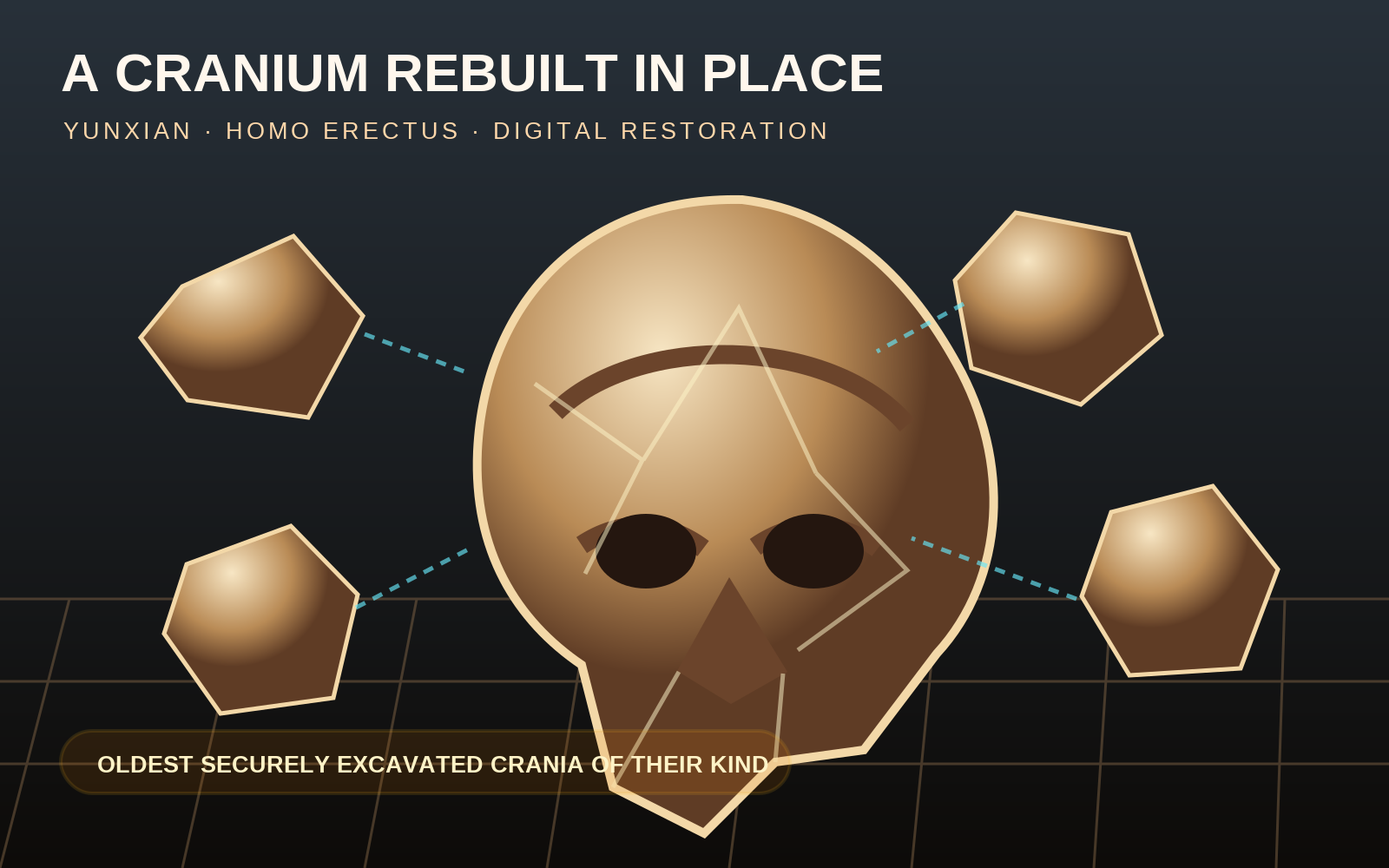 Illustration🏺 Archaeology
Yunxian's 1.77-Million-Year-Old Homo Erectus Crania
Cosmogenic-nuclide burial dating placed the fossil-bearing Yunxian sediments at 1.77 ± 0.08 million years old, making the three crania the oldest Homo erectus fossils securely recovered in place in eastern Asia.
Read more →