 Illustration — not a photo of the discovery
773,000-Year-Old Hominins from Casablanca
Fossils from Thomas Quarry I in Casablanca were tightly dated to about 773,000 years ago and show a mix of traits that the authors place near the root of the Homo sapiens lineage.
The story
Why scientists were there
The common ancestry of modern humans, Neanderthals, and Denisovans is poorly represented by fossils, especially in Africa. A precise age improves the comparison, but morphology alone cannot identify a direct ancestor or replace genetic evidence; the proposed lineage placement must be tested against additional fossils and analyses.
How they found it
Researchers excavated mandibles and other hominin remains from Grotte à Hominidés at Thomas Quarry I. They used a high-resolution magnetostratigraphic sequence, including the Matuyama–Brunhes magnetic reversal, alongside faunal context to date the fossil-bearing deposits to about 773,000 years ago.
What makes it unique
The direct evidence is the hominin anatomy and unusually well-resolved age of the deposits. The description of the fossils as an African population basal to the Homo sapiens lineage follows comparative morphology and phylogenetic analysis; because that ancestry interpretation remains indirect, this entry is marked preliminary.
Gallery
Where it was found
Thomas Quarry I, Casablanca
Tags
Related discoveries
 Illustration🏺 Archaeology
Early Homo and an Unnamed Australopithecus at Ledi-Geraru
Thirteen teeth from Ledi-Geraru date to 2.6–2.8 million years ago and support the coexistence there of early Homo and a previously unrecognized Australopithecus form.
Read more →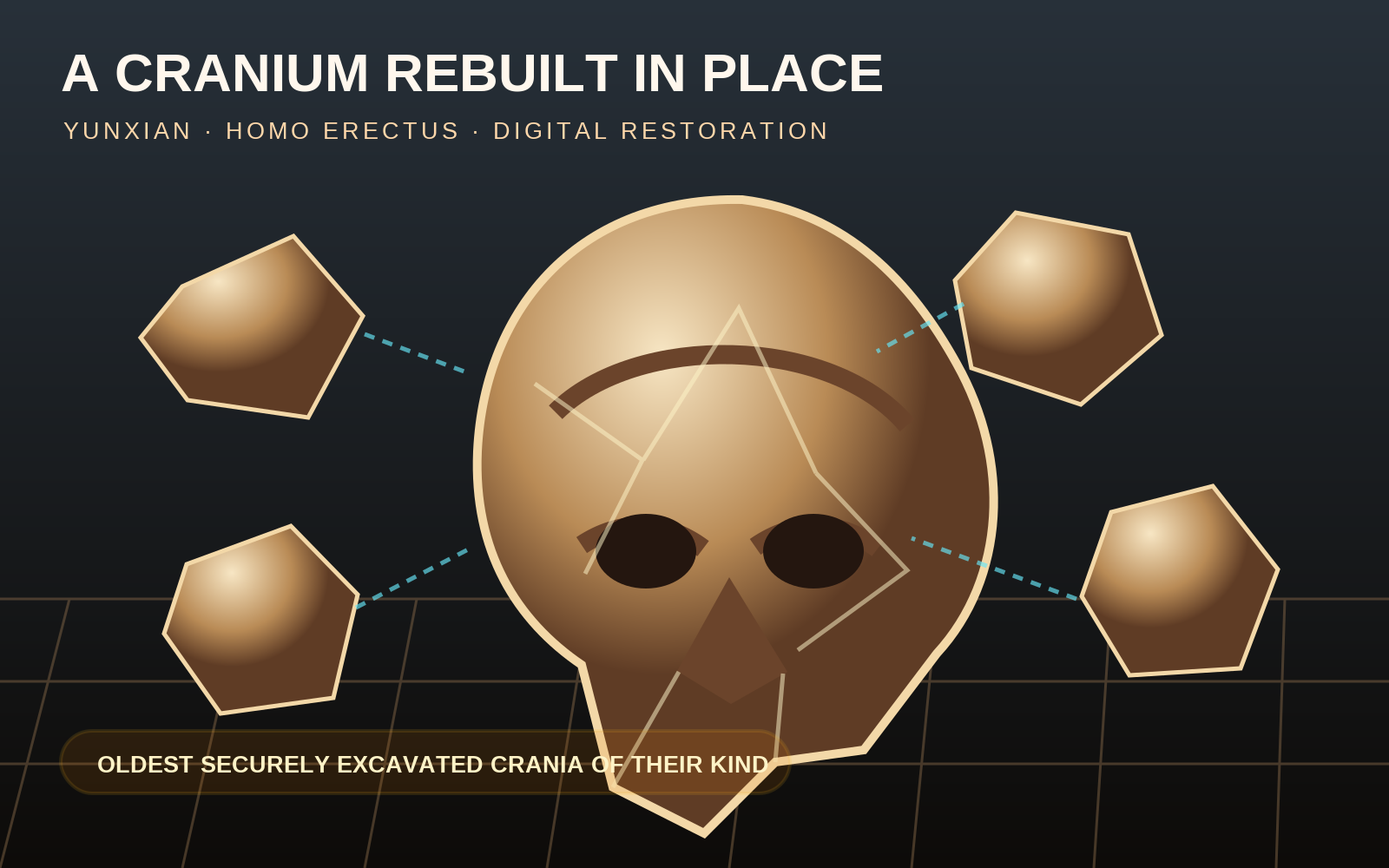 Illustration🏺 Archaeology
Yunxian's 1.77-Million-Year-Old Homo Erectus Crania
Cosmogenic-nuclide burial dating placed the fossil-bearing Yunxian sediments at 1.77 ± 0.08 million years old, making the three crania the oldest Homo erectus fossils securely recovered in place in eastern Asia.
Read more →