
Topic hub
Human origins discoveries in Archaeology
This topic hub follows 4 catalogued human origins discoveries across The Nucleon directory. Each entry connects the finding to its location, discovering institution, scientific source, and related work.
What this topic includes
In archaeology, human origins can describe a change in what scientists observe, classify, or measure. The entries below are grouped by their documented subject rather than by headline popularity, making it easier to compare discoveries from different years and places.
Key discoveries
 Illustration🏺 Archaeology
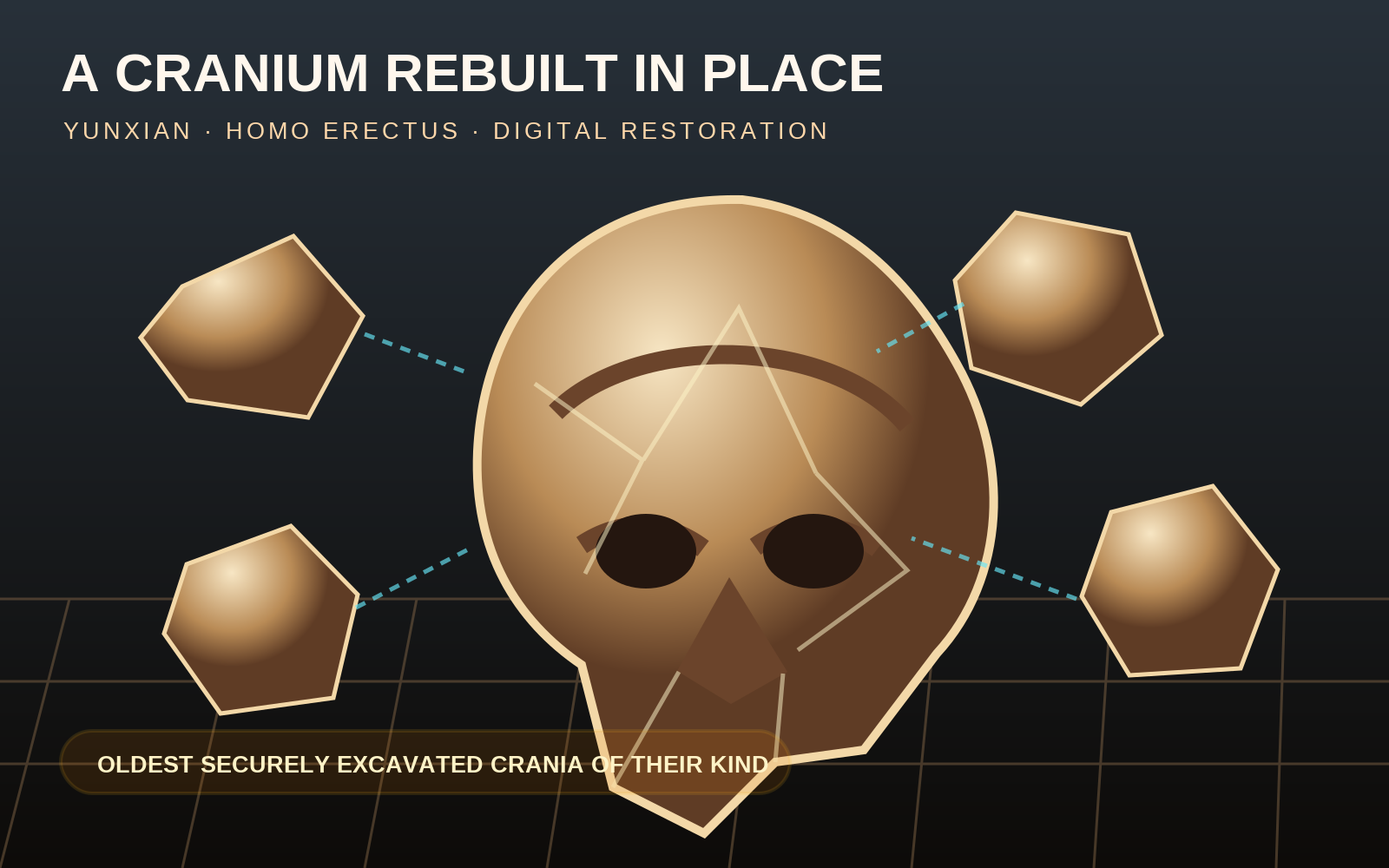
Yunxian's 1.77-Million-Year-Old Homo Erectus Crania
Cosmogenic-nuclide burial dating placed the fossil-bearing Yunxian sediments at 1.77 ± 0.08 million years old, making the three crania the oldest Homo erectus fossils securely recovered in place in eastern Asia.
Read more → Illustration🏺 Archaeology
773,000-Year-Old Hominins from Casablanca
Fossils from Thomas Quarry I in Casablanca were tightly dated to about 773,000 years ago and show a mix of traits that the authors place near the root of the Homo sapiens lineage.
Read more → Illustration🏺 Archaeology
Early Homo and an Unnamed Australopithecus at Ledi-Geraru
Thirteen teeth from Ledi-Geraru date to 2.6–2.8 million years ago and support the coexistence there of early Homo and a previously unrecognized Australopithecus form.
Read more → Illustration🏺 Archaeology
Modern Humans at Grotte Mandrin 54,000 Years Ago
Teeth, stratigraphy, and stone-tool layers at Grotte Mandrin indicate a short Homo sapiens presence in southeastern France about 54,000 years ago, followed by renewed Neanderthal occupation.
Read more →Questions readers ask
How many human origins discoveries are catalogued?
The Nucleon currently lists 4. The total changes as new source-checked entries are added.
Where have these discoveries been made?
They span 4 countries or international research settings, from Xuetangliangzi site, Yunyang District, Hubei to other locations in the catalogue.
How should these entries be compared?
Start with the primary source and the discovery method. A visually striking result and a formal species or particle identification do not always use the same standard of evidence.