
 Illustration — not a photo of the discovery
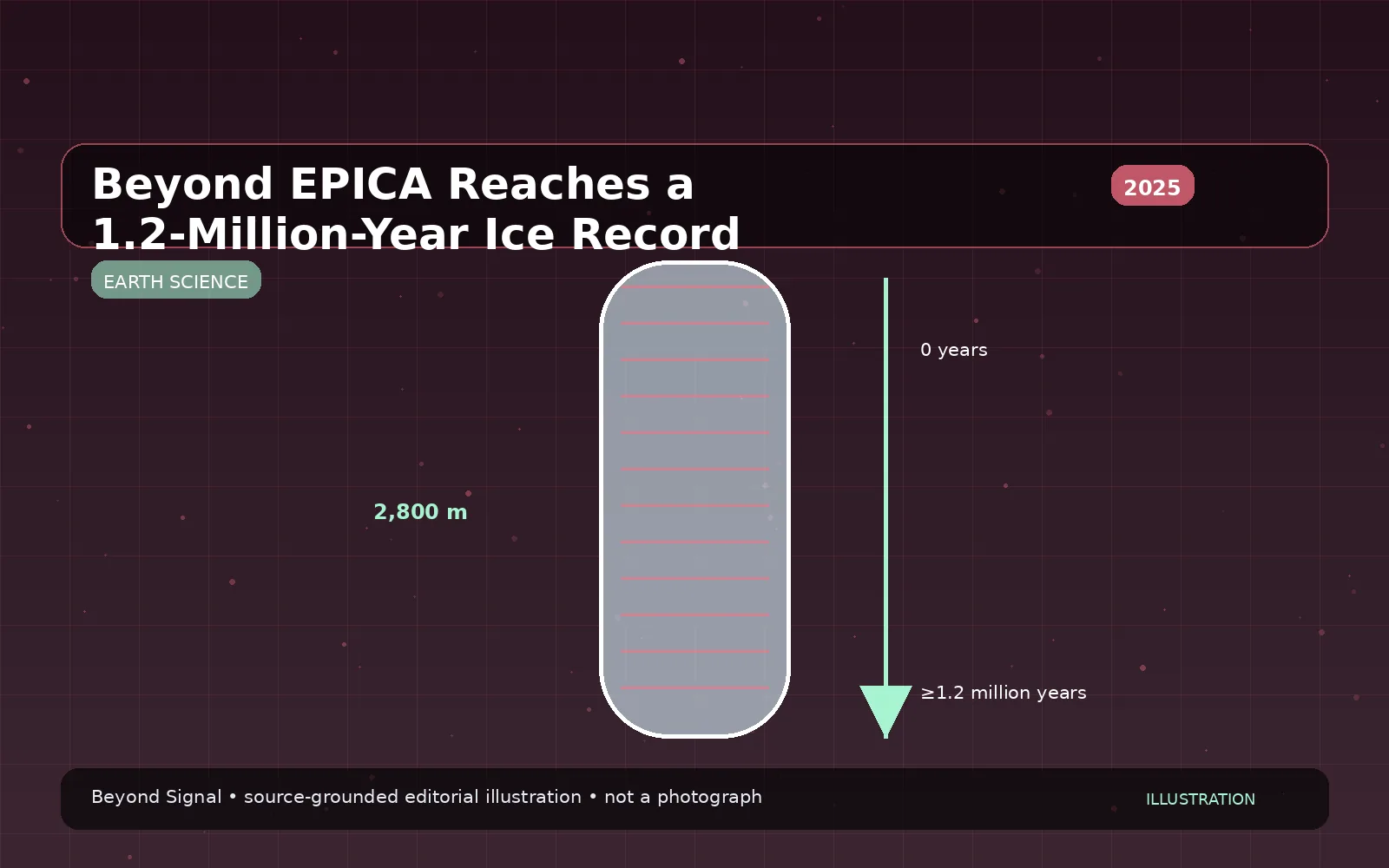
Beyond EPICA Reaches a 1.2-Million-Year Ice Record
The Beyond EPICA team completed drilling to bedrock at Little Dome C, recovering a 2,800-metre Antarctic ice core expected to preserve a continuous climate record reaching at least 1.2 million years. The core targets the interval when glacial cycles shifted from roughly 41,000-year to 100,000-year rhythms.
The story
Why scientists were there
Scientists selected Little Dome C after radar surveys and ice-flow modelling identified thick, cold, slowly moving ice likely to preserve very old layers without excessive folding or melting near the bed.
How they found it
Across several Antarctic field seasons, crews drilled cylindrical sections, logged their depth and physical properties, and transported them under strict cold-chain conditions to European laboratories. Gas bubbles, water isotopes, dust, and chemical impurities will be analysed as the sections are processed.
What makes it unique
The core potentially doubles the reach of the previous continuous Antarctic ice record. Its scientific value lies in the measurements still to come: direct samples of ancient atmosphere that may explain the Mid-Pleistocene Transition, rather than a completed climate reconstruction at the moment drilling ended.
Gallery
Where it was found
Little Dome C, East Antarctica
Tags
Related discoveries
 Illustration🧬 Biology
Greenland's Two-Million-Year-Old Environmental DNA
Environmental DNA recovered from mineral-rich sediments at Greenland's Kap København Formation reconstructed a roughly two-million-year-old ecosystem containing mastodons, reindeer, hares, geese, plants, and marine organisms. The fragmented DNA extended the known survival limit of ancient genetic material by about one million years.
Read more →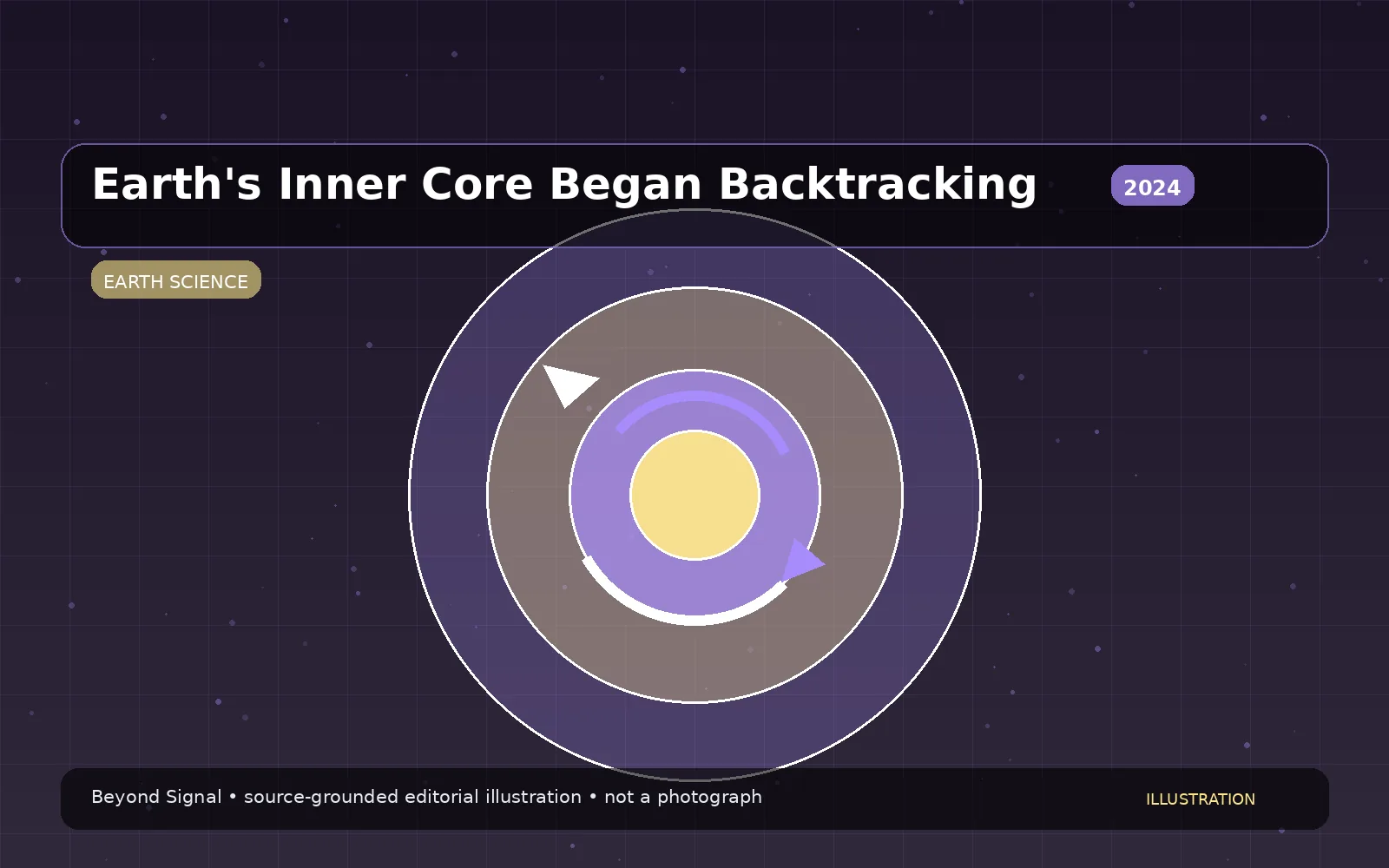 Illustration🌋 Earth Science
Earth's Inner Core Began Backtracking
Seismic waveforms from repeating earthquakes indicated that Earth's solid inner core had slowed and was moving backward relative to the mantle after about 2010. The result extended evidence that inner-core rotation oscillates over decades rather than maintaining a constant faster or slower spin.
Read more →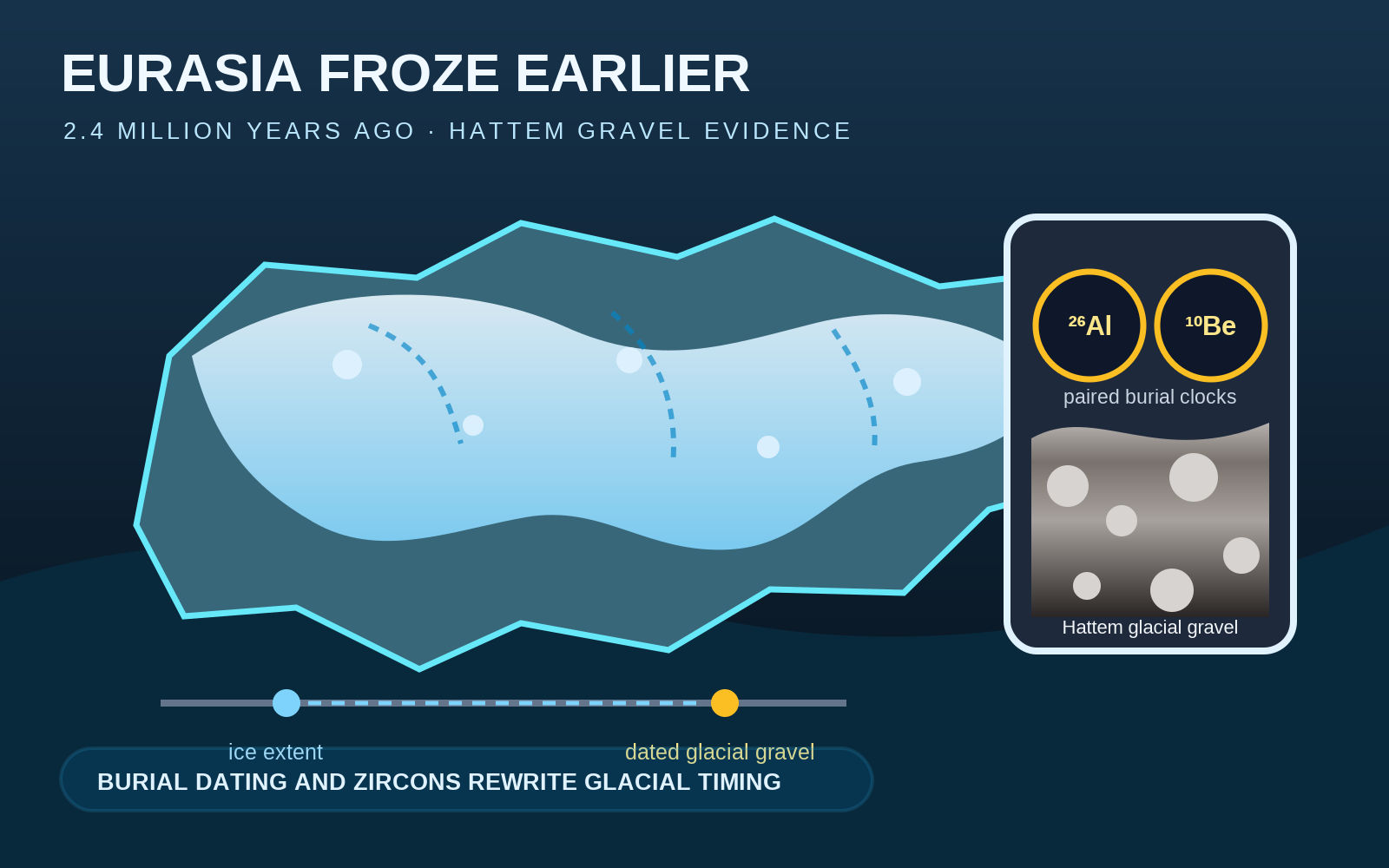 Illustration🌋 Earth Science
A Continental-Scale Eurasian Ice Sheet 2.4 Million Years Ago
Burial dating and zircon provenance showed that Fennoscandian glacial gravels reached the Netherlands about 2.41 million years ago, documenting continental-scale Eurasian ice more than a million years earlier than the classic mid-Pleistocene expansion.
Read more → Illustration🧬 Biology
Woolly Rhino Genome Recovered from a Wolf's Stomach
Scientists reconstructed a high-quality woolly rhinoceros genome from undigested meat preserved in the stomach of a roughly 14,400-year-old wolf pup. Comparisons with older rhino genomes found no prolonged loss of diversity or rising inbreeding before extinction, supporting a comparatively rapid population collapse.
Read more → Illustration🌋 Earth Science
Glacier Retreat Exposed Thousands of Kilometres of New Arctic Coastline
A Northern Hemisphere survey mapped 2,466 ± 0.8 kilometres of coastline exposed by retreating marine-terminating glaciers between 2000 and 2020, with 66% of the total in Greenland.
Read more → Illustration🏺 Archaeology
Valeriana, a Maya City Revealed in Old LiDAR Data
Archaeologists reanalysed airborne LiDAR collected for an environmental survey and identified a dense Maya urban landscape in eastern Campeche, including the newly named centre Valeriana. Across 122 square kilometres, the data revealed 6,479 structures, ceremonial complexes, plazas, reservoirs, causeways, and residential zones.
Read more →