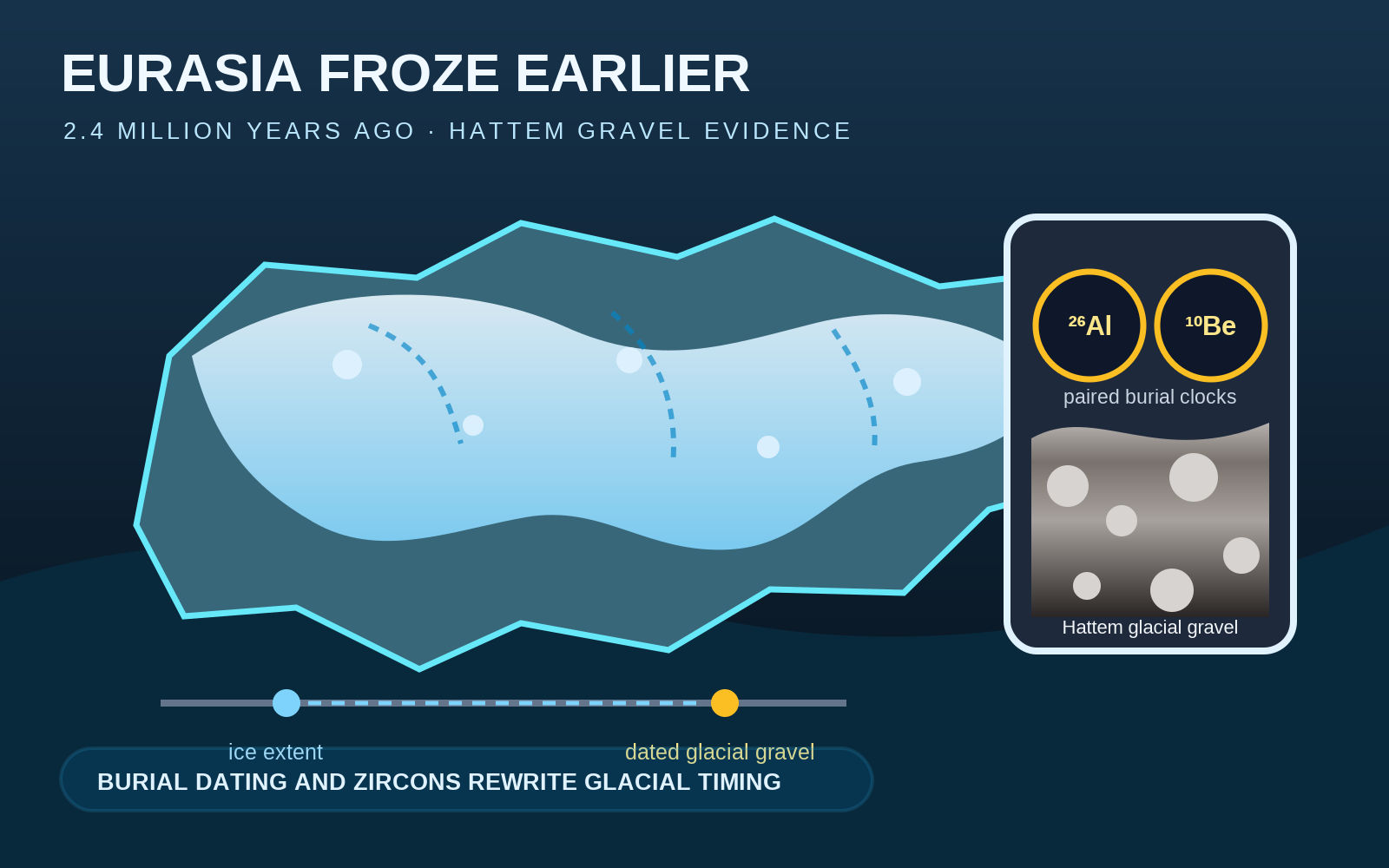
 Illustration — not a photo of the discovery
A Continental-Scale Eurasian Ice Sheet 2.4 Million Years Ago
Burial dating and zircon provenance showed that Fennoscandian glacial gravels reached the Netherlands about 2.41 million years ago, documenting continental-scale Eurasian ice more than a million years earlier than the classic mid-Pleistocene expansion.
The story
Why scientists were there
Terrestrial evidence had not matched marine records that implied large Northern Hemisphere ice volumes early in the Pleistocene. The deposit narrows that mismatch, but its age has asymmetric uncertainty and one site cannot map the entire ice margin; additional dated glacial units are needed to reconstruct extent, duration, and climate forcing.
How they found it
Researchers applied paired aluminum-26 and beryllium-10 burial dating to glacially transported gravels in the Hattem Bed Complex and used detrital-zircon age fingerprints to trace their source to Fennoscandia. The combined evidence gave a first trans-Baltic advance at 2.41 million years ago and a second advance near 1.72 million years ago.
What makes it unique
The Dutch gravels provide the earliest directly dated evidence that a Eurasian ice sheet crossed the Baltic basin on a continental scale. The paper was published as an accepted, unedited early-access version, so wording and presentation may change even though peer review and the reported measurements are complete.
Gallery
Where it was found
Hattem Bed Complex, eastern Netherlands
Tags
Related discoveries
 Illustration🌋 Earth Science
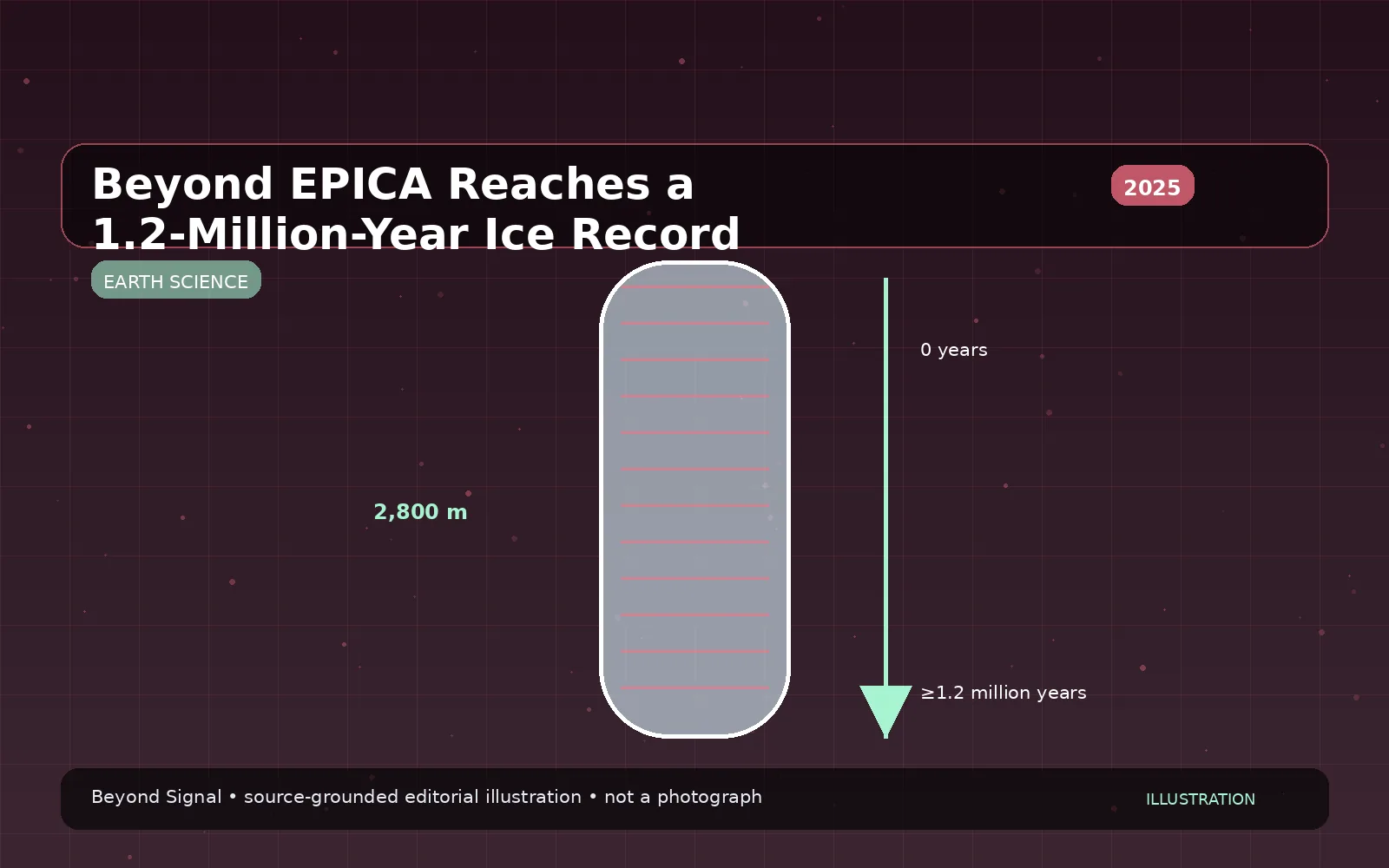
Beyond EPICA Reaches a 1.2-Million-Year Ice Record
The Beyond EPICA team completed drilling to bedrock at Little Dome C, recovering a 2,800-metre Antarctic ice core expected to preserve a continuous climate record reaching at least 1.2 million years. The core targets the interval when glacial cycles shifted from roughly 41,000-year to 100,000-year rhythms.
Read more →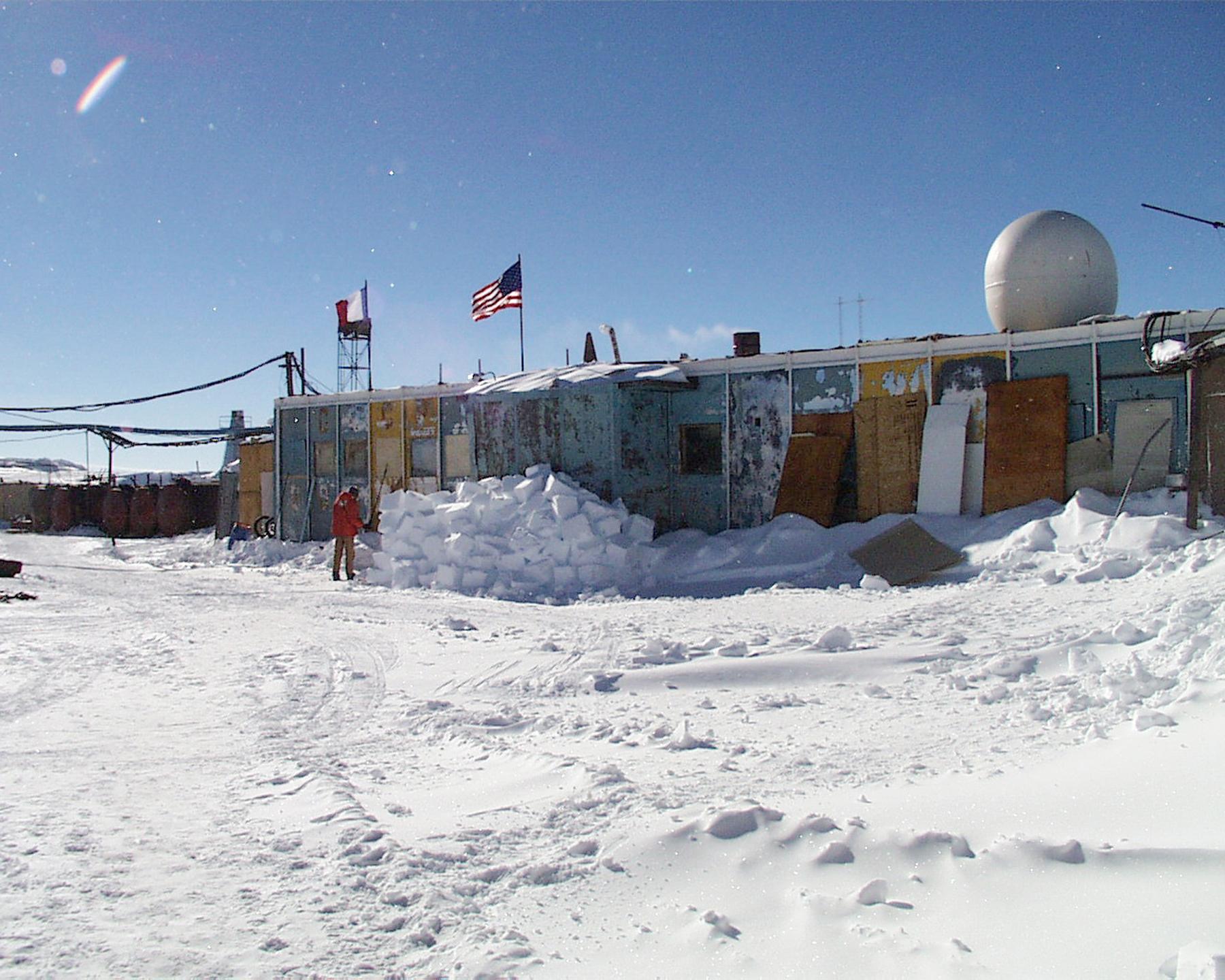 🌋 Earth Science
Reaching Subglacial Lake Vostok
Drillers reached the surface of a vast lake sealed beneath ~3.8 km of Antarctic ice and isolated from the surface for millions of years.
Read more →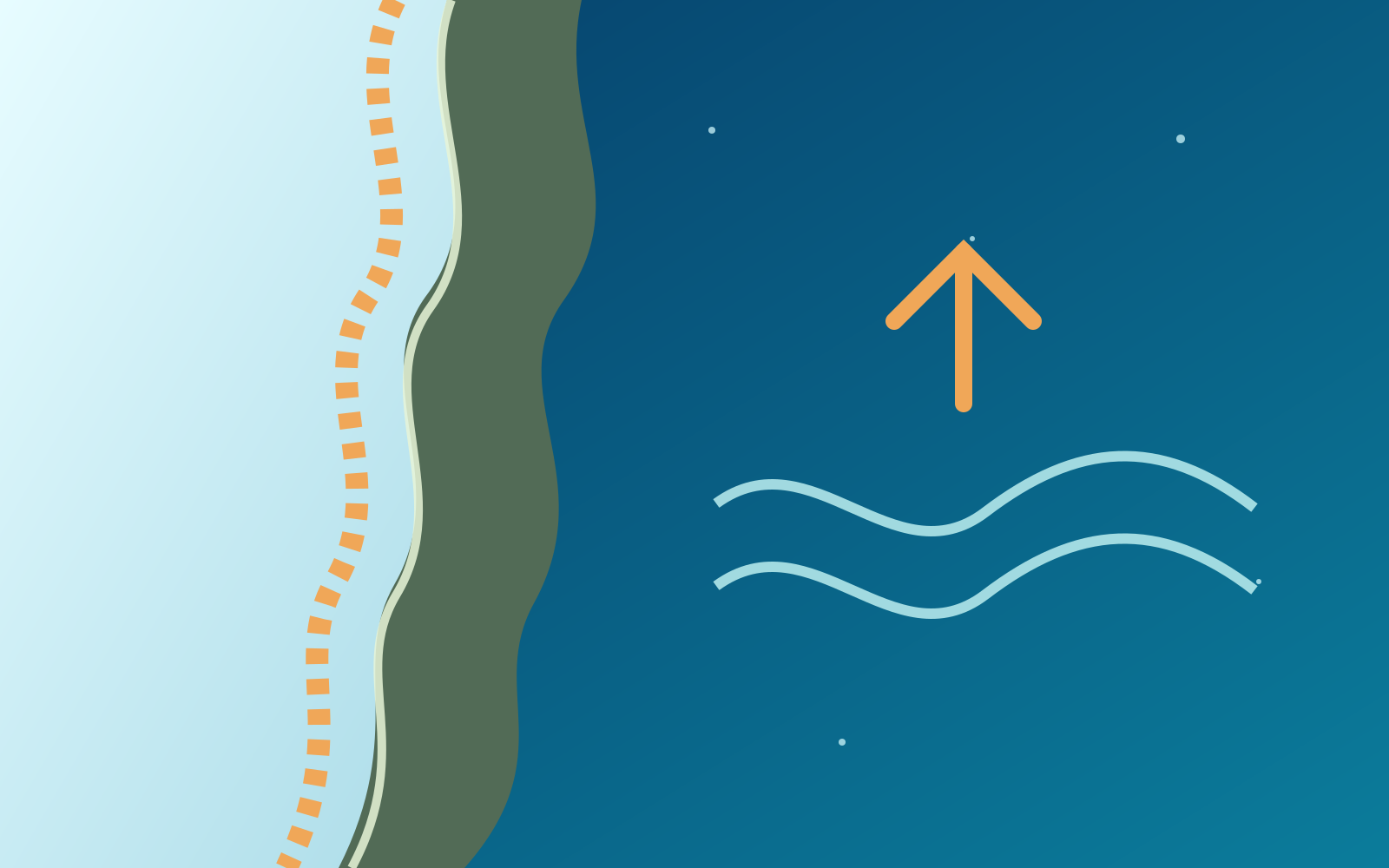 Illustration🌋 Earth Science
Glacier Retreat Exposed Thousands of Kilometres of New Arctic Coastline
A Northern Hemisphere survey mapped 2,466 ± 0.8 kilometres of coastline exposed by retreating marine-terminating glaciers between 2000 and 2020, with 66% of the total in Greenland.
Read more →