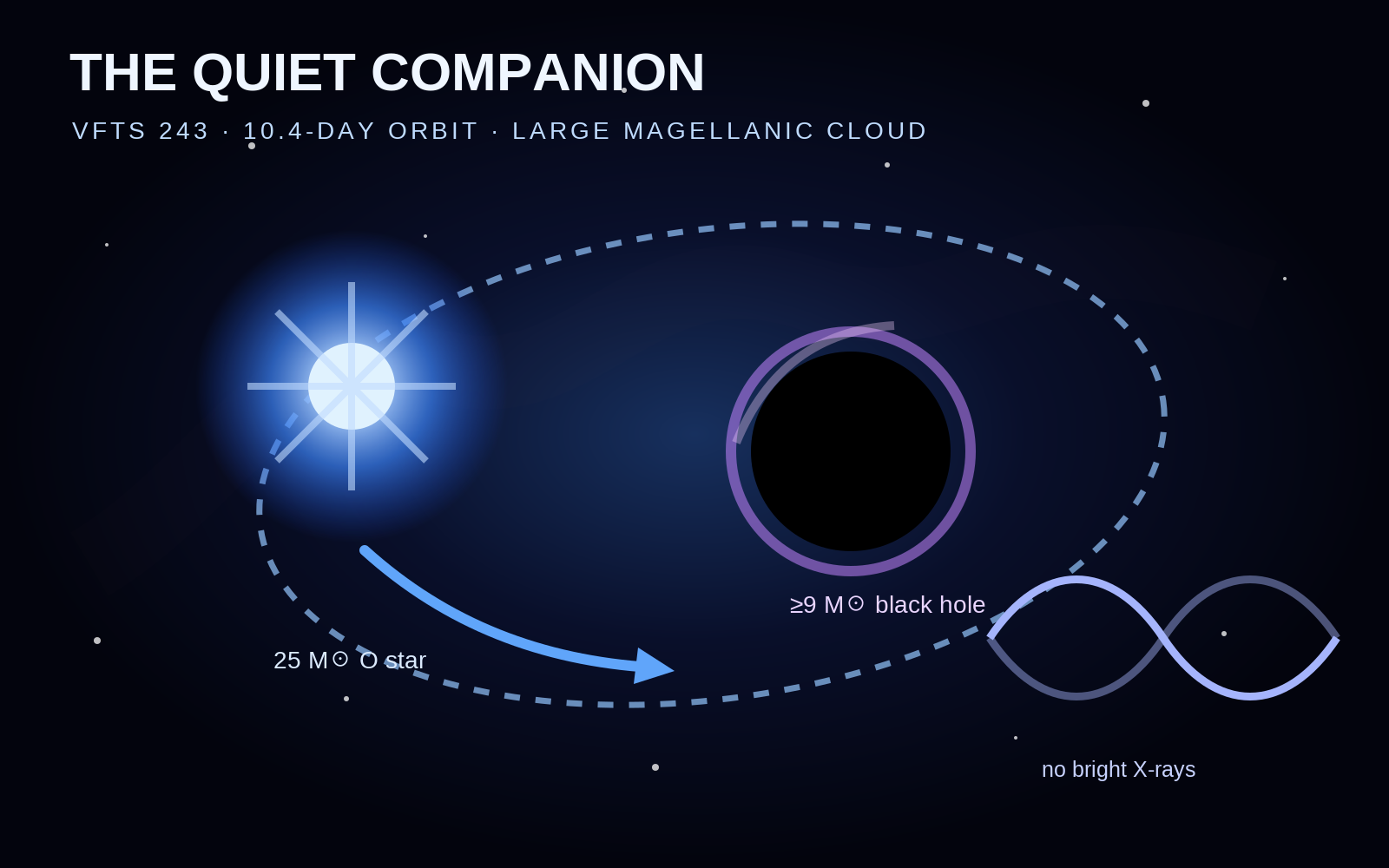
 Illustration — not a photo of the discovery
VFTS 243, an Extragalactic Dormant Black Hole
Six years of stellar spectra revealed that the massive star VFTS 243 orbits an unseen companion of at least nine solar masses, making the companion the first unambiguous X-ray-quiet stellar black hole identified outside the Milky Way at the time.
The story
Why scientists were there
Most known stellar black holes announce themselves by accreting gas and producing X-rays, biasing the census toward active systems. VFTS 243 provides a quieter evolutionary laboratory, although its exact mass and formation history depend on orbital inclination; longer monitoring can tighten the orbit and test how often massive stars collapse with little kick.
How they found it
Researchers analyzed 37 epochs of Very Large Telescope spectroscopy from the Tarantula Nebula and measured the O star's 10.4-day radial-velocity cycle. They found no spectrum from a normal companion, excluded non-degenerate alternatives at high confidence, and inferred an unseen object with a minimum mass in the black-hole range; archival X-ray data showed no bright accretion source.
What makes it unique
The binary's nearly circular orbit and modest motion indicate that the black hole probably formed with little ejected material and little natal kick. That directly constrains quiet stellar collapse and the precursors of black-hole mergers, while the word dormant describes low accretion rather than an absence of gravity or orbital effects.
Gallery
Where it was found
KU Leuven, Leuven
Tags
Related discoveries
 ⚛️ Physics
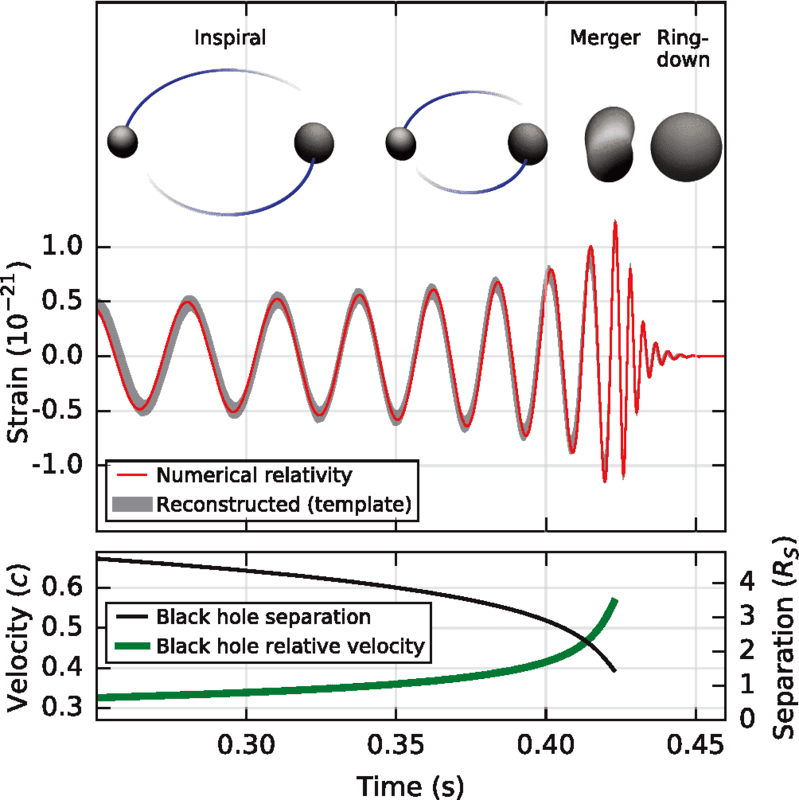
First Detection of Gravitational Waves
LIGO recorded the spacetime ripple from two black holes colliding 1.3 billion years ago — confirming a key prediction of general relativity.
Read more → 🌌 Space
First Image of a Black Hole (M87*)
Humanity's first direct image of a black hole — a glowing ring of light around the shadow of M87*, 6.5 billion solar masses.
Read more →