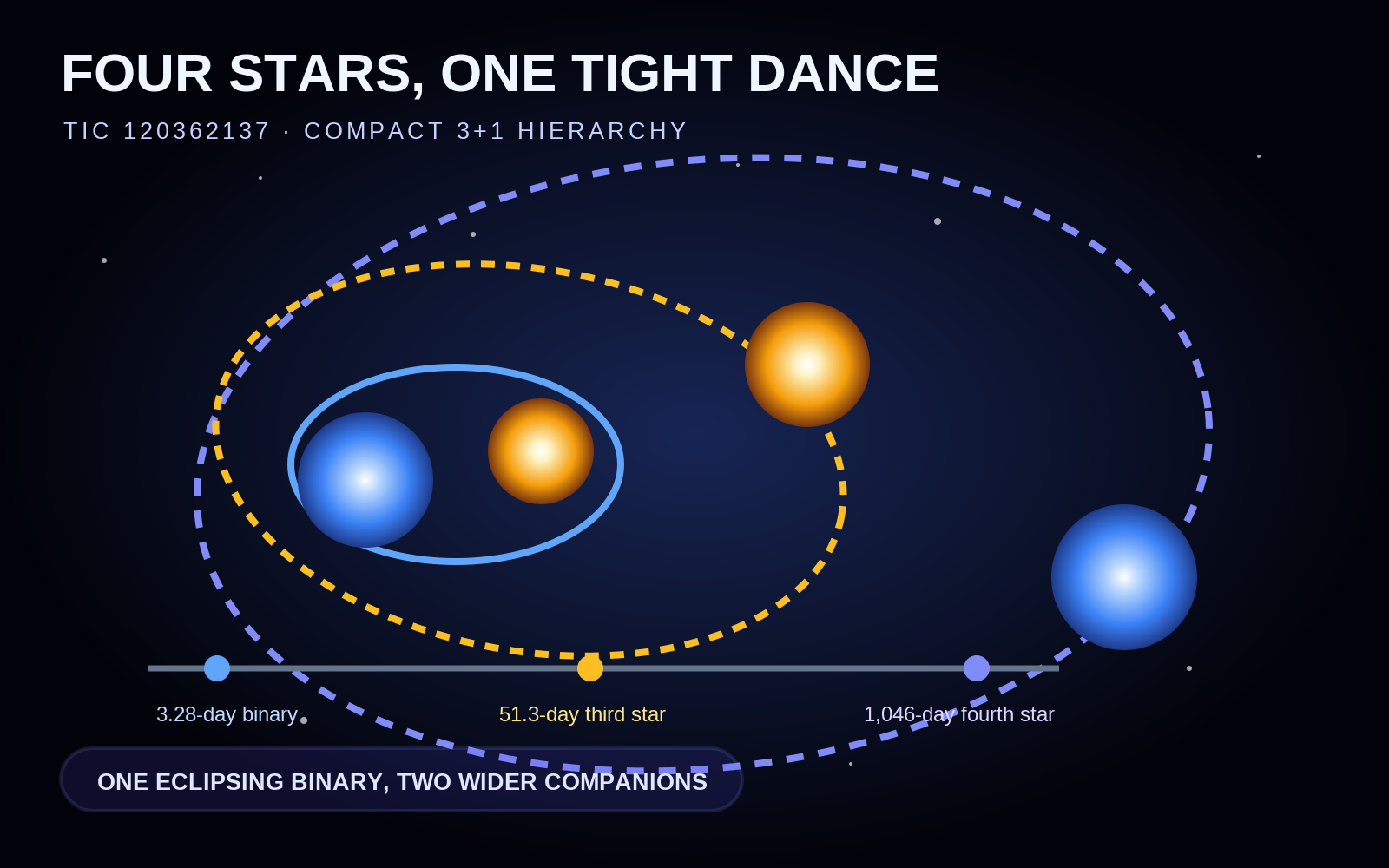
 Illustration — not a photo of the discovery
The Most Compact Known 3+1 Quadruple Star System
TESS eclipse timing, ground photometry, and spectra revealed TIC 120362137 as the tightest known hierarchical 3+1 quadruple: three stars fit inside a region comparable to Mercury's orbit while a fourth circles outside them.
The story
Why scientists were there
Extremely compact stellar multiples test how collapsing clouds build stable hierarchies and how strong interactions reshape stars. The 'most compact' label is a record among known 3+1 systems at publication, not a physical upper bound; continued TESS searches and long-term timing can find rivals and refine the outer orbit.
How they found it
Nine TESS sectors showed a 3.28-day eclipsing binary plus extra eclipse sequences from a third star on a 51.3-day orbit. Eclipse-timing variations, ground-based photometry, and radial velocities for all four spectral components were fitted simultaneously with a spectro-photodynamical model, revealing a fourth star on a 1,046-day orbit.
What makes it unique
It was both the most compact known 3+1 stellar hierarchy and the first such system with all four stars directly detected in composite spectra. Evolution models suggest mergers may eventually leave a white-dwarf pair, but that future is model-dependent and unfolds far beyond human timescales.
Gallery
Where it was found
University of Szeged, Szeged
Tags
Related discoveries
 🌌 Space
The Inside-Out LHS 1903 Planetary System
Four close-orbiting planets arranged rocky–gaseous–gaseous–rocky, an unexpected architecture that supports sequential, gas-depleted planet formation.
Read more → 🌌 Space
The TRAPPIST-1 Planetary System
Seven Earth-sized planets circling a cool red dwarf 40 light-years away — three of them in the habitable zone.
Read more →