 Illustration — not a photo of the discovery
NANOGrav Finds Evidence of a Cosmic Gravitational-Wave Background
Fifteen years of pulsar timing revealed the distinctive inter-pulsar correlations expected from a low-frequency gravitational-wave background, likely produced largely by orbiting supermassive black-hole binaries.
The story
Why scientists were there
Gravitational waves with periods of years are too slow for ground-based interferometers, but they should subtly advance or delay radio pulses arriving from millisecond pulsars across the sky.
How they found it
NANOGrav compared timing residuals from 67 pulsars and tested whether their correlated pattern matched the Hellings–Downs curve predicted for an isotropic gravitational-wave background.
What makes it unique
The result opened a new nanohertz window on the universe, although the collaboration described it as strong evidence rather than a final identification of every contributing source.
Gallery
Where it was found
North American Nanohertz Observatory for Gravitational Waves
Tags
Related discoveries
 🌌 Space
First Image of a Black Hole (M87*)
Humanity's first direct image of a black hole — a glowing ring of light around the shadow of M87*, 6.5 billion solar masses.
Read more →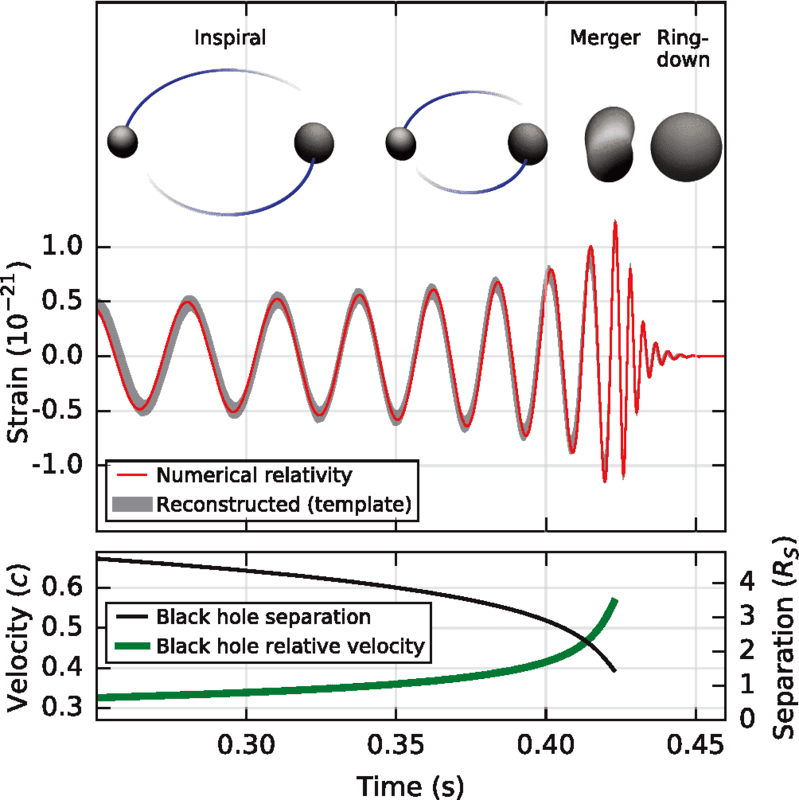 ⚛️ Physics
First Detection of Gravitational Waves
LIGO recorded the spacetime ripple from two black holes colliding 1.3 billion years ago — confirming a key prediction of general relativity.
Read more →