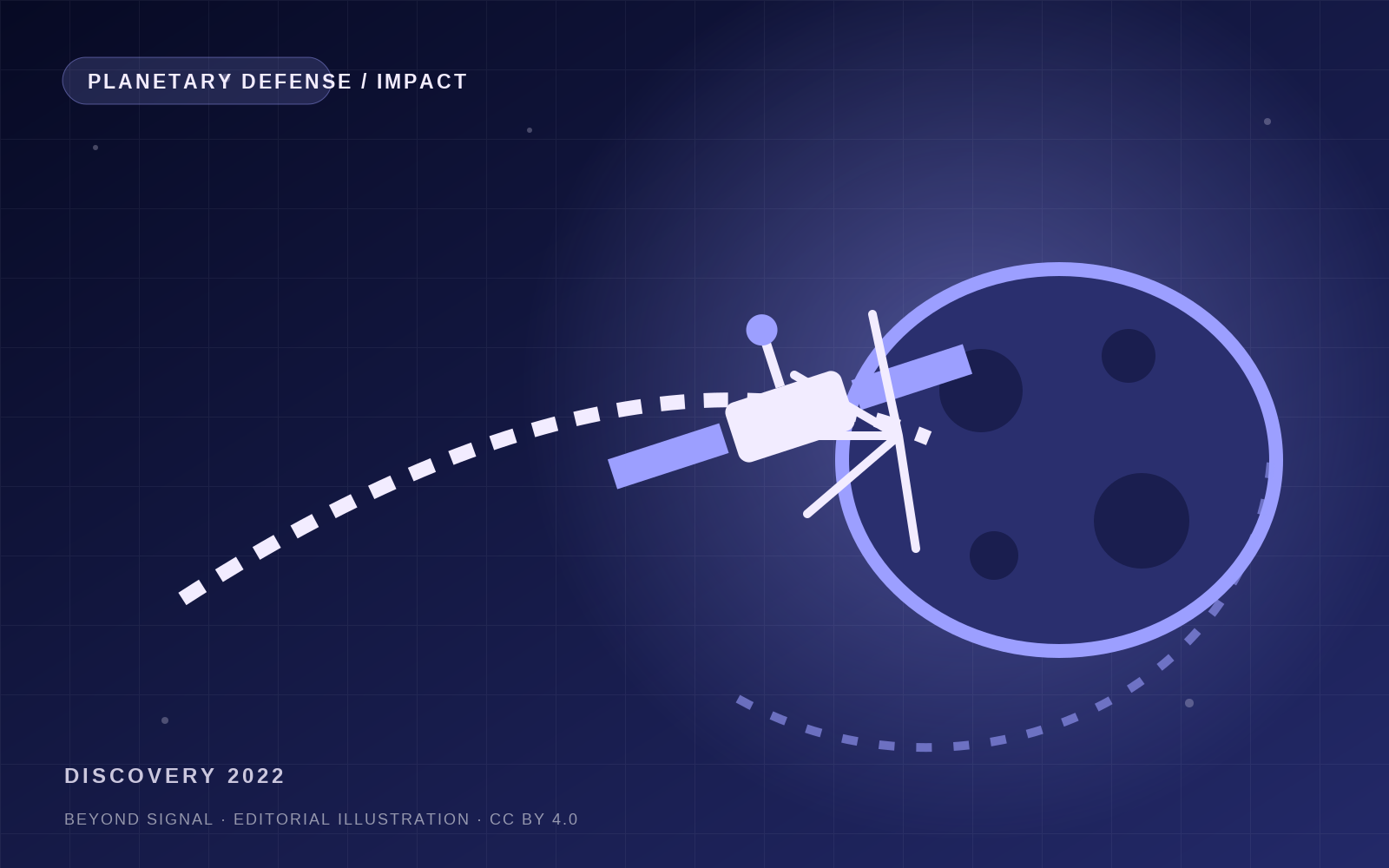
 Illustration — not a photo of the discovery
DART Successfully Changes an Asteroid's Orbit
Observations confirmed that NASA's DART spacecraft shortened Dimorphos's orbit around Didymos by roughly 32 minutes, proving that a kinetic impactor can measurably deflect an asteroid.
The story
Why scientists were there
Planetary-defense teams needed a full-scale test of whether deliberately striking a small asteroid could change its motion enough to help avert a future collision with Earth.
How they found it
DART autonomously targeted Dimorphos and struck it on 26 September 2022. Ground and space telescopes then timed repeated eclipses in the binary system to measure the new orbital period.
What makes it unique
It was humanity's first intentional alteration of a celestial body's motion and transformed asteroid deflection from a modelled concept into a demonstrated technique.
Gallery
Where it was found
Johns Hopkins Applied Physics Laboratory, Laurel, Maryland
Tags
Related discoveries
 Illustration🌌 Space
Lucy Discovers Selam, Dinkinesh's Contact-Binary Moon
NASA's Lucy spacecraft found that the small main-belt asteroid Dinkinesh has a moon composed of two lobes touching each other, the first contact-binary satellite seen during a spacecraft flyby.
Read more →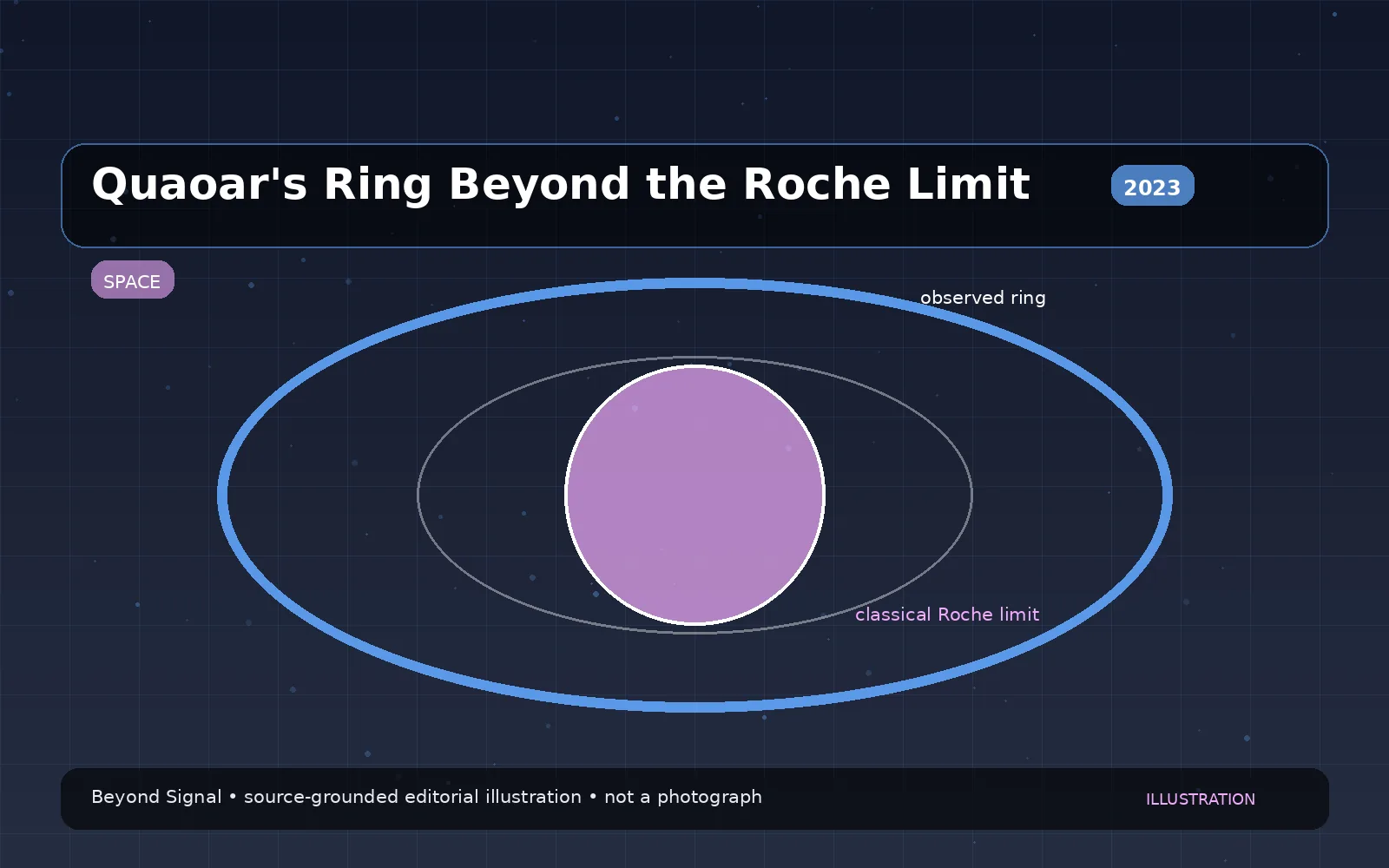 Illustration🌌 Space
Quaoar's Ring Beyond the Roche Limit
Observations of the dwarf planet Quaoar revealed a dense ring far beyond the classical Roche limit, the distance inside which tidal forces are expected to prevent ring material from assembling into a moon. The ring challenges a simple rule used to explain why planetary rings persist.
Read more → Illustration🌌 Space
Cassini Gravity Data Reveal Strong Tidal Dissipation in Titan
A reanalysis of Cassini radio tracking measured unexpectedly strong tidal energy loss in Titan and found that the gravity signal is inconsistent with the global subsurface ocean model previously favored for the moon.
Read more →