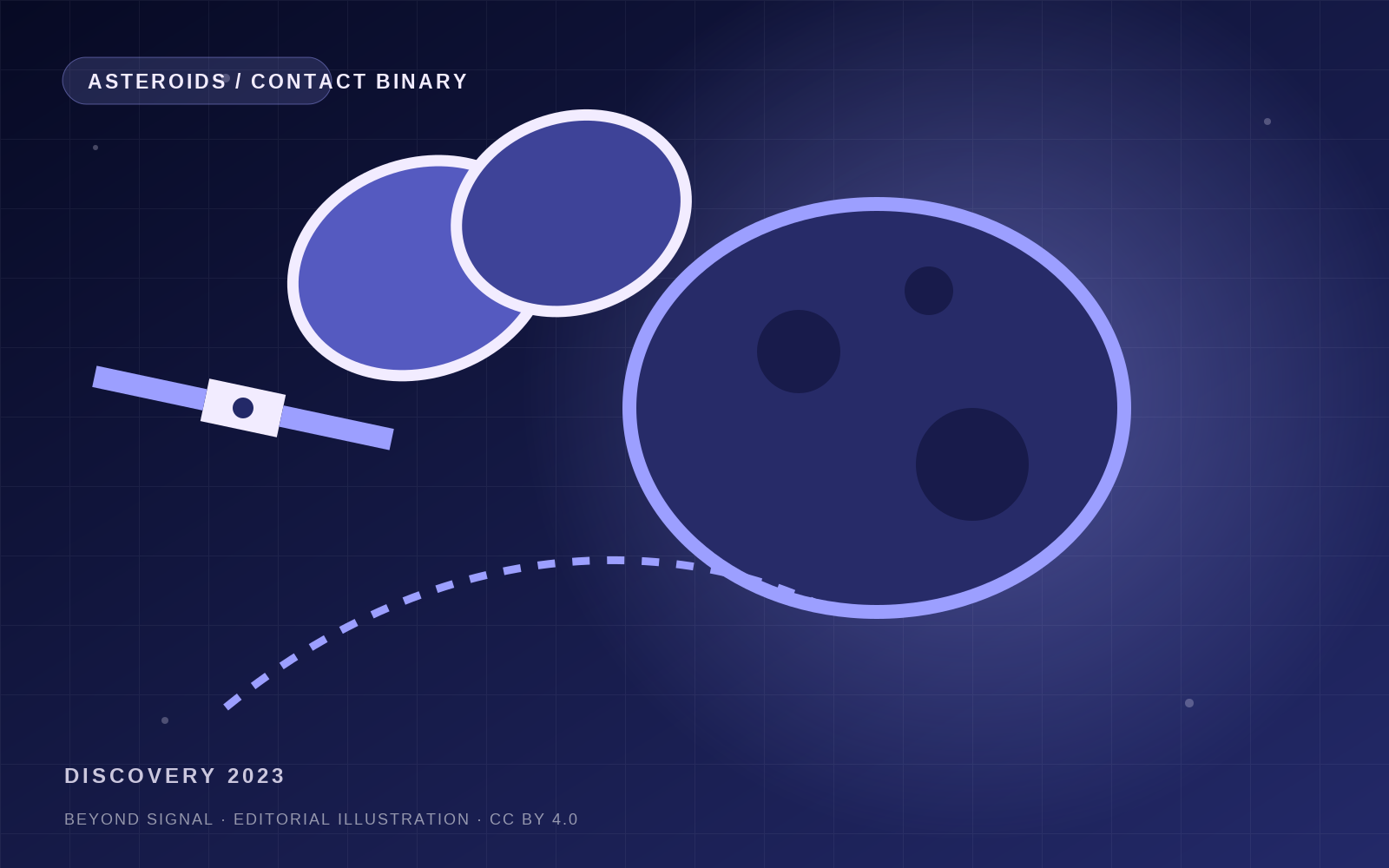
 Illustration — not a photo of the discovery
Lucy Discovers Selam, Dinkinesh's Contact-Binary Moon
NASA's Lucy spacecraft found that the small main-belt asteroid Dinkinesh has a moon composed of two lobes touching each other, the first contact-binary satellite seen during a spacecraft flyby.
The story
Why scientists were there
Dinkinesh was added as a rehearsal target so the Lucy team could test tracking, navigation, and imaging procedures before the mission reaches Jupiter's Trojan asteroids.
How they found it
Images taken during the 1 November flyby first revealed a satellite and then, as the viewing angle changed, showed that the moon consists of two similarly sized components in contact.
What makes it unique
The compact Dinkinesh–Selam system offers a close look at how small asteroids shed material, reassemble rubble, and build binary companions.
Gallery
Where it was found
NASA Goddard Space Flight Center, Greenbelt, Maryland
Tags
Related discoveries
 Illustration🌌 Space
DART Successfully Changes an Asteroid's Orbit
Observations confirmed that NASA's DART spacecraft shortened Dimorphos's orbit around Didymos by roughly 32 minutes, proving that a kinetic impactor can measurably deflect an asteroid.
Read more → 🌌 Space
Saturn's 128 New Moons
An international team found and confirmed 128 previously unrecognized small moons of Saturn, raising the planet's official total to 274 at the time of announcement.
Read more →