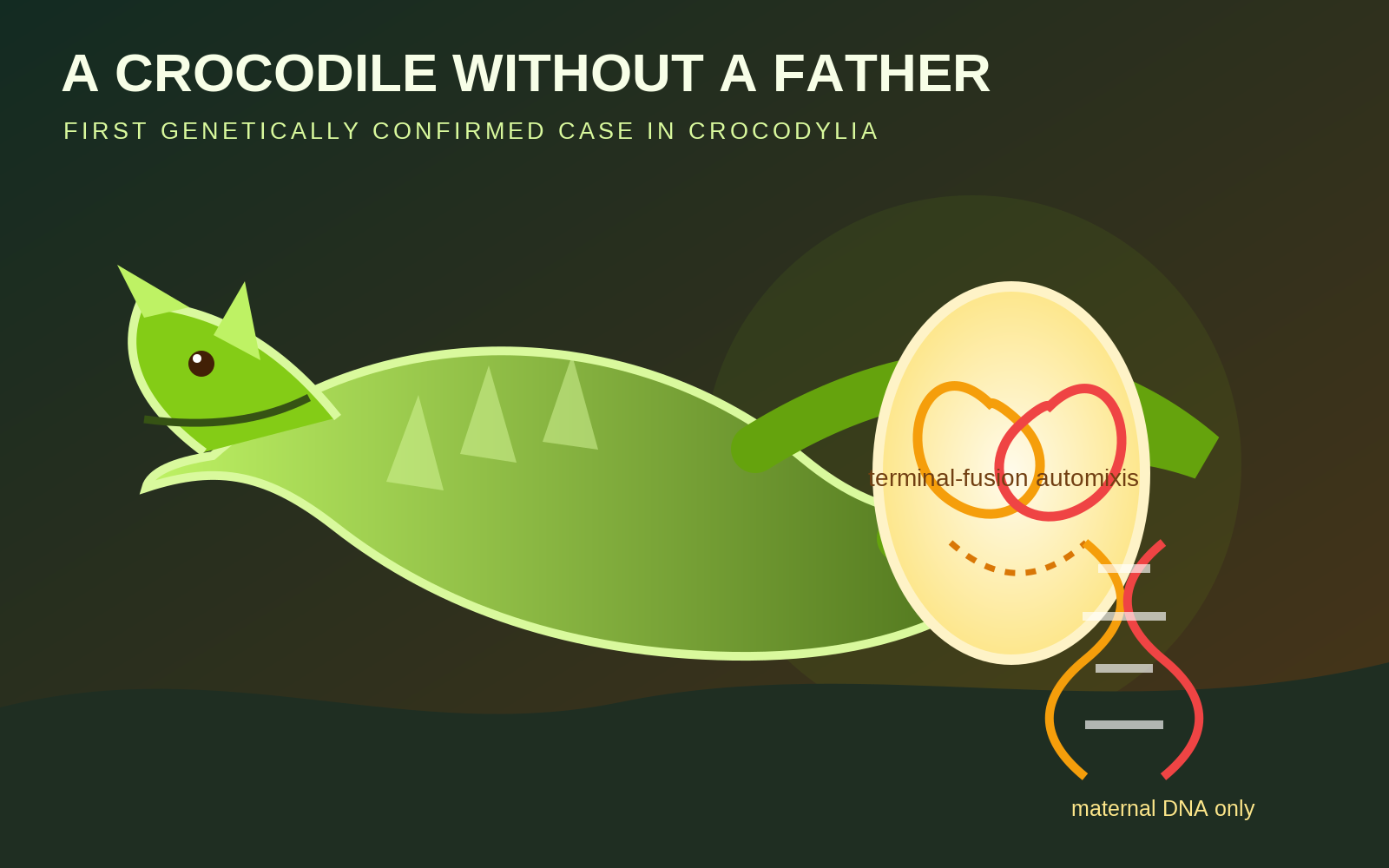
 Illustration — not a photo of the discovery
Crocodile Facultative Parthenogenesis Confirmed
Genetic analysis of a fully formed fetus from an egg laid by an isolated American crocodile documented facultative parthenogenesis in crocodilians for the first time.
The story
Why scientists were there
Parthenogenesis had been documented in birds and several reptile lineages but not their crocodilian relatives, so the case helps trace the reproductive capacity across archosaurs. The fetus was stillborn and this is one captive event, leaving frequency and adaptive value uncertain; broader genomic screening of isolated females is the next test.
How they found it
A female kept apart from males for about 16 years laid a clutch containing one apparently complete fetus. Microsatellite genotyping showed that its alleles came only from the mother and matched terminal-fusion automixis, in which products of the same meiotic division restore diploidy.
What makes it unique
The result added Crocodylia to the vertebrate groups capable of switching from sexual reproduction to development without fertilization. Because crocodilians and birds bracket extinct dinosaurs phylogenetically, it makes ancestral archosaur parthenogenesis plausible, but it cannot demonstrate the behavior in dinosaurs.
Gallery
Where it was found
Parque Reptilandia, Dominical
Tags
Related discoveries
 Illustration🦕 Dinosaurs & Fossils
The Oldest Known Fossilized Amniote Skin
A tiny three-dimensional patch of reptile-like skin from an Oklahoma cave system pushed the direct fossil record of amniote skin back by more than 130 million years.
Read more → Illustration🦕 Dinosaurs & Fossils
Meraxes Gigas, a Giant Short-Armed Predator
An unusually complete giant predatory dinosaur from Patagonia revealed that reduced forelimbs evolved independently in several large theropod lineages.
Read more → Illustration🧬 Biology
A New Sex-Determination Mechanism in an African Butterfly
Work in Bicyclus anynana showed that combinations of variants of the Z-linked Masculinizer gene determine sex, revealing a sex-determination mechanism not previously described in butterflies.
Read more →