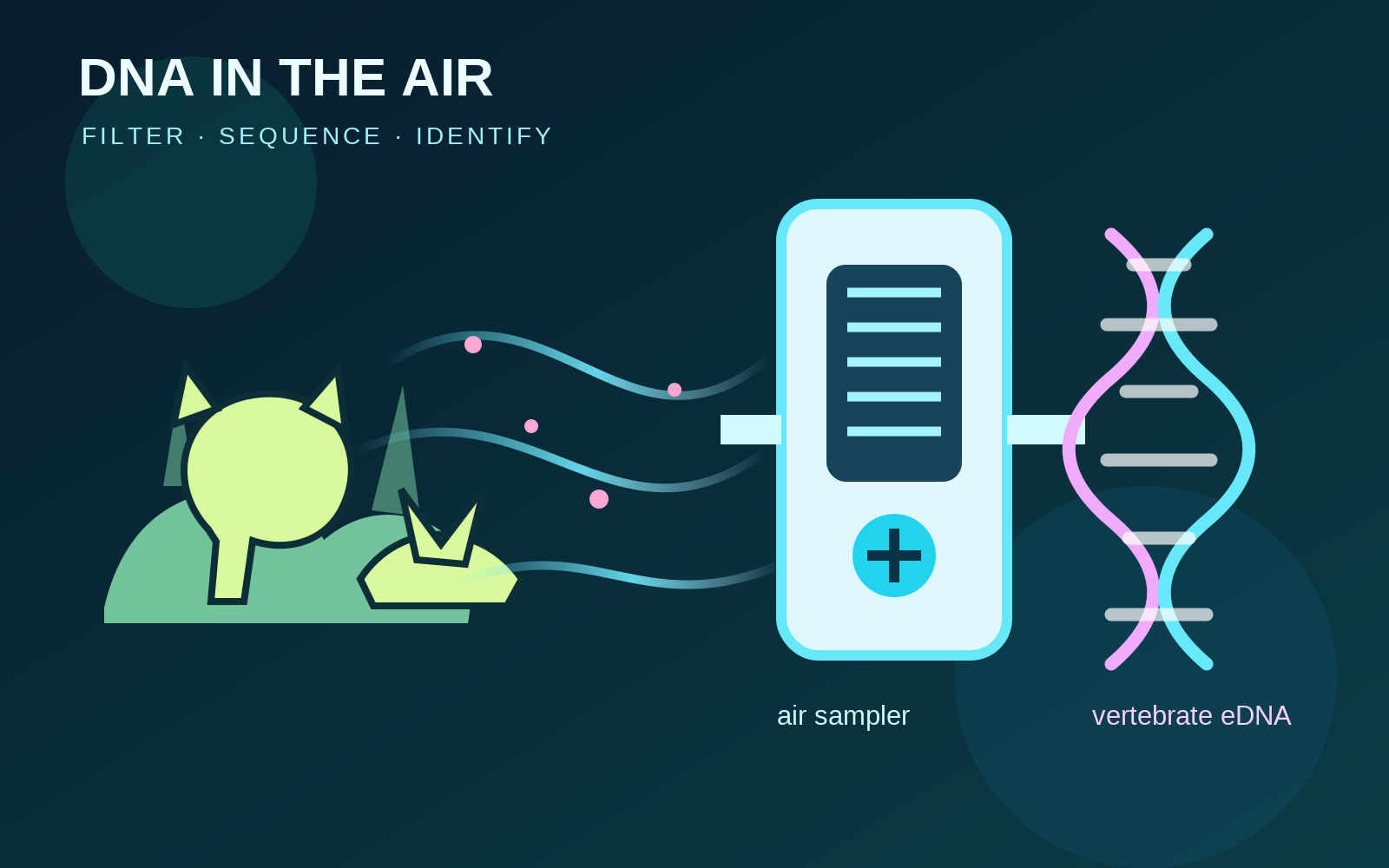
 Illustration — not a photo of the discovery
Airborne eDNA Reveals Terrestrial Vertebrates
Two independent zoo studies showed that vertebrate DNA can be collected directly from air and matched to nearby species, establishing airborne eDNA as a practical new route for surveying terrestrial biodiversity.
The story
Why scientists were there
Wildlife surveys routinely miss quiet, nocturnal, rare, or inaccessible animals. Air sampling could complement cameras, tracks, and acoustic surveys, but zoo demonstrations do not yet establish detection distance or reliability across open, windy ecosystems; the next step is standardized field validation with contamination controls.
How they found it
The Copenhagen team pulled outdoor air through filters at three zoo locations, extracted trace DNA, amplified vertebrate barcode regions, and compared the sequences with reference databases. They detected 49 vertebrate species, including zoo animals, local wildlife, and fish used as feed; a separate UK team published a parallel proof of concept in the same journal issue.
What makes it unique
The evidence showed that land-animal DNA does not have to be collected from soil, water, hair, or droppings: biological material suspended in ordinary air can carry a community signal. The result introduced a genuinely new sampling medium while leaving abundance estimates and species-level error rates as active research questions.
Gallery
Where it was found
Copenhagen Zoo, Frederiksberg
Tags
Related discoveries
 Illustration🧬 Biology
Greenland's Two-Million-Year-Old Environmental DNA
Environmental DNA recovered from mineral-rich sediments at Greenland's Kap København Formation reconstructed a roughly two-million-year-old ecosystem containing mastodons, reindeer, hares, geese, plants, and marine organisms. The fragmented DNA extended the known survival limit of ancient genetic material by about one million years.
Read more → Illustration🧬 Biology
A More Diverse Human Pangenome Reference
Researchers released a draft human pangenome built from 47 genetically diverse people, replacing a single linear reference with multiple possible genomic paths.
Read more → Illustration🪸 Ocean Discoveries
A Global Ocean Census of RNA Viruses
A metatranscriptomic survey of ocean samples substantially expanded the known RNA virome, reorganizing major evolutionary groups and revealing that marine RNA viruses are both abundant and deeply diverse.
Read more →