
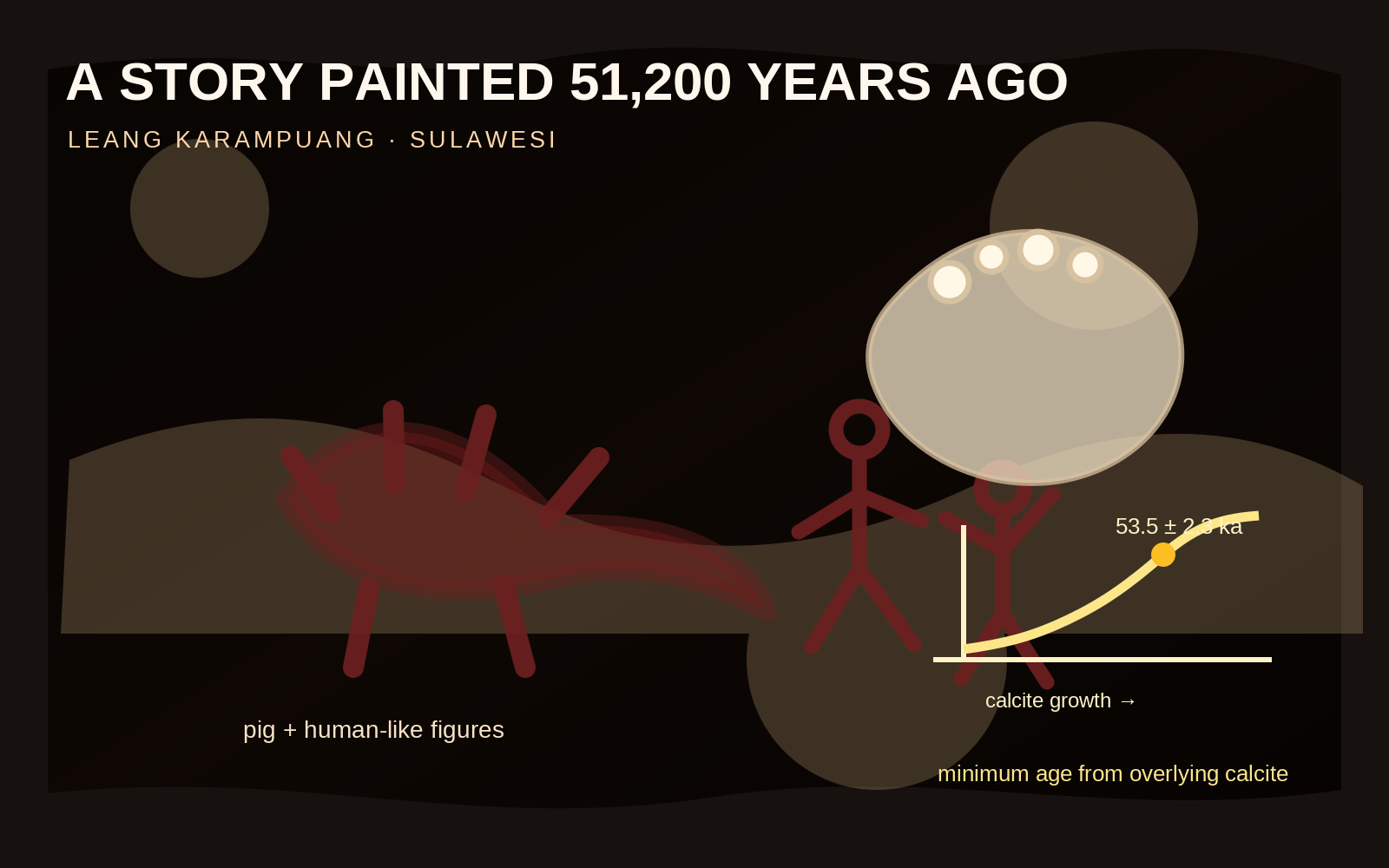
 Illustration — not a photo of the discovery
The 51,200-Year-Old Sulawesi Narrative Cave Art
Laser-ablation uranium-series dating showed that a scene of human-like figures interacting with a pig at Leang Karampuang was painted at least 51,200 years ago, then the oldest securely dated surviving narrative and representational art.
The story
Why scientists were there
The panel pushes composed visual storytelling deep into the Pleistocene and broadens a record once centered on European caves. The measurement dates calcite that formed over the pigment, so it is a minimum age rather than the painting's exact birthday; future dating at more Indonesian sites can reveal how widespread this artistic tradition was.
How they found it
Researchers removed tiny calcite accretions lying directly above pigment and mapped uranium and thorium isotopes across polished cross-sections with a laser. The oldest growth zone over one figure yielded 53.5 ± 2.3 thousand years, establishing a conservative minimum painting age of 51.2 thousand years while exposing complex mineral growth that earlier bulk sampling could miss.
What makes it unique
The scene combines recognizable animal imagery with human-like figures in an apparently intentional interaction, making it evidence for narrative composition rather than an isolated motif. Interpretation of the action remains partly subjective, and later discoveries may surpass its age, but the physical minimum date is independently tied to the overlying calcite.
Gallery
Where it was found
Leang Karampuang, Maros-Pangkep karst
Tags
Related discoveries
 🏺 Archaeology
Göbekli Tepe, the First Temple
Massive carved stone pillars built ~11,000 years ago — monumental architecture from hunter-gatherers, predating Stonehenge by six millennia.
Read more → Illustration🏺 Archaeology
The 476,000-Year-Old Wooden Structure at Kalambo Falls
Two shaped logs from Zambia were dated to at least 476,000 years ago, preserving the earliest known structural use of wood by hominins.
Read more →