
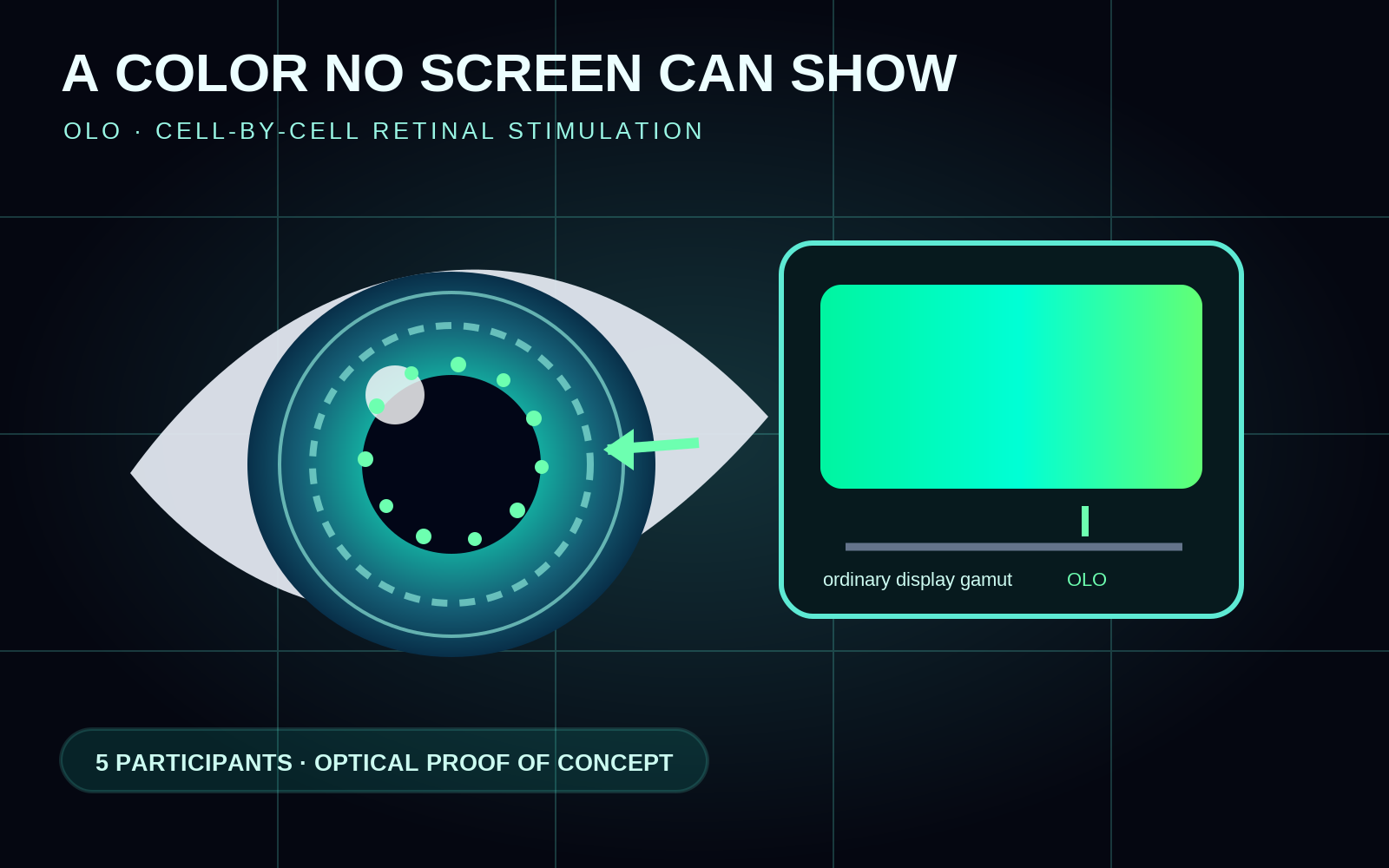
 Illustration — not a photo of the discovery
Olo, a Color Beyond the Natural Human Gamut
An adaptive-optics system stimulated selected retinal cone cells one by one, letting five participants perceive an exceptionally saturated blue-green called olo that ordinary light mixtures cannot produce on the same patch of retina.
The story
Why scientists were there
Directly controlling cone populations creates a new experimental display for testing how retinal codes become color and may eventually probe vision loss. The evidence comes from five trained participants viewing a tiny stabilized field, so olo is not a screen color available to the public; larger, independent psychophysical studies and safer, wider-field devices are the next steps.
How they found it
Researchers first mapped each participant's long-, middle-, and short-wavelength cones, tracked eye motion, and scanned a laser so it activated hundreds of targeted cells while largely skipping their neighbors. Color matching and discrimination tests showed that near-exclusive M-cone stimulation produced a percept participants placed beyond the saturation of ordinary monochromatic green.
What makes it unique
Natural spectra always stimulate overlapping cone sensitivities, whereas the Oz apparatus partially bypassed that constraint and drove a population pattern approaching LMS coordinates (0, 1, 0), which inspired the name olo. The finding is a novel controlled percept, not evidence for a new wavelength or a fourth human photoreceptor.
Gallery
Where it was found
University of California, Berkeley
Tags
Related discoveries
 🧬 Biology
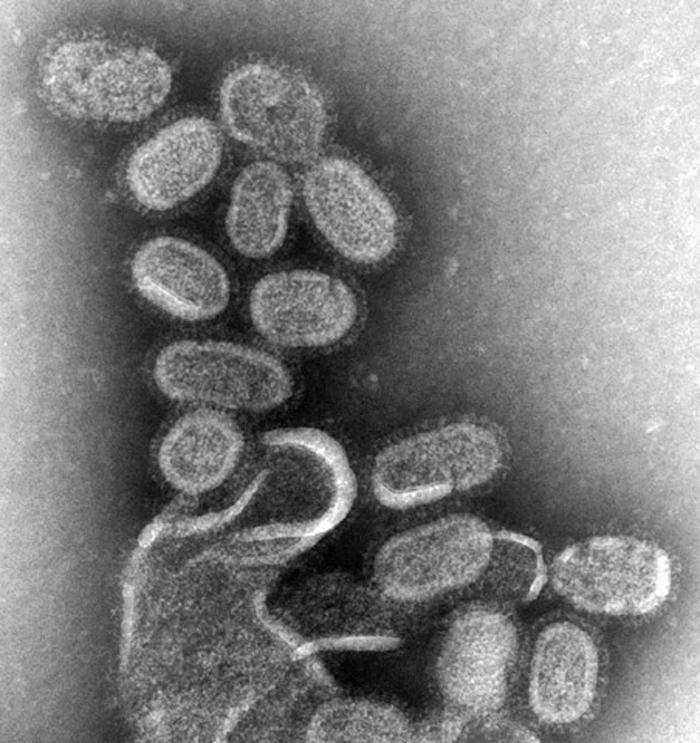
Watching Influenza Enter a Living Cell
A new combined microscopy method let scientists watch influenza viruses invade living cells in real time, revealing that cells actively help capture the virus.
Read more →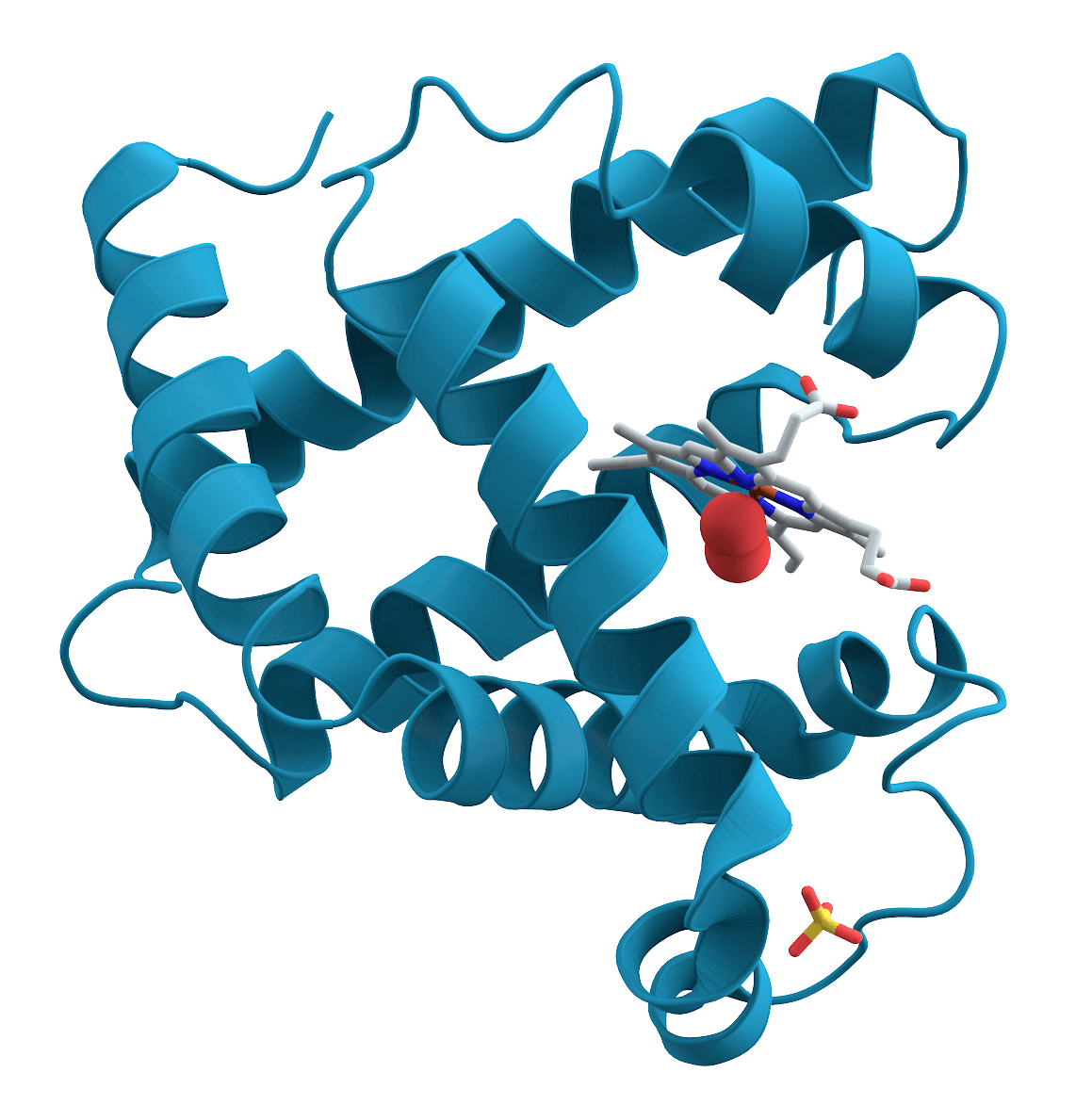 🤖 Technology
AlphaFold Solves Protein Folding
A neural network predicted protein 3D structures from sequence with near-experimental accuracy — cracking a 50-year grand challenge in biology.
Read more → Illustration🧬 Biology
The Anteromedial Thalamus Gates Long-Term Memory in Mice
Longitudinal recordings and targeted perturbations in mice identified the anteromedial thalamus as a circuit node that helps select and stabilize salient memories for long-term cortical storage.
Read more →