
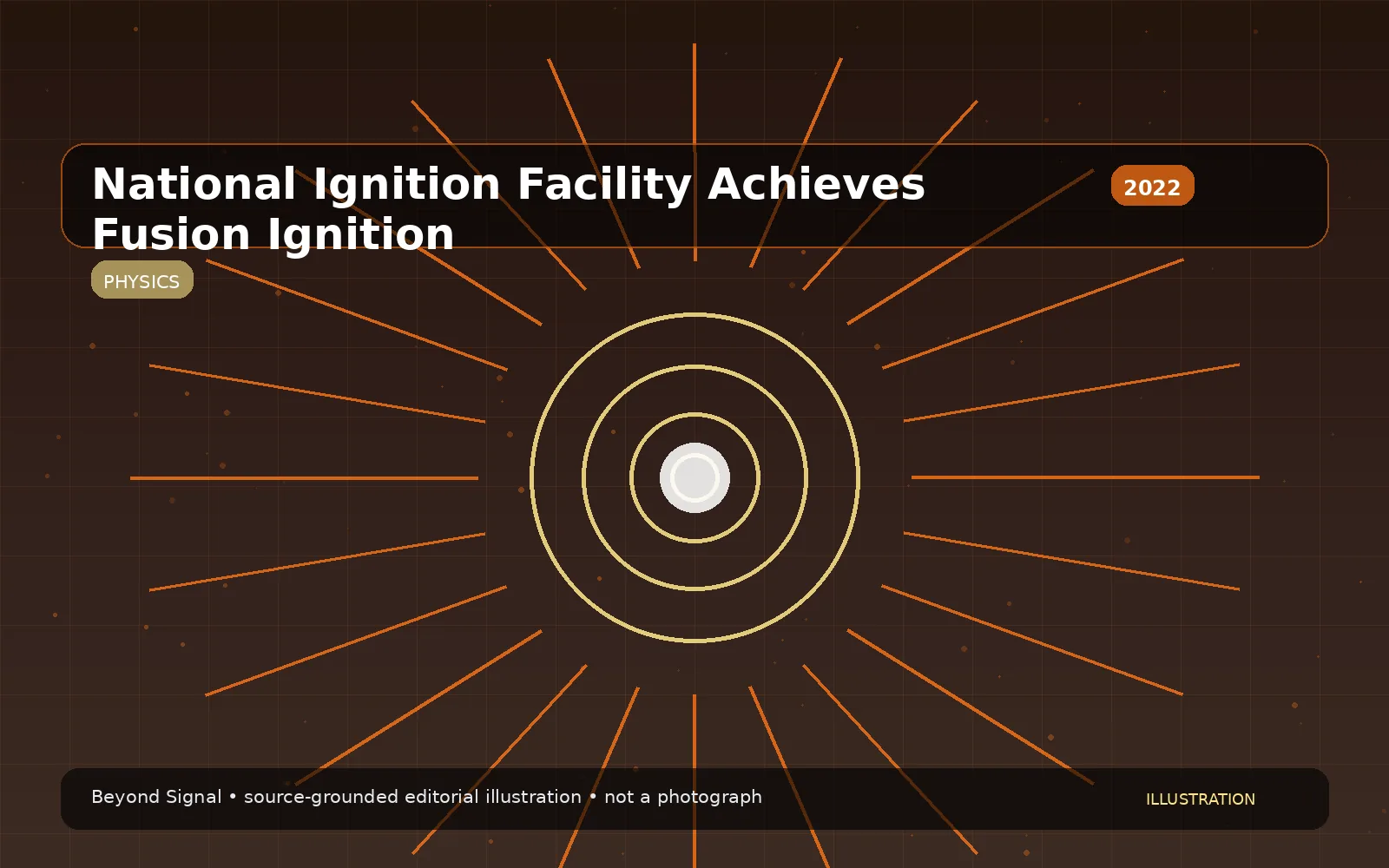
 Illustration — not a photo of the discovery
National Ignition Facility Achieves Fusion Ignition
The National Ignition Facility announced the first controlled fusion experiment to produce more fusion energy from a target than the laser energy delivered to it. The December 5 shot sent 2.05 megajoules of laser energy into a fuel capsule and produced about 3.15 megajoules of fusion output.
The story
Why scientists were there
For decades, inertial-confinement researchers had compressed tiny capsules of hydrogen isotopes with powerful laser pulses, seeking a self-heating burn in which fusion reactions deposit enough energy to sustain further reactions. The milestone was pursued for basic plasma science, national security research, and long-term fusion-energy development.
How they found it
NIF split a laser pulse among 192 beams aimed into a gold-lined target chamber. X-rays generated inside the chamber imploded a diamond capsule containing deuterium and tritium, briefly creating the extreme temperature and pressure needed for ignition.
What makes it unique
The result crossed scientific energy breakeven at the target, not at the power-plant level: the facility consumed far more electricity than the fusion output. It nevertheless provided the clearest laboratory demonstration that a laser-driven fusion burn can amplify the energy delivered directly to its fuel.
Gallery
Where it was found
Lawrence Livermore National Laboratory, California
Tags
Related discoveries
 Illustration🤖 Technology
Willow Demonstrates Below-Threshold Quantum Error Correction
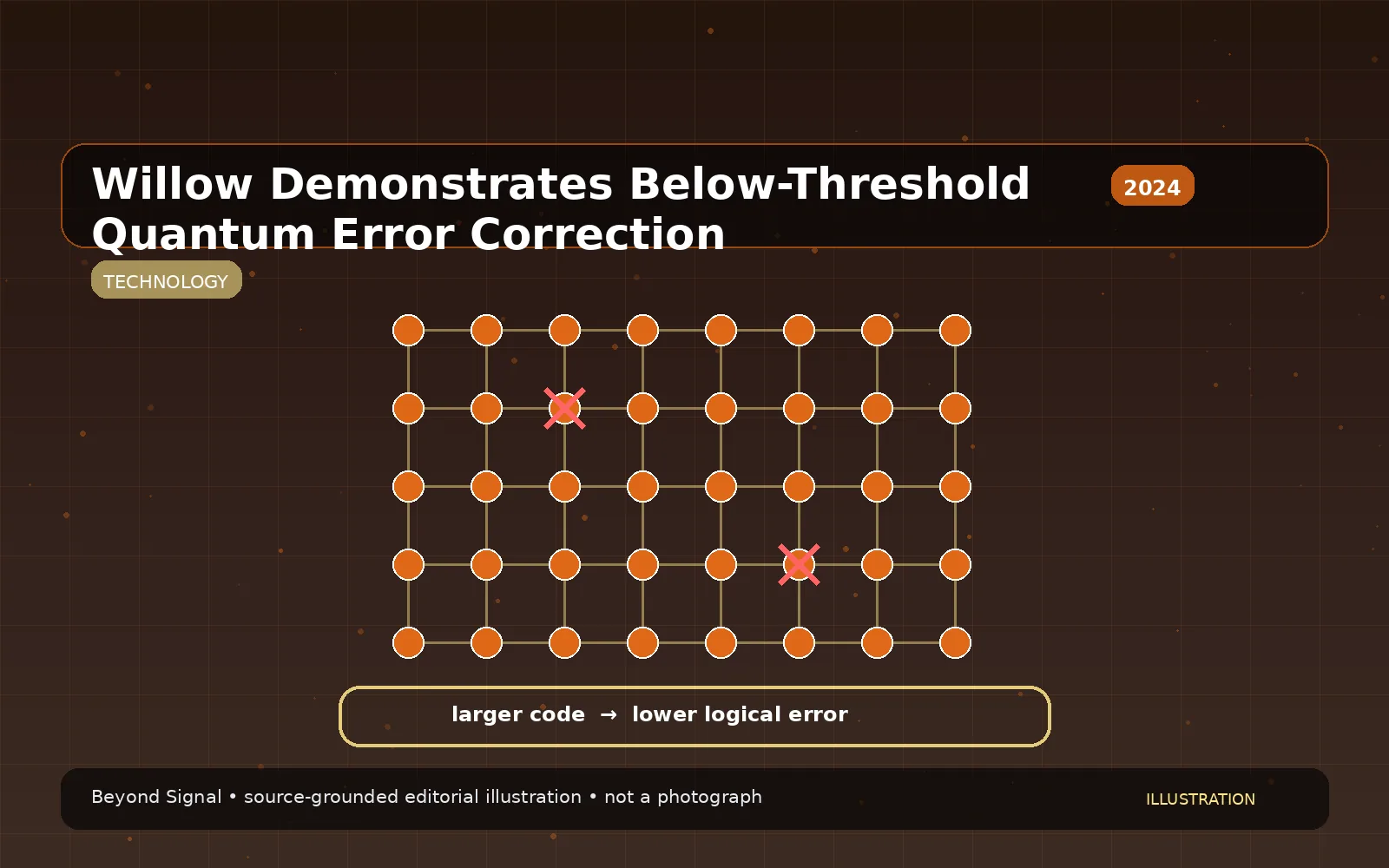
Google's Willow processor demonstrated below-threshold surface-code error correction: as researchers increased the size of encoded logical qubits, the logical error rate fell rather than rose. The experiment was an important scaling result for fault-tolerant quantum computing, although it did not produce a general-purpose error-corrected computer.
Read more →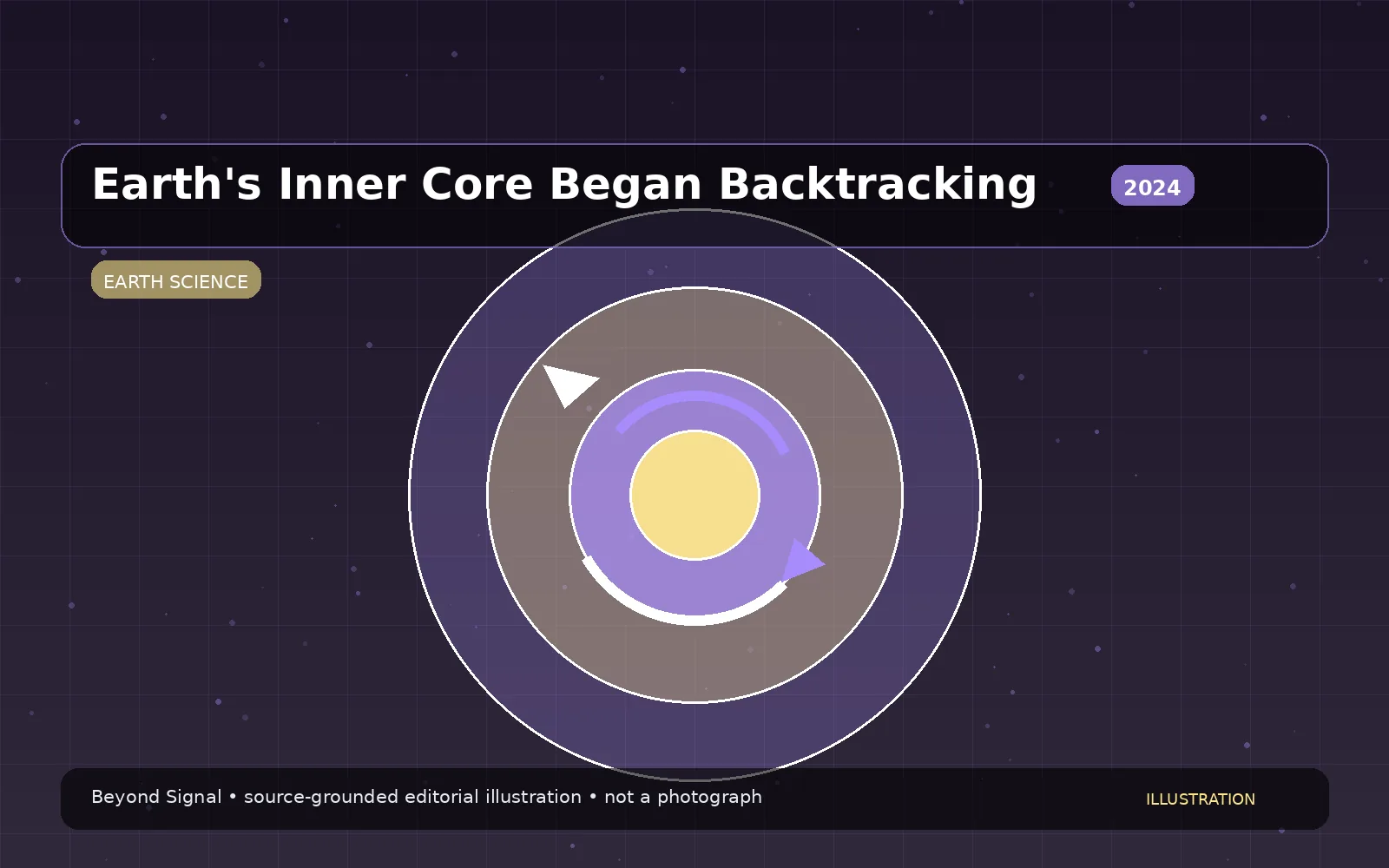 Illustration🌋 Earth Science
Earth's Inner Core Began Backtracking
Seismic waveforms from repeating earthquakes indicated that Earth's solid inner core had slowed and was moving backward relative to the mantle after about 2010. The result extended evidence that inner-core rotation oscillates over decades rather than maintaining a constant faster or slower spin.
Read more →