
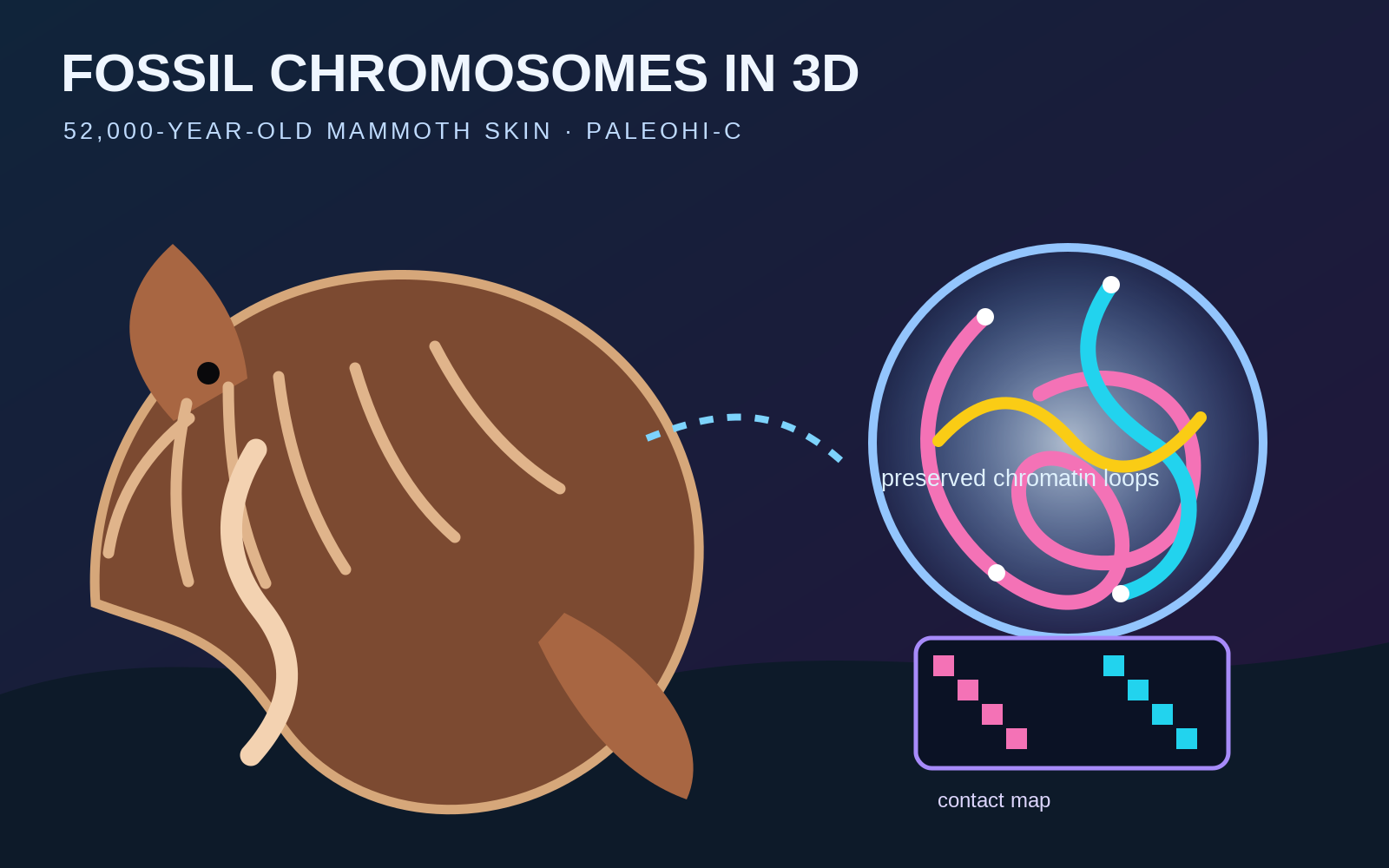
 Illustration — not a photo of the discovery
Three-Dimensional Chromosomes Preserved in Mammoth Skin
A 52,000-year-old woolly mammoth skin sample retained chromosome-scale contacts, allowing researchers to reconstruct 28 chromosomes and features of the genome's three-dimensional organization in an extinct animal.
The story
Why scientists were there
Ancient-DNA studies usually recover sequence fragments but lose how chromosomes were folded and regulated inside cells. The exceptional skin opens a path toward ancient functional genomics, although it is one unusually preserved tissue and inferred activity is not direct RNA evidence; replication in other specimens and tissues is the next challenge.
How they found it
The team adapted Hi-C proximity-ligation methods into PaleoHi-C, measured which DNA fragments remained physically near one another, and combined those contacts with sequence data. The maps recovered chromosome territories, A/B compartments, loops, an inactive X chromosome, and a chromosome-length assembly that was compared with modern elephant skin.
What makes it unique
The sample preserved spatial genome architecture roughly a million times longer than typical ancient-DNA fragments, probably because rapid freeze-drying drove the tissue into a glass-like state. The method can infer past chromosome organization and relative gene activity, but it does not resurrect intact living chromosomes or cells.
Gallery
Where it was found
Belaya Gora, Sakha Republic
Tags
Related discoveries
 Illustration🧬 Biology
Greenland's Two-Million-Year-Old Environmental DNA
Environmental DNA recovered from mineral-rich sediments at Greenland's Kap København Formation reconstructed a roughly two-million-year-old ecosystem containing mastodons, reindeer, hares, geese, plants, and marine organisms. The fragmented DNA extended the known survival limit of ancient genetic material by about one million years.
Read more → Illustration🧬 Biology
Woolly Rhino Genome Recovered from a Wolf's Stomach
Scientists reconstructed a high-quality woolly rhinoceros genome from undigested meat preserved in the stomach of a roughly 14,400-year-old wolf pup. Comparisons with older rhino genomes found no prolonged loss of diversity or rising inbreeding before extinction, supporting a comparatively rapid population collapse.
Read more →