
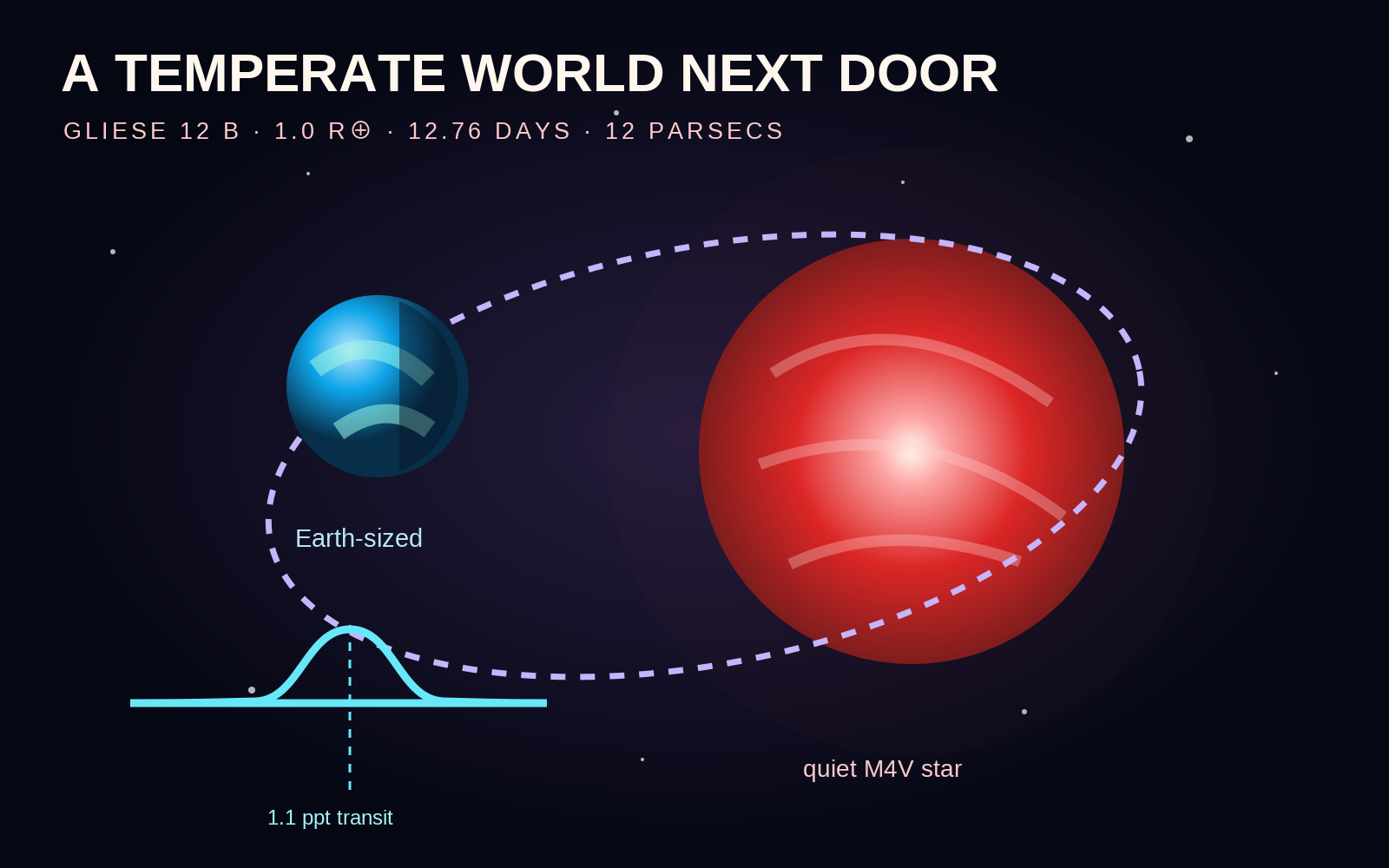
 Illustration — not a photo of the discovery
Gliese 12 b, a Nearby Temperate Earth-Sized Planet
Transit observations validated Gliese 12 b as a planet about Earth's size orbiting a quiet red dwarf only 12 parsecs away, with an equilibrium temperature near 315 kelvin under standard assumptions.
The story
Why scientists were there
Nearby small planets around bright, quiet stars are the best laboratories for measuring masses and testing whether temperate M-dwarf worlds retain atmospheres. Neither an atmosphere nor surface liquid water has been detected, and equilibrium temperature is model-dependent; radial-velocity and transmission-spectroscopy observations are the critical next steps.
How they found it
TESS recorded three initial transit events but left two possible orbital periods. New TESS sectors, five CHEOPS visits, and ground-based photometry fixed the period at 12.76144 days, while spectroscopy, high-resolution imaging, archival plates, and statistical tests rejected stellar and background-eclipse alternatives.
What makes it unique
At publication it was the nearest known transiting planet combining a temperate irradiation level and an Earth-like radius. Its measured radius is 1.0 ± 0.1 Earth radii, but its mass, composition, atmosphere, rotation state, and actual surface temperature remain unknown.
Gallery
Where it was found
University of Southern Queensland, Toowoomba
Tags
Related discoveries
 🌌 Space
The TRAPPIST-1 Planetary System
Seven Earth-sized planets circling a cool red dwarf 40 light-years away — three of them in the habitable zone.
Read more → 🌌 Space
GJ 887 d, a Nearby Habitable-Zone Super-Earth
A 50.77-day super-Earth confirmed in the habitable zone of GJ 887, only about 10.7 light-years away and second only to Proxima b in proximity among known temperate planets.
Read more →