
 Illustration — not a photo of the discovery
Euclid Identifies 15,072 Strong Gravitational Lens Candidates
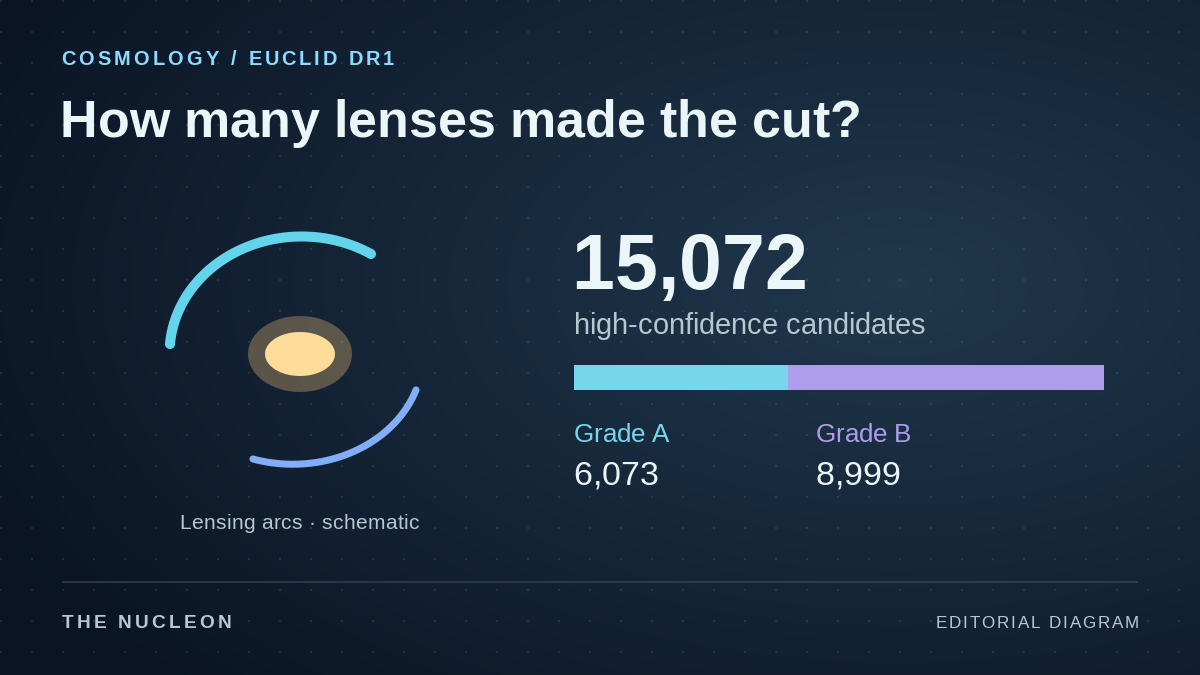
Euclid’s first major survey release contains 15,072 high-confidence candidates for strong gravitational lenses. These are alignments in which foreground mass bends light from a more distant source into arcs or multiple images.
The story
Why scientists were there
A lens requires an alignment along our line of sight. Surveying roughly 2,000 square degrees gave Euclid many chances to catch one. The Earth marker identifies the mission’s science archive near Madrid. The telescope observed from space.
How they found it
The search started with images of candidate systems. Machine-learning models narrowed the field, citizen scientists inspected images, and lens specialists graded the remaining systems. The high-confidence total combines 6,073 grade A systems and 8,999 grade B systems.
What makes it unique
A ring or arc traces how strongly a foreground galaxy bends light. A large sample lets astronomers compare mass distributions across many galaxies. The catalog records confidence grades, and the additional 9,010 grade C possibilities are outside the headline count. The team described its catalog in a research preprint accompanying the public release.
Gallery
Where it was found
European Space Astronomy Centre, Spain (Euclid science archive)
Tags
Related discoveries
 Illustration🌌 Space
JWST Confirms JADES-GS-z14-0 at Cosmic Dawn
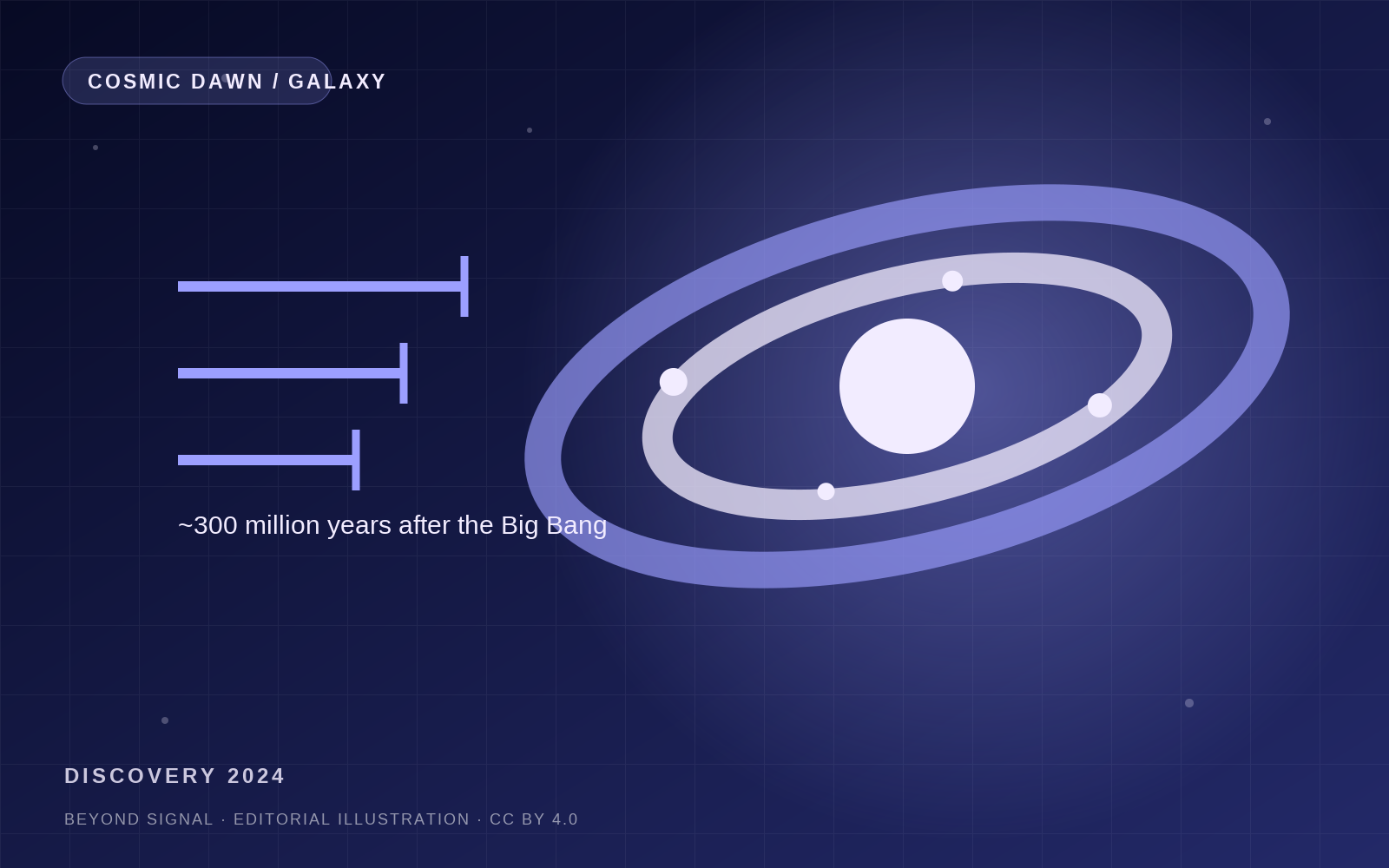
JWST spectroscopy confirmed a remarkably luminous galaxy seen only about 300 million years after the Big Bang, showing that substantial galaxies assembled unexpectedly early.
Read more → 🌌 Space
First Image of a Black Hole (M87*)
Humanity's first direct image of a black hole — a glowing ring of light around the shadow of M87*, 6.5 billion solar masses.
Read more →