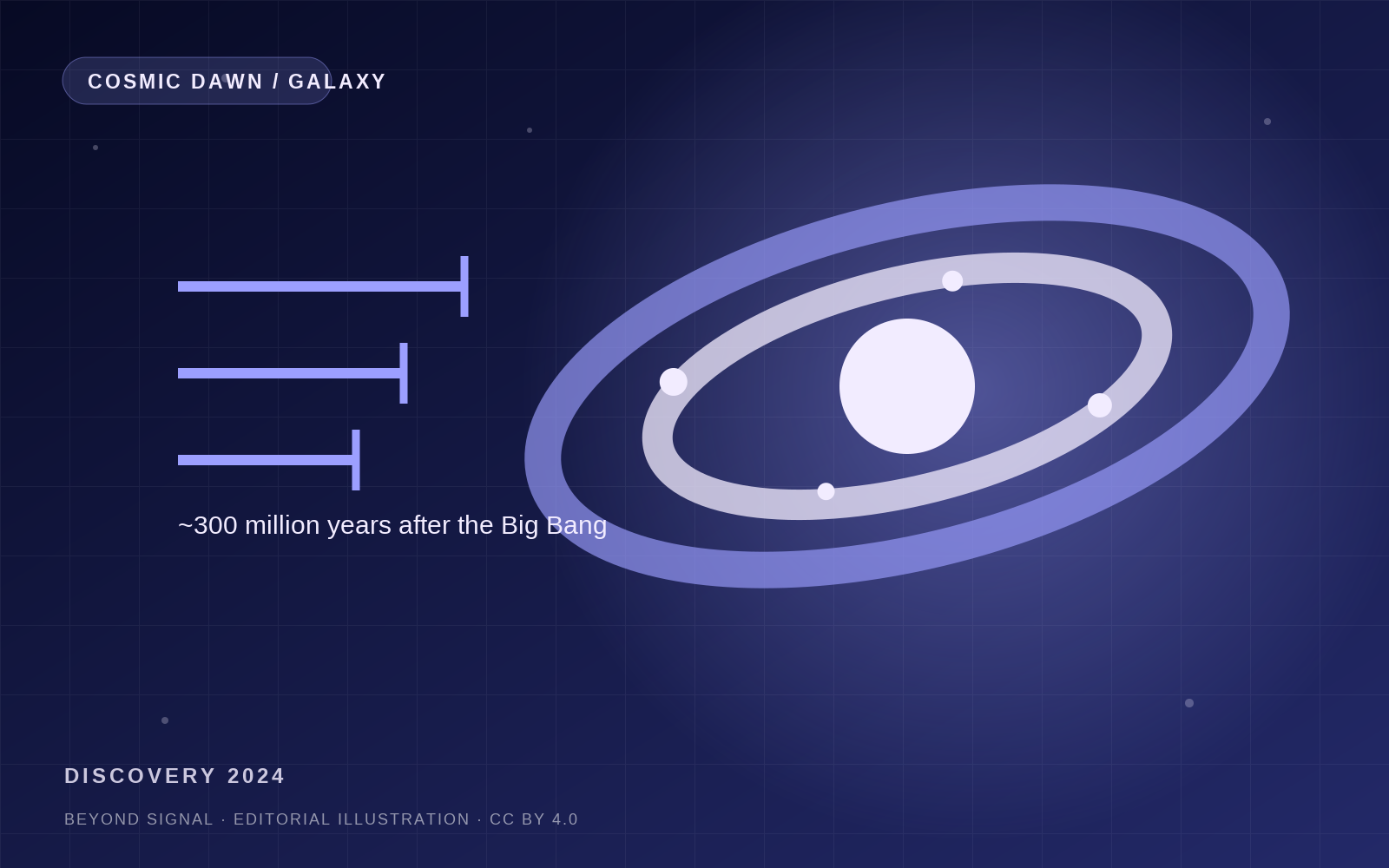
 Illustration — not a photo of the discovery
JWST Confirms JADES-GS-z14-0 at Cosmic Dawn
JWST spectroscopy confirmed a remarkably luminous galaxy seen only about 300 million years after the Big Bang, showing that substantial galaxies assembled unexpectedly early.
The story
Why scientists were there
Deep JADES imaging contained several unusually red candidates whose distances could only be secured by splitting their faint infrared light into spectra.
How they found it
NIRSpec detected the sharp Lyman break expected at extreme redshift, while NIRCam and MIRI measurements constrained the galaxy's size, stars, and ionized gas.
What makes it unique
JADES-GS-z14-0 became the most distant spectroscopically confirmed galaxy known at announcement and was brighter and more developed than many early-universe models predicted.
Gallery
Where it was found
Space Telescope Science Institute, Baltimore, Maryland
Tags
Related discoveries
 🌌 Space
First Image of a Black Hole (M87*)
Humanity's first direct image of a black hole — a glowing ring of light around the shadow of M87*, 6.5 billion solar masses.
Read more →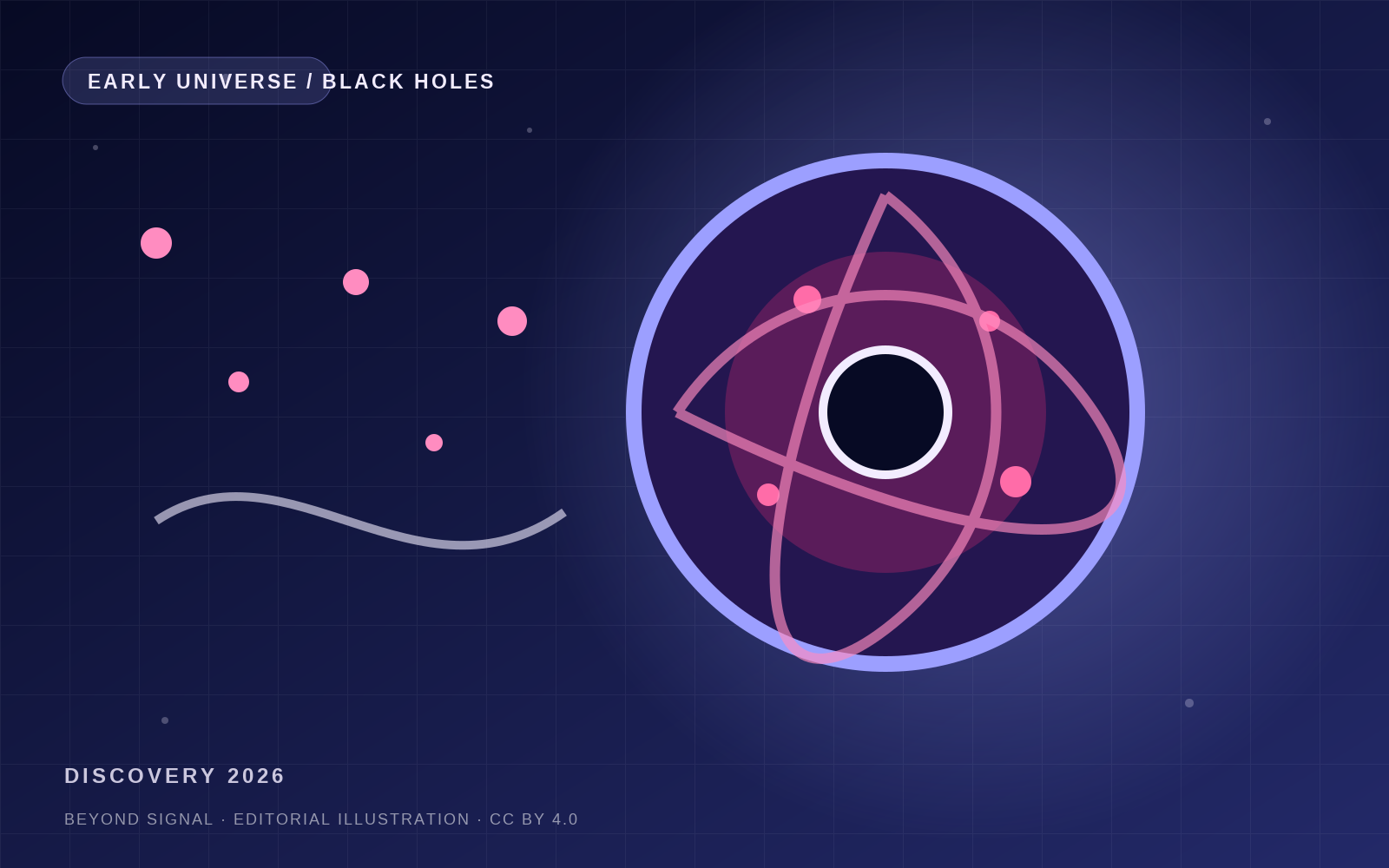 Illustration🌌 Space
Dense Gas Cocoons Explain Many Little Red Dots
Radiative-transfer modelling showed that the puzzling spectra of many JWST 'little red dots' can be reproduced by relatively young supermassive black holes embedded in compact, dense cocoons of ionized gas.
Read more →