
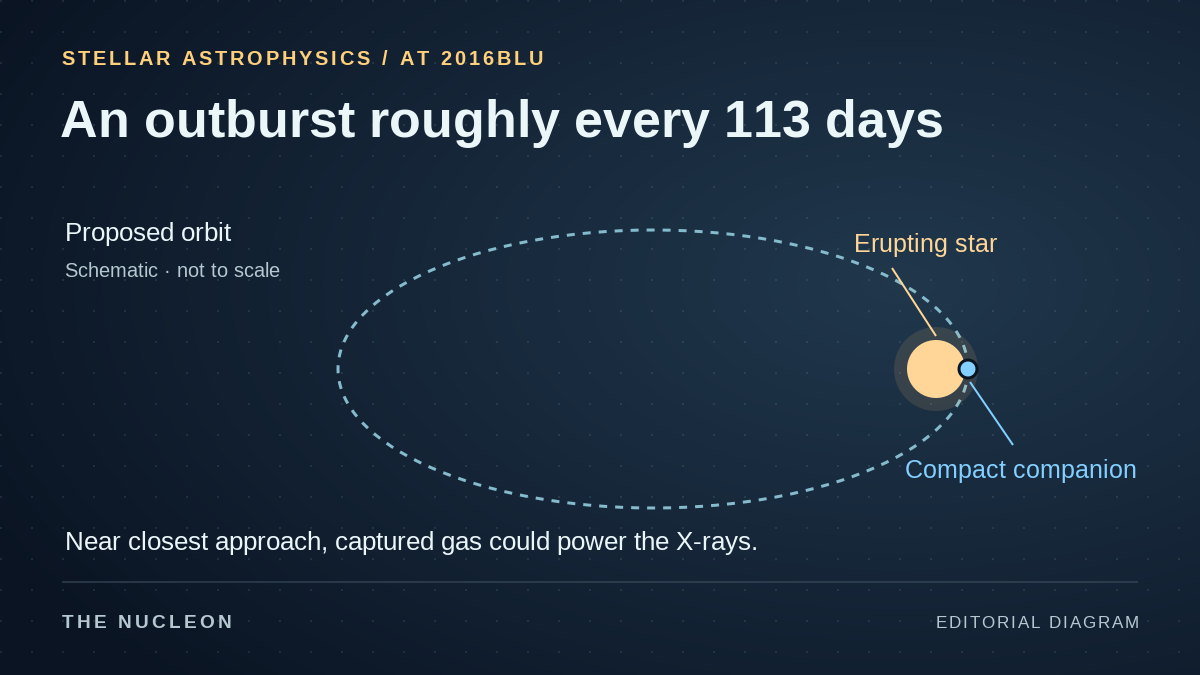
 Illustration — not a photo of the discovery
Chandra Catches AT 2016blu During a Recurring Outburst
A giant star in the galaxy NGC 4559 flares roughly every 113 days. Chandra caught X-rays from the system during a flare, evidence that a dense companion collects material shed by the star.
The story
Why scientists were there
Astronomers could predict roughly when the next optical outburst would occur because the star had repeatedly brightened and faded. Chandra could separate it from a nearby X-ray source in the same galaxy. The map marks the lead researcher’s university in Virginia.
How they found it
Optical observers tracked the star and alerted the Chandra team when it brightened in early 2026. Five closely spaced X-ray observations in March detected the source. Its X-ray brightness was at least a hundred times the upper limit from archival observations in 2001–2002.
What makes it unique
The repeated flares had resembled stellar explosions, yet the star survived. The authors propose that gas heats up as a compact companion captures it near the closest point in an elongated orbit. Both a neutron star and a stellar-mass black hole fit the evidence so far.
Gallery
Where it was found
University of Virginia, Charlottesville (lead research institution)
Tags
Related discoveries
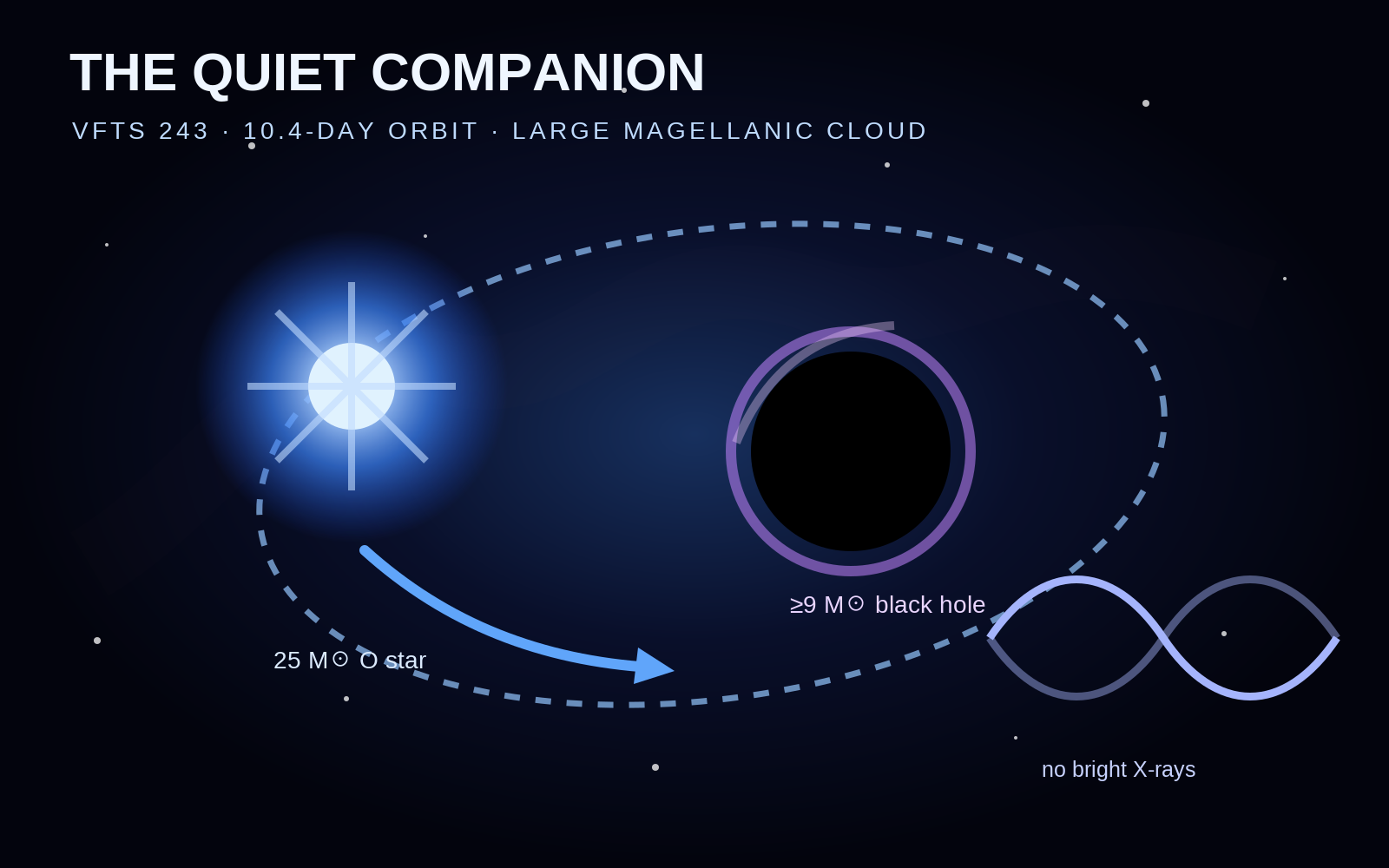 Illustration🌌 Space
VFTS 243, an Extragalactic Dormant Black Hole
Six years of stellar spectra revealed that the massive star VFTS 243 orbits an unseen companion of at least nine solar masses, making the companion the first unambiguous X-ray-quiet stellar black hole identified outside the Milky Way at the time.
Read more → 🌌 Space
First Image of a Black Hole (M87*)
Humanity's first direct image of a black hole — a glowing ring of light around the shadow of M87*, 6.5 billion solar masses.
Read more →