
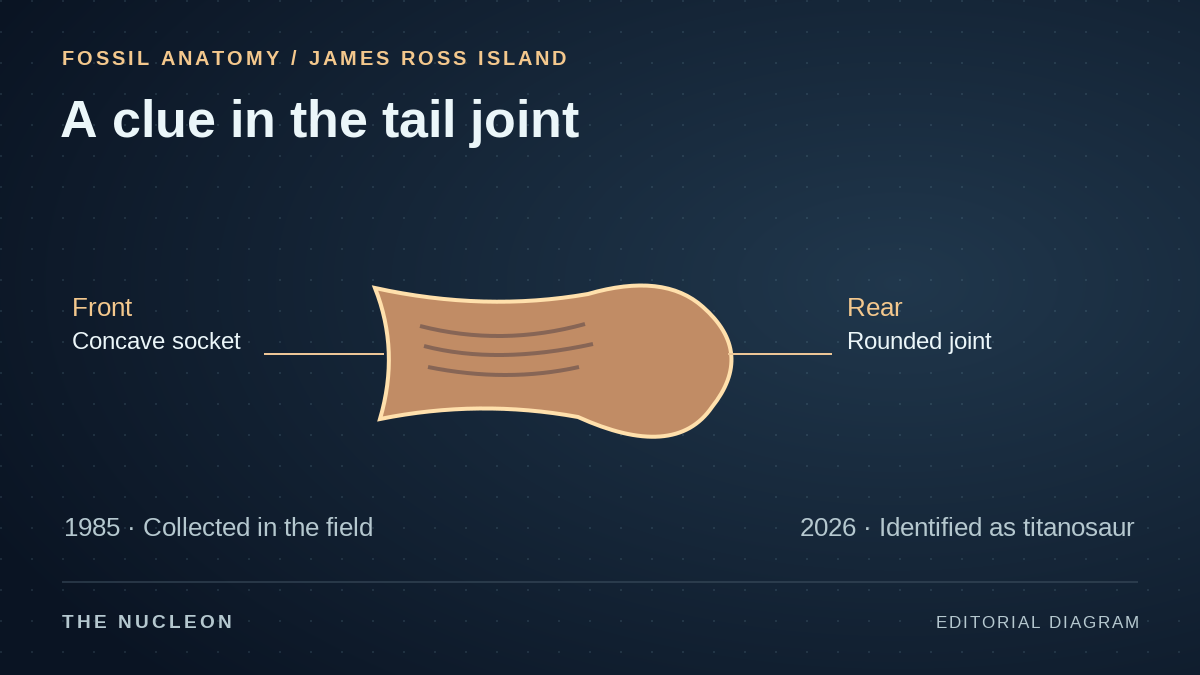
 Illustration — not a photo of the discovery
A Tail Bone Identifies a Titanosaur on James Ross Island
A bone collected in Antarctica in 1985 has been identified as part of a titanosaur’s tail. The vertebra came from roughly 82-million-year-old marine rocks on James Ross Island.
The story
Why scientists were there
The island exposes sediment deposited offshore during the Late Cretaceous. A land animal’s remains could reach that seabed after death. Decades later, the survey notebooks still linked this small fossil to its collecting site and rock layer.
How they found it
Researchers compared the vertebra with tail bones from other long-necked dinosaurs. The socket at the front, the rounded joint at the rear and the overall anatomy helped place the specimen within a group of titanosaurs. The June 2026 date marks the public description of the find.
What makes it unique
The authors identify it as the first dinosaur bone collected in Antarctica, even though other specimens were recognized earlier. The bone is unusually small. Its size could reflect a young individual or a small-bodied form, and a single vertebra cannot settle that question.
Gallery
Where it was found
Abernethy Flats, James Ross Island, Antarctica
Tags
Related discoveries
 🦕 Dinosaurs & Fossils
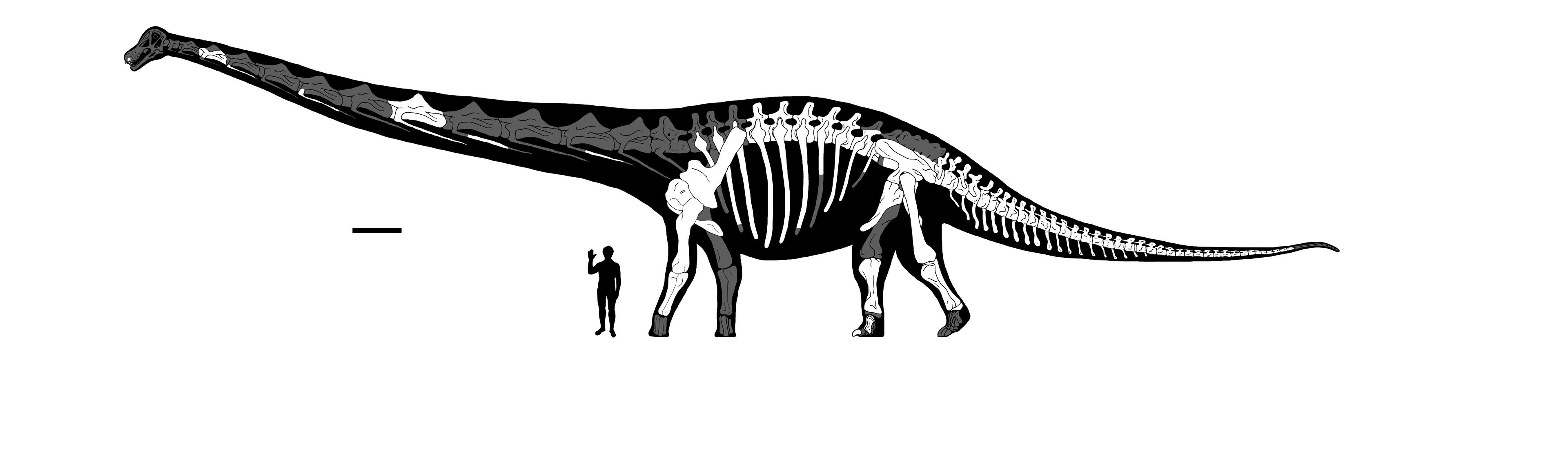
Dreadnoughtus, a Colossal Titanosaur
One of the most complete giant dinosaurs ever found — a 26 m sauropod whose skeleton let scientists reliably estimate its ~59-tonne mass.
Read more → Illustration🦕 Dinosaurs & Fossils
Meraxes Gigas, a Giant Short-Armed Predator
An unusually complete giant predatory dinosaur from Patagonia revealed that reduced forelimbs evolved independently in several large theropod lineages.
Read more →