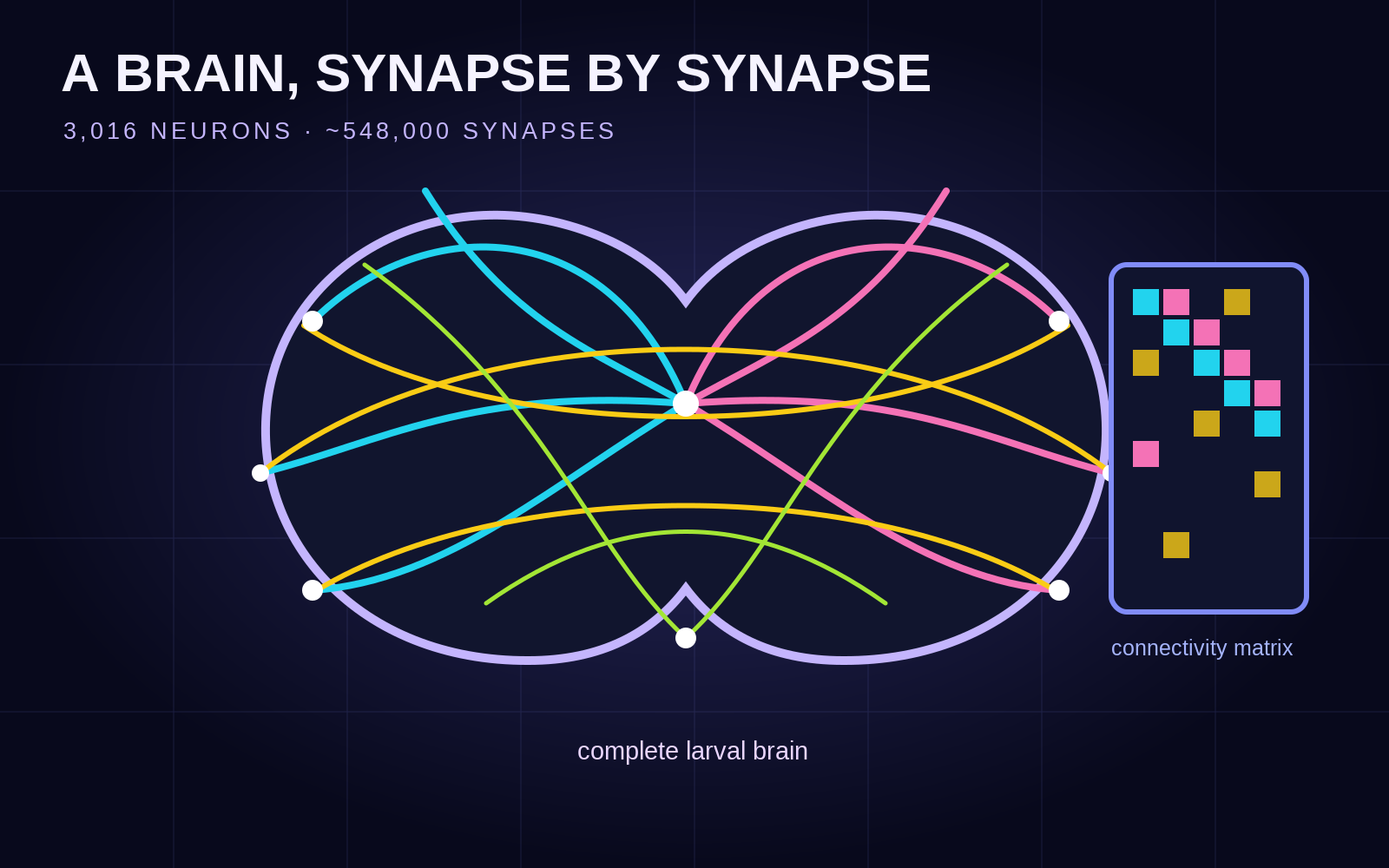
 Illustration — not a photo of the discovery
The First Complete Connectome of an Insect Brain
Researchers reconstructed all 3,016 neurons and roughly 548,000 synapses in a fruit-fly larva's brain, producing the first complete synaptic-resolution wiring map of an insect brain capable of complex behavior.
The story
Why scientists were there
A full wiring diagram can reveal organizing principles that are hard to see in isolated circuits and can inform both neuroscience and artificial networks. One larval brain is not a universal atlas, and connectivity alone does not reveal signal strength or moment-to-moment activity; the next work links this structure to physiology, development, and behavior across individuals.
How they found it
The team imaged thousands of ultrathin brain sections with electron microscopy, traced neuronal branches through the volume, annotated synapses, and represented the result as a directed network. Network analysis identified hubs, recurrent loops, multisensory convergence, cross-hemisphere pathways, and 93 connectivity-defined neuron types.
What makes it unique
Earlier complete connectomes covered much smaller nervous systems, while larger brains were mapped only in parts. This dataset joined every neuron and synapse of an entire insect brain in one graph, yet it deliberately excluded the ventral nerve cord and should not be confused with the later adult-fly connectome.
Gallery
Where it was found
MRC Laboratory of Molecular Biology, Cambridge
Tags
Related discoveries
 🧬 Biology
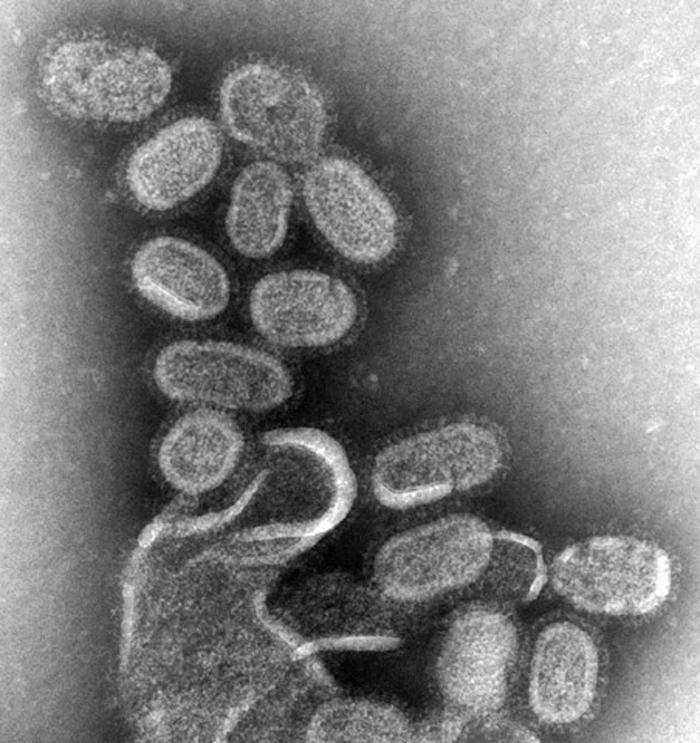
Watching Influenza Enter a Living Cell
A new combined microscopy method let scientists watch influenza viruses invade living cells in real time, revealing that cells actively help capture the virus.
Read more →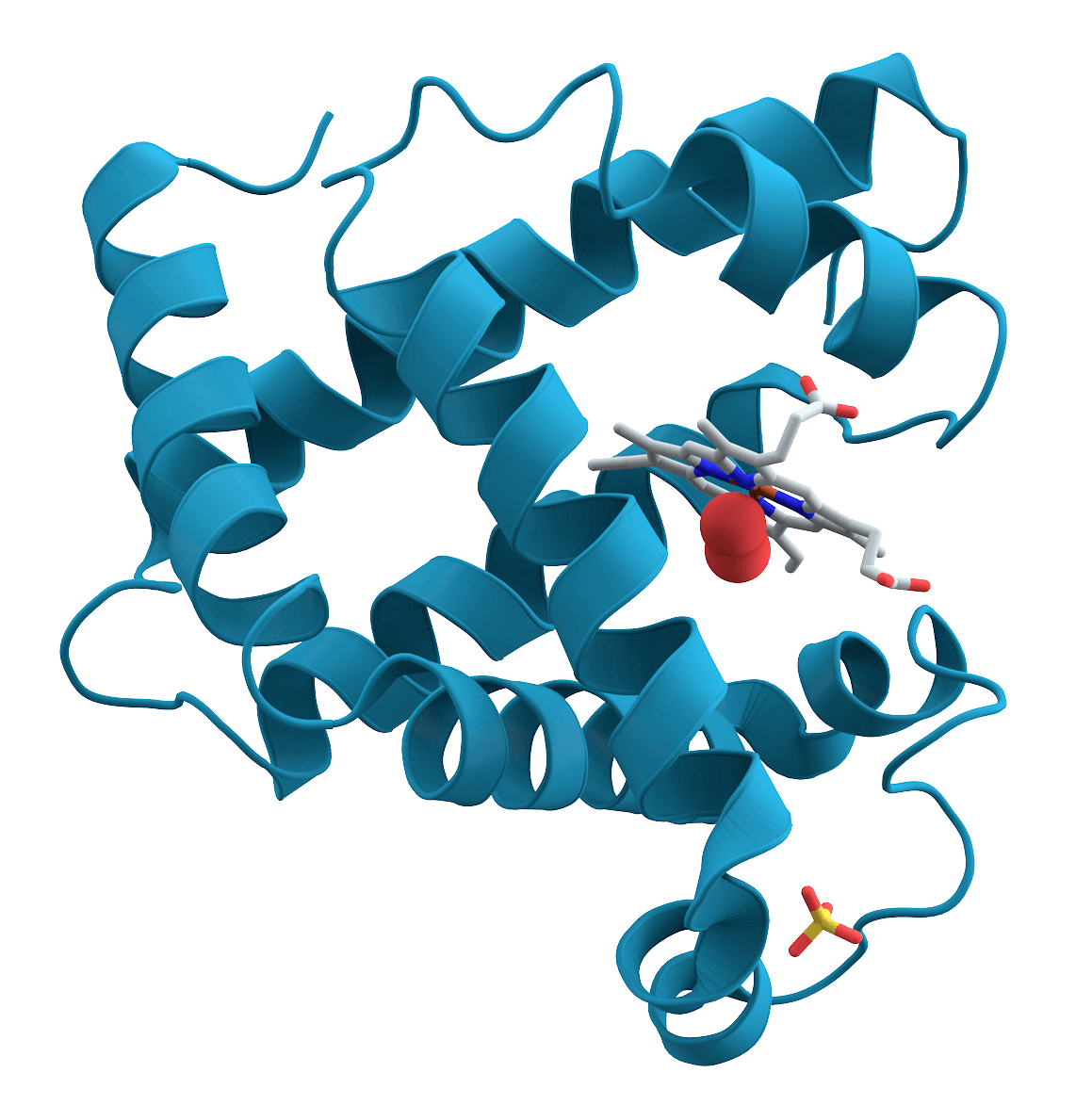 🤖 Technology
AlphaFold Solves Protein Folding
A neural network predicted protein 3D structures from sequence with near-experimental accuracy — cracking a 50-year grand challenge in biology.
Read more → Illustration🧬 Biology
The Anteromedial Thalamus Gates Long-Term Memory in Mice
Longitudinal recordings and targeted perturbations in mice identified the anteromedial thalamus as a circuit node that helps select and stabilize salient memories for long-term cortical storage.
Read more →