
 Illustration — not a photo of the discovery
Under-Ice Eddies Explain Giant Rings on Lake Baikal
Measurements beneath Lake Baikal’s frozen surface linked giant dark rings in the ice to rotating bodies of relatively warm water below.
The story
Why scientists were there
Satellite images had revealed circular features several kilometres across. Researchers returned to the Middle Baikal study area near Cape Nizhneye Izgolovye to investigate from the ice.
How they found it
They compared satellite images with field measurements of water temperature, currents and ice conditions. A lens-shaped eddy altered the transfer of heat to the underside of the ice.
What makes it unique
The process explains how an almost circular pattern can appear on an otherwise continuous frozen lake. The visible ring is a surface signature of water moving below it.
Gallery
Where it was found
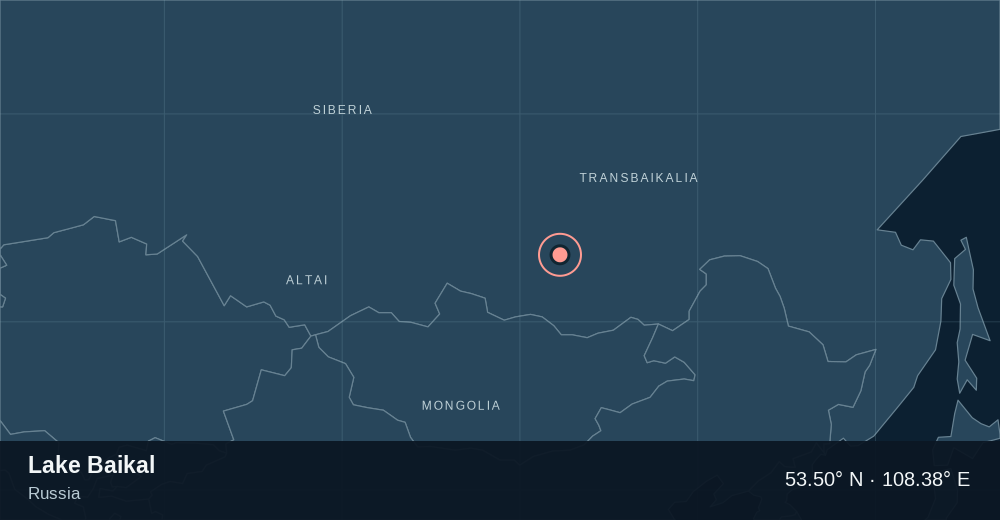
Lake Baikal off Cape Nizhneye Izgolovye (study area)
Tags
Related discoveries
 Illustration🌋 Earth Science
A Siberian Crater Lake Preserves Evidence of a Much Warmer Arctic
Sediment beneath Lake El’gygytgyn records exceptionally warm Arctic summers during the Pliocene and a later cooling trend spanning millions of years.
Read more → Illustration🌋 Earth Science
Batagay Exposes Ground Ice at Least 650,000 Years Old
A thaw slump in eastern Siberia exposed an ice-rich layer that researchers dated to at least 650,000 years ago. The ancient layer lies beneath much younger deposits.
Read more →