
🧬 How Scientists Finally Completed the Human Genome
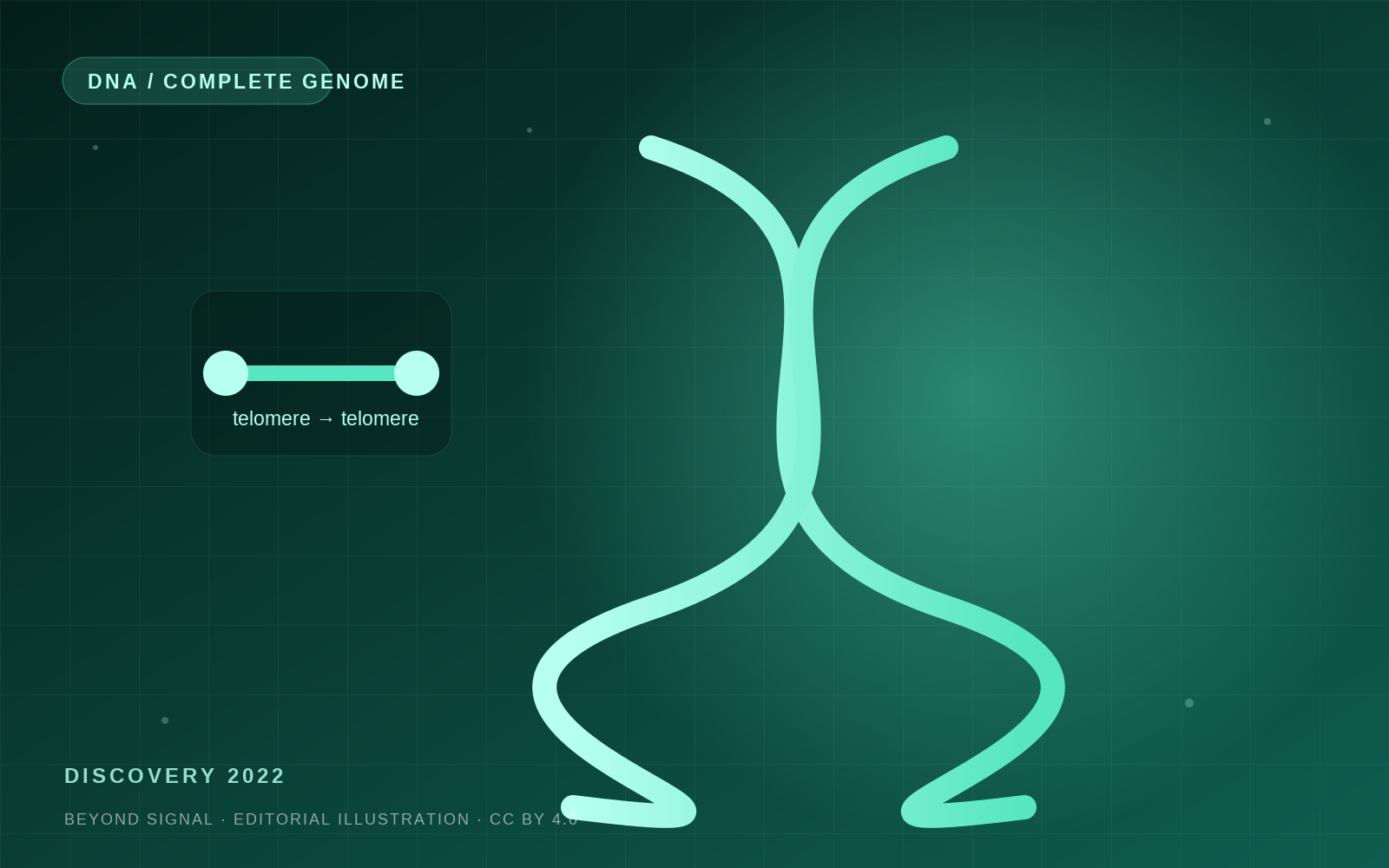
The Human Genome Project was celebrated as complete in 2003, yet important stretches of human DNA remained unread. They were not empty spaces. They were some of the genome's most repetitive and structurally complex regions, including chromosome centres and ends. In 2022, the Telomere-to-Telomere Consortium published T2T-CHM13, the first essentially gapless sequence of a human genome from one chromosome end to the other.
Key facts
- Reference
- T2T-CHM13
- Published
- March 31, 2022
- Added sequence
- Nearly 200 million DNA letters
- Major advance
- Gapless autosomes and X chromosome
- Key technologies
- PacBio HiFi and Oxford Nanopore long reads
- Initial limitation
- No Y chromosome in the first release
Why the original human genome still had holes
Early genome sequencing worked by breaking DNA into many short fragments, reading those fragments and assembling them by matching their overlapping letters. The method was transformative, but it struggled when enormous regions contained long, nearly identical repetitions. A short fragment from one repeat could look almost indistinguishable from a fragment taken millions of letters away.
The unresolved regions clustered around centromeres, which help chromosomes separate during cell division, telomeres at chromosome ends, large segmental duplications and repeated ribosomal DNA. Because these regions were difficult rather than unimportant, the gaps limited research into chromosome behaviour, evolution and genetic variation.
The technologies that made a complete assembly possible
The T2T team combined two complementary kinds of long-read sequencing. PacBio HiFi reads were highly accurate and long enough to span many difficult repeats. Oxford Nanopore ultra-long reads could stretch across exceptionally large repeated regions, providing the long-range structure needed to place sequences correctly.
The researchers also used DNA from the CHM13 cell line, derived from a complete hydatidiform mole. Its chromosome copies are nearly identical, which removed much of the ambiguity created when an ordinary diploid genome contains different maternal and paternal versions. The team then checked the assembly with multiple independent maps and sequencing datasets rather than trusting a single algorithm.
What the missing 200 million letters revealed
T2T-CHM13 added nearly 200 million DNA letters to the previous reference and corrected errors in regions that had already been assembled. It supplied continuous sequences for all autosomes and the X chromosome, including complete centromeres and telomeres, and revealed additional genes and repeated gene families.
A complete reference also made it easier to detect structural variants, where large pieces of DNA are inserted, deleted, duplicated or rearranged. Those changes can be missed when researchers compare a person's genome against a reference that contains gaps or incorrectly collapsed repeats.
Complete does not mean universal
T2T-CHM13 is a landmark reference, not a single blueprint that represents every person. Human genomes differ, and the cell line used for the first assembly did not include a Y chromosome. The Y was completed in later work, while the Human Pangenome Reference Consortium began building a graph-based reference from many people and populations.
The achievement changed the question from whether the difficult parts of a human genome could be assembled to how complete, diverse genomes can be produced routinely. In that sense, closing the last gaps was not the end of human genomics. It opened a much wider map.
Frequently asked questions
Was the Human Genome Project actually incomplete?
It successfully produced the first broadly usable human reference genome, but repetitive regions remained unresolved. T2T-CHM13 closed most of those remaining gaps in 2022.
What does telomere-to-telomere mean?
It means a chromosome sequence is assembled continuously from the telomere at one end to the telomere at the other, without unknown gaps between them.
Why was the CHM13 cell line useful?
Its chromosome copies are nearly identical, reducing the challenge of separating two different parental versions while assembling highly repetitive DNA.
Does T2T-CHM13 represent every human population?
No. It is one exceptionally complete genome reference. Pangenome projects add many diverse genomes so researchers are not forced to compare everyone with one linear sequence.