
🛰️ DART and Dimorphos: How Humanity Moved an Asteroid
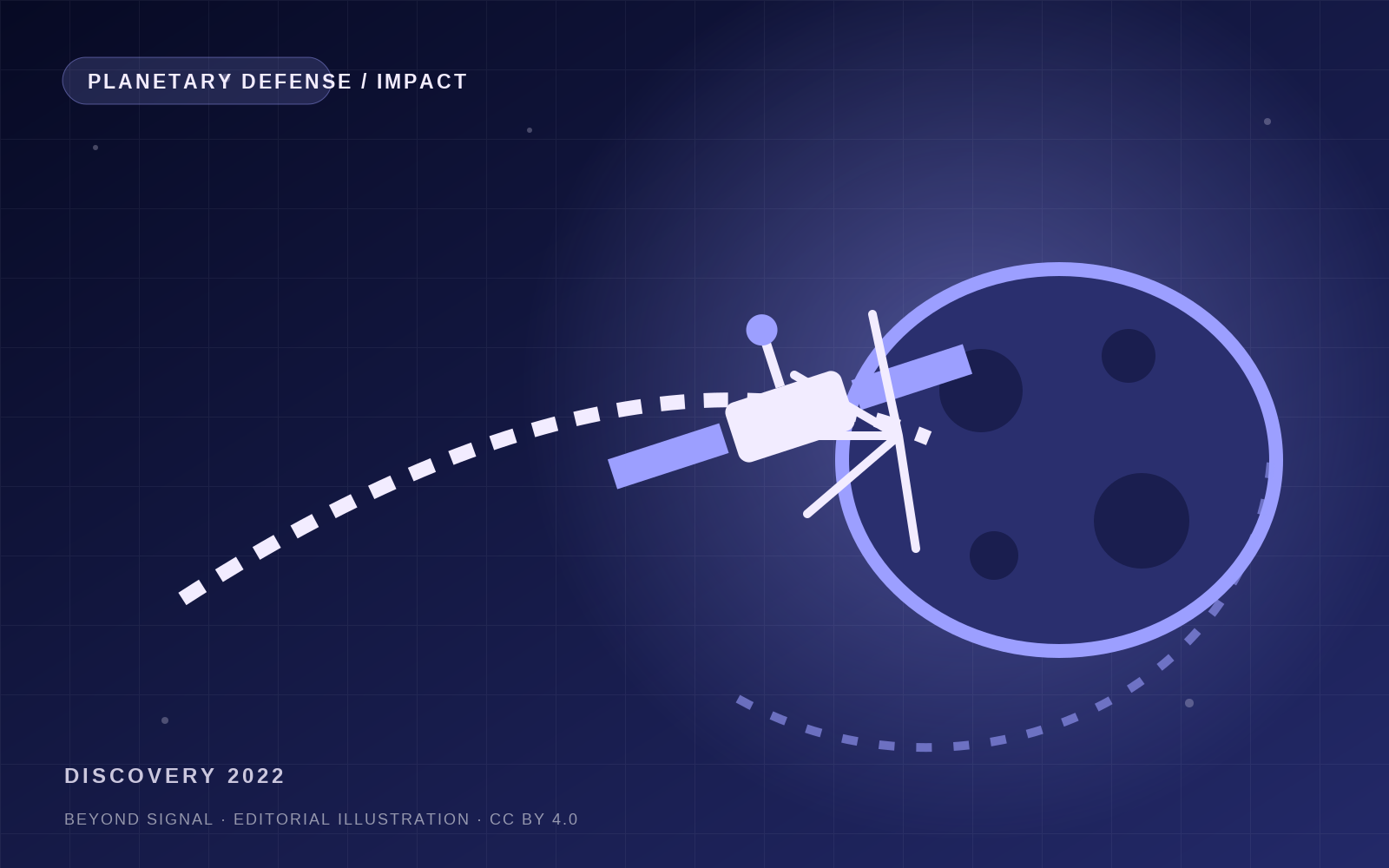
On September 26, 2022, NASA deliberately crashed a spacecraft into an asteroid. The target, Dimorphos, was not threatening Earth. It was chosen as a controlled laboratory in space, where scientists could test whether a high-speed impact could measurably change an asteroid's motion. The answer arrived two weeks later: Dimorphos was orbiting its larger companion faster than before.
Key facts
- Impact date
- September 26, 2022
- Target
- Dimorphos, moon of asteroid Didymos
- Impact speed
- About 22,530 km/h
- Orbit before
- 11 hours 55 minutes
- Initial measured change
- About 32 minutes shorter
- Purpose
- Full-scale planetary-defense test
Why NASA chose a binary asteroid
Dimorphos is a small moon orbiting the larger near-Earth asteroid Didymos. From Earth, telescopes can measure the pair's repeating brightness changes as Dimorphos passes in front of and behind Didymos. That made the system an unusually precise natural clock.
A mission did not need to measure the asteroid's entire path around the Sun. It only needed to determine whether the moon's orbital period around Didymos changed after impact. Neither object posed a danger to Earth before or after the test.
A spacecraft that aimed itself during the final approach
DART travelled to the Didymos system and used autonomous optical navigation during its final hours. The spacecraft first distinguished the larger Didymos, then locked onto Dimorphos as the smaller body resolved from a point of light into a rough, boulder-covered world.
The spacecraft returned images until moments before impact, then struck at roughly 22,530 kilometres per hour. DART was a kinetic impactor: it relied on momentum from speed and mass, not an explosive charge.
How scientists proved the orbit had changed
Before impact, Dimorphos took 11 hours and 55 minutes to circle Didymos. Telescopes around the world monitored the binary system after the collision and measured an initial orbital period of about 11 hours and 23 minutes, a shortening of roughly 32 minutes with an uncertainty of about two minutes.
NASA had defined a change of 73 seconds as the minimum successful result. The first measurement exceeded that benchmark by more than 25 times. Later analyses refined the orbit and examined how the impact reshaped Dimorphos, but the central result was already clear: a spacecraft had intentionally altered the motion of a celestial body.
The debris plume did part of the pushing
DART transferred its own momentum to Dimorphos, but the impact also blasted rock and dust away from the asteroid. The recoil from that ejecta amplified the push, much as gas rushing from a balloon sends the balloon in the opposite direction. The amount of amplification depends on the asteroid's structure, strength and surface material.
That is why one successful impact is not a universal recipe. A future planetary-defense mission would need years of warning and detailed knowledge of its target. DART demonstrated a tool, not a last-minute shield. Its importance is that the tool now has real-world data behind it.
Frequently asked questions
Did DART destroy Dimorphos?
No. The impact changed Dimorphos's orbit and altered its surface and shape, but the moon remained in orbit around Didymos.
Was Dimorphos going to hit Earth?
No. The Didymos-Dimorphos system was selected as a safe test target and posed no hazard to Earth before or after the mission.
Why did the orbit become shorter?
DART struck opposite Dimorphos's direction of travel around Didymos, reducing its orbital energy and pulling it into a faster, shorter-period orbit.
Could the same method stop a dangerous asteroid?
Potentially, when the asteroid is discovered early enough. Even a small velocity change can grow into a large miss distance after years of travel.